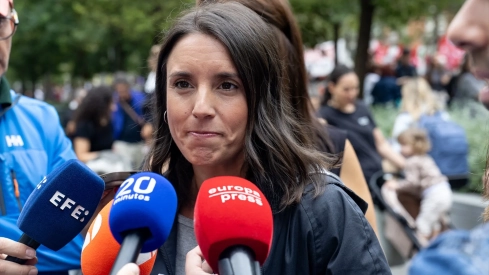
Irene Montero will be Podemos' candidate for the Presidency of the Government and its number one for Madrid after receiving 24,136 votes in primaries without a rival for that position. The result is known this Friday, in the last hours to register coalitions before the general elections on November 29, while calls from within the party itself to reach agreements are growing. In another distinct vote, its members have backed territorial pacts and the continuation of negotiations until midnight.
The Madrid list remains one of the main obstacles to understanding with the Frente Amplio. Sources from that space consulted by 'ElConstitucional.es' consider a separate Podemos candidacy in Madrid "almost certain", although the deadline remains open. This newspaper has also again consulted sources from Podemos, who maintain silence on the progress of the conversations while the formation concentrates its efforts on the negotiation.
Two distinct votes
The open primaries were held on October 14 and 15 and registered 26,590 participants, with 2,453 blank votes, according to the results released. Montero, MEP and former Minister of Equality, gathered around 91% of the support. Podemos had proposed this procedure to resolve the leadership of a joint candidacy, but the Frente Amplio parties declined to participate without a prior agreement on the conditions. The vote thus sets Podemos' candidacy while its fit with the other organizations remains pending.
Participation is below the 27,172 people who voted in the 2025 assembly that re-elected Ione Belarra, a difference of 582 participants. It is also far from the 52,829 registered members who participated in the consultation to negotiate the coalition with Sumar in 2023. Comparisons require taking into account that these were different decisions and that the deadlines do not coincide either; in the 2025 assembly there were five days to vote and in these primaries, two. Furthermore, the current process was open to citizens, while the consultation on this Friday's agreements was directed at registered members.
In that second vote, 10,064 people participated, with 8,834 votes in favor and 1,230 against. Podemos has reported 87.7% support for running in the broadest possible candidacies and highlighted that the consultation was resolved in four hours. The result authorizes the leadership to materialize the understandings reached and to continue seeking others before the registration closes.
The endorsement includes collaboration with ERC in Catalonia, the Unidad del Pueblo Canario coalition, the pact with Valencian left-wing forces and progressive candidacies for the Senate in Menorca, Ibiza, and Formentera. It also allows continuing conversations with Ara Més, Chunta Aragonesista, Izquierda Unida, and other organizations. Canarias and the Comunitat Valenciana already offer concrete agreements between Podemos and parties of the Broad Front, although these territorial alliances leave open the state dispute on how to extend unity.
Pressure from within
The most direct call this Friday was made by Javier Sánchez Serna, Podemos deputy for Murcia and member of its state leadership. He has asked left-wing parties, "mine too," to make a sincere effort to close a general agreement. As he explained, he is receiving calls from leaders and former colleagues with a shared concern. "If there is no unity, if with our division we contribute to the arrival of a PP-VOX government, we will be discredited for many years," he warned.
Estos días estoy recibiendo muchas llamadas de dirigentes de la izquierda, compañeros y compañeras que pasaron por el Congreso y por Podemos, y el diagnóstico es similar y compartido: si no hay unidad, si con nuestra división contribuimos a la llegada de un gobierno de PP-VOX,…
— Javier Sánchez Serna (@J_Sanchez_Serna) October 16, 2026
The coordinator of Podemos in Extremadura and regional deputy, Irene de Miguel, has expressed her weariness with the distance between negotiations in Madrid and political work in the territories. Without pointing to a specific organization, she criticized that the dispute to impose the narrative displaces the electoral objective and recalled that "we have to win a country." Former minister and former IU coordinator Alberto Garzón has also publicly supported Sánchez Serna's message.
No sé qué pasará hoy pero lo que es evidente es que existe una brecha cada vez mayor entre lo que sucede en Madrid y la política que hacemos en las periferias. Muy harta quienes solo piensan en ganar el relato pero olvidan que hay que ganar un país.
— Irene de Miguel (@IrenedeMiguelEx) October 16, 2026
To these voices has been added the former Secretary of State for Equality Ángela Rodríguez 'Pam', who has defended that Podemos must agree if there is an offer of exit positions in Madrid. Her argument starts from this condition and questions rejecting a joint candidacy when it allows obtaining representation. The proposal for the second position for Montero, conveyed to this newspaper by sources from the Broad Front, has been publicly confirmed by Emilio Delgado this Friday, although Podemos spokesperson Pablo Fernández has denied it.
The pressure also comes from the shared work between regional organizations. The Murcian deputy Víctor Egío has appealed this week for daily collaboration with IU, while Nico Sguiglia in Andalusia and Mercedes González in Cantabria have demanded agreements from their territories. Sources from Podemos consulted by 'ElConstitucional.es' these days have insisted that their proposal to pact with IU in ten communities is still on the table and have asked for the rejection to be reconsidered. Maíllo maintains that IU must negotiate within the Broad Front, together with its partners.
Iglesias points to two lists in Madrid
Pablo Iglesias has defended this Friday a strategy of territorial alliances compatible with competing separately in Madrid. After the Valencian agreement, the former general secretary of Podemos has demanded to reproduce that understanding in other communities and has questioned that pacts are conditioned on integrating into the same Madrid coalition. His approach gives political backing to the possibility of Podemos having its own candidacy in the capital, the scenario that sources from the Broad Front space consider increasingly likely.
Iglesias maintains that, if there are agreements in the rest of the territories, competing separately in Madrid would not entail an electoral penalty. That effect will depend on the votes each candidacy obtains and their translation into seats. The constituencies that elect more deputies offer greater margin to achieve representation, although fragmentation can alter the distribution even when both lists manage to enter. Added to this is the ability to mobilize an electorate that the leaders themselves are warning about the risk of a victory for the PP and the far-right Vox.
🔴 En País Valencià se llega a un acuerdo por el que irán juntos a las elecciones, entre otros, Compromis, Podemos, Izquierda Unida y ERC (sí, el partido de Gabriel Rufián que en Cataluña no va con el Frente Amplio pero al que apoya Podemos que se integrará en sus listas).
— Pablo Iglesias 🔻{R} (@PabloIglesias) October 16, 2026
➡️… https://t.co/eadCigTnGc
The former leader of Podemos presents as alternatives the leadership of Delgado and Colau and the political collaboration between Montero and Gabriel Rufián. Rufián will run with ERC in Catalonia, with the support of Podemos, and the agreement between both formations includes joint campaign events. This cooperation does not mean that the republican spokesperson is part of the Madrid list. The disagreement between the lefts affects both the leadership and the territorial scope of the alliances and the procedure for deciding the candidacies.
The results of the two votes leave Podemos with an elected candidate and with authorization from its members to continue negotiating. Conversations are pending in the territories where a shared formula has not yet been closed, while Madrid concentrates the greatest difficulties. The deadline to communicate electoral coalitions ends today, Friday, at 11:59 p.m.; the presentation of the complete lists will take place at a later stage.
