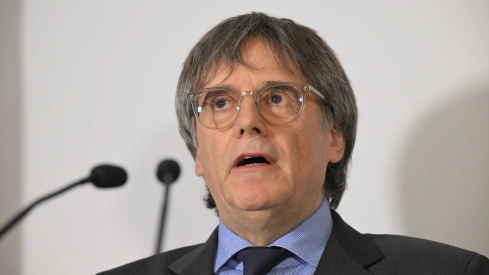
The former president of the Generalitat and leader of Junts, Carles Puigdemont, has assured that he is already preparing his return to Catalonia and has ruled out the possibility of serving as leader of the opposition in the Parliament, in an interview on La2 Cat.
"I could not act as such, but on the other hand, even if I could, it seems to me that someone who has been president of the Generalitat and has held the presidency, which is an institution, it is not correct for them to then go on to control the president, whoever it may be," Puigdemont stated, when asked about his political future.
The endorsement of the Constitutional Court and the return
Puigdemont has maintained that an irreversible point is being reached after the endorsement of the Constitutional Court (TC) of the Amnesty Law, and has linked this scenario with the preparation of his return: "It is irreversible and, therefore, they will have to end up signing the surrender. And it is true that now my mind has begun to think that, indeed, the return must now be prepared. Just as I have dedicated a lot of time to preparing my exile, if a chronic one was necessary, now I am preparing my return."
The leader of Junts has explained that, after his first nights in Belgium, he did not want to hide or go unnoticed, and has defended that his stay in the heart of Europe was part of a political strategy aimed at internationalizing the conflict. "But I exposed myself to being extradited, and furthermore I have not gone unnoticed because my function was to shake public opinion, internationalize the conflict and work from the heart of Europe to explain what problem there is between Catalonia and Spain and also seek political solutions," he pointed out.
Amnesty, the PSOE and the rejection of a pardon
Puigdemont has admitted that he came to think that the amnesty would never be applied in his case, although he specified that it has not yet materialized. Regarding this process, he warned that it cannot be ruled out that institutions act "outside of all legal logic."
In his account, he also explained that, before the votes of Junts became decisive after the 2023 general elections, he received a discreet visit from a PSOE politician, whose name he did not want to reveal, who offered him "a deal similar to pardons," a proposal he rejected. Puigdemont maintained that he made it clear that he would only accept an amnesty and that, if not, he was willing to remain in Belgium for life.
According to his version, that socialist leader then closed the door to any amnesty, a position that, he added, changed when the socialists needed the support of his party for the investiture of Pedro Sánchez.
The departure from Girona, Belgium and the planned return
Asked if he would have acted the same after 1-O 2017 if he had known he would spend nine years away, Puigdemont replied that, when he made the decision, he assumed a scenario of uncertainty and the possibility of never returning. "I was willing to stay here my whole life in exchange for protecting the institution," he said.
The former president explained that he mentally prepared himself to face a stage that he knew would be tough and that he could not resist without psychological preparation. He also insisted that his goal was always to return, and considered that the passage of time and pressure in Europe would eventually make his situation unsustainable for the State.
Regarding his departure from Catalonia, he detailed that on the night of October 29, 2017, he left Girona sitting in a car bound for Belgium, dressed in a jacket and tie and with a hand bag with the essentials. "I never went in any trunk," he stressed, and added that he also did not travel that way when he returned to Catalonia on August 8 two years ago and went back to Waterloo.
In August 2024, he specified, he wanted to enter the Parliament, but he was aware that, if he tried, he would have been arrested before entering the chamber. He also took for granted that his return may involve more personal risks and admitted that, at some point, he may have to go to Madrid.
Security, personal finances and life in Waterloo
Puigdemont explained that two volunteers have been helping him with security tasks since the first day he traveled to Brussels, and indicated that he has never wanted to stage a "prank" return. Despite feeling persecuted and watched, he recounted that one day he had another person drive his Belgian car to his home in Sant Julià de Ramis (Girona), without him, and that no one stopped him at the border.
He also specified that in Belgium he had to get his driver's license again, that the only salary he receives is that of a regular Junts deputy in the Parliament and that the rent for the house in Waterloo is paid with money from donations, "Not a single public euro pays for it, either directly or indirectly," he said.
In addition, he said that he does not miss the European Parliament (EP) or trips to Strasbourg, and highlighted that one of the visits that surprised him most was that of the former president of FC Barcelona Joan Gaspart, whom he thanked for the support received.
Regarding the personal consequences of these years away, he mentioned the death of his parents and the impossibility of attending their burial, and pointed out that, once the institutional matter is resolved, the first thing he will do will be to go to the cemetery of Amer (Girona) to visit their graves and then return to his home.