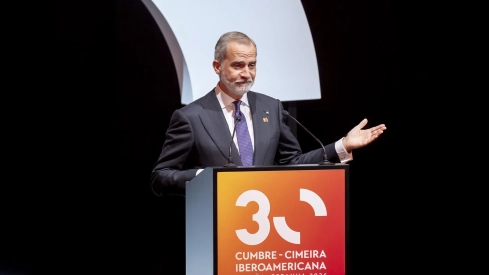
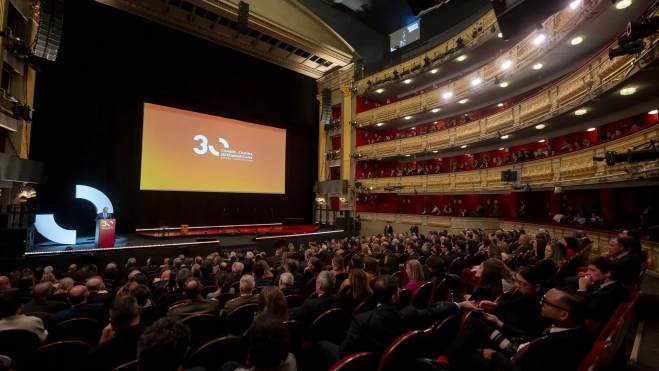
King Felipe VI warned this Wednesday of the risks facing the international economy and the importance of maintaining trust between countries and institutions. "Trust is one of our most valuable assets and, let me say, also one of the easiest to lose," he said during the closing of the XVI Ibero-American Business Meeting, held at the Las Ventas bullring in Madrid, within the framework of the XXX Ibero-American Summit.
During his speech, the monarch defended the need to strengthen collaboration among Ibero-American countries to face a scenario marked by "great uncertainty and profound transformations." In this context, he pointed out that competition for energy, technology, and supply chains is changing the global economy, while geopolitical fragmentation and trade tensions test the rules that have provided stability for decades.
Given this situation, Felipe VI argued that "the best response to this drift is not in withdrawal or protectionism, but in an open economy, based on equal rules for all and on cooperation among partners who share values." The King also focused on the potential of Ibero-America, especially due to its energy resources, its capacity to contribute to global food security, and its biodiversity. In this regard, he called for more investment, innovation, and cooperation so that the countries of the region can participate in international value chains and not limit themselves to exporting raw materials.
Felipe VI calls for more cooperation and opportunities to face economic and technological challenges
The monarch has dedicated part of his speech to technological transformation and the role that Spain, Portugal, and Latin American countries must play in the development of artificial intelligence. Felipe VI has argued that this technology can help reduce territorial inequalities, facilitate access for small and medium-sized enterprises to international markets, and generate higher value-added employment. To achieve this, he has called for more digital infrastructures, training, and regulatory frameworks that allow for innovation without sacrificing security or citizens' rights. Furthermore, he has championed Spanish and Portuguese as strategic tools for the technological and economic future of the Ibero-American community. "For AI to think, understand, and create using these languages is a first-order economic and strategic issue," he stated.
Felipe VI has also advocated for sustainable and inclusive economic growth. In his opinion, companies that lead the green transition will have a prominent position in future markets. He also recalled that development must guarantee opportunities for everyone, since "talent is widely distributed in our Community; what is not always, but must be equally distributed, are opportunities." In his speech, the King also explained the responsibilities of institutions and the business sector. "Governments are responsible for guaranteeing quality infrastructure, education and training, and decisive support for entrepreneurship," while companies must "invest, innovate, and generate decent employment" and contribute to the common good.
El rey Felipe VI en la Cumbre Iberoamericana en Madrid:
— RTVE Noticias (@rtvenoticias) November 4, 2026
"Como tantos españoles, cada día más, yo me reconozco orgullosamente en el espejo iberoamericano".
En el #Canal24Horas pic.twitter.com/urQsVvfjYd
Another central point has been the relationship between the European Union and Latin America and the Caribbean. The monarch has argued that it is necessary to continue strengthening these ties and has cited as examples the renewed agreements with Chile and Mexico, in addition to the pact between the EU and Mercosur. "Spain will always work to make this relationship more ambitious and closer to businesses and citizens on both shores," he assured.
Finally, he expressed his wish that the XXX Ibero-American Summit be remembered as "a place of new alliances, new investments and initiatives capable of generating prosperity for millions of citizens." He also congratulated the participants on the commitments reached and asked that they be "a real starting point, not an arrival point."
The Ibero-American Summit addresses artificial intelligence, investment, and international cooperation
Felipe VI's intervention is part of the XXX Ibero-American Summit, which gathers representatives from the 22 countries that make up the community in Madrid on November 4 and 5. The event seeks to strengthen political and economic cooperation between Spain, Portugal, and Latin America, at a time marked by technological changes and international tensions.
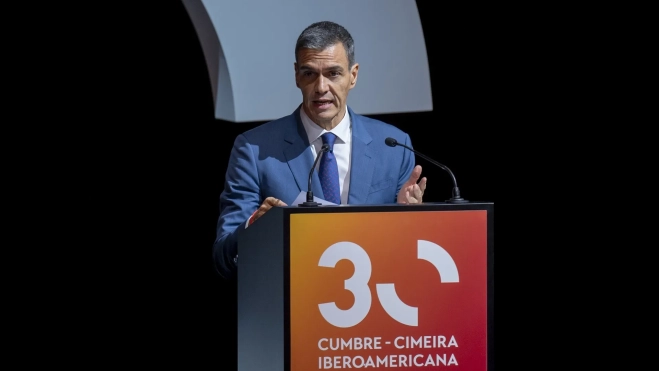
During the XVI Ibero-American Business Meeting, held as part of the summit's program, the President of the Government, Pedro Sánchez; the presidents of Costa Rica, Laura Fernández; Bolivia, Rodrigo Paz; and the Dominican Republic, Luis Abinader; as well as the Portuguese Prime Minister, Luís Montenegro, and the Ibero-American Secretary General, Andrés Allamand, participated. The meetings and conversations addressed issues such as entrepreneurship, investments, climate change, artificial intelligence, legal certainty, and the strengthening of institutions. The need to give the region greater prominence in technological development and to leverage the economic potential of the participating countries was also discussed.
During his speech, Felipe VI also wanted to remember the victims of the train accident in Urda (Toledo), which occurred on October 28. The monarch thanked the expressions of solidarity received from Ibero-American countries and expressed his "deep sadness" over the death of Fátima Báñez, former Minister of Employment and Social Security and president of the CEOE Foundation, who was scheduled to attend the meeting. "It is a gesture of friendship that we will not forget," said the King in reference to the expressions of affection received from Ibero-America after the accident.
