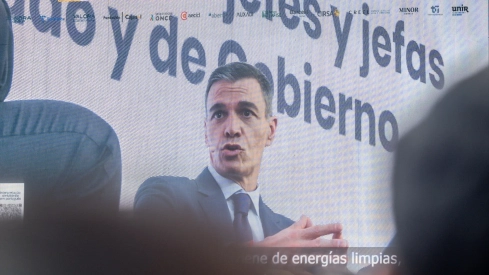
Pedro Sánchez has placed artificial intelligence among the great challenges that Ibero-American countries must face together. The President of the Government defended this Wednesday the need to reach agreements on the development and regulation of this technology, with attention to its effects on employment, production and supply chains.
The call comes at the start of the XXX Ibero-American Summit, which is held between this Wednesday and Thursday in Madrid. The event brings together representatives from 22 countries in a context of international tensions and with the aim of recovering the forum's capacity for agreement, after the previous edition ended without a joint declaration.
Sánchez participated before the official inauguration in the closing of the XVI Ibero-American Business Meeting, held in the Las Ventas bullring and presided over by Felipe VI. There he shared a dialogue with the presidents of Costa Rica, Laura Fernández; Dominican Republic, Luis Abinader; and Bolivia, Rodrigo Paz, as well as the Prime Minister of Portugal, Luís Montenegro.
The head of the Executive has pointed out that medium-sized countries need to cooperate in the face of a technological transformation that affects both companies and workers. His approach coincides with one of the issues that reach the table of Ibero-American leaders, the creation of an alliance to promote a common agenda on artificial intelligence.
The ministers and digital transformation officials of the region already agreed on Tuesday in Madrid to promote this alliance. The document must now be submitted to the summit for adoption by the heads of State and Government. Its lines of work include cooperation to access quality data, the development of models adapted to Ibero-American languages and needs, and collaboration in computing capacity.
The ministerial agreement also emphasizes rights and freedoms in the face of the use of these tools. Its concrete scope will depend on how the commitments are developed and on the decisions subsequently adopted by the countries, which maintain their own national rules and priorities.
Sánchez has extended his call to other shared challenges, such as the climate emergency and youth mobility for training. Among the initiatives being studied are an Ibero-American civil protection network for disasters and an educational exchange program inspired by the European Erasmus.
The president has defended that "the voice of Ibero-America is very necessary" in the United Nations and in cooperation spaces such as the summit itself. He has also asked that the event serve as a catalyst against those powers that "disregard international legality."
A summit between absences and tension
Madrid's agenda arrives with difficulties in bringing together the region's leaders. The president of Brazil, Luiz Inácio Lula da Silva, and the president of Mexico, Claudia Sheinbaum, have decided not to attend, two particularly relevant absences due to the political and economic weight of their countries. The Venezuelan president, Delcy Rodríguez, will also not be present.
The presence of ten representatives at the highest level, including Sánchez, is expected, while other countries will be headed by vice presidents or ministers. Among those attending Thursday's plenary session are the Argentine president, Javier Milei, and the Chilean, José Antonio Kast, two leaders of the Latin American far-right with positions very far from those of the Spanish Government.
Milei, however, has chosen not to attend the inauguration at the Teatro Real on Wednesday or the dinner offered by the Kings to the delegations. The Argentine president has a meeting scheduled with the leader of Vox, Santiago Abascal, and his agenda includes participating in Thursday's plenary session.
His visit comes after he called Sánchez an "unpresentable dictator" during an event in Madrid in October. La Moncloa has ruled out a bilateral meeting between the two for the moment, in a relationship marked by the Argentine president's continuous attacks on the Spanish president.
Political differences add difficulty to the search for a joint declaration. At the Cuenca summit, held in Ecuador in 2024, the countries failed to close a common text. The Spanish Government and the Ibero-American General Secretariat have since worked to arrive in Madrid with agreements in areas such as technology, education, and emergency response.
During the business meeting, Felipe VI has advocated for closer relations between the European Union and Latin America and the Caribbean in a scenario of "geopolitical fragmentation and trade tensions." The King also remembered the victims of the Urda train accident and thanked for the messages of condolence received.
