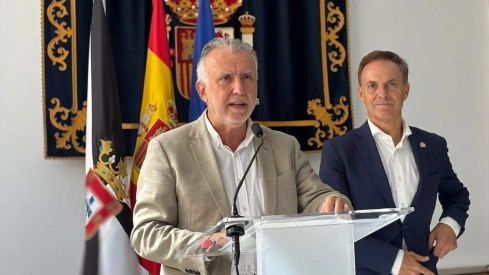
The Minister of Territorial Policy and Democratic Memory and sole commander in the management of the migratory crisis in Ceuta, Ángel Víctor Torres, this Sunday granted an interview to journalist Gonzo on ‘Salvados’, the laSexta program where he conveyed the evolution of the massive entry of people between July 30 and 31. Likewise, he spoke with citizens of Ceuta who conveyed their feeling of “abandonment” by the Government of Pedro Sánchez.
Torres defended that the Government did not expect the arrival of “80,000 or 90,000 people”, despite the increase in entries registered in the previous days. “That was absolutely unpredictable and absolutely no one warned of a quantity of that magnitude,” he stated.
The minister also referred to the fatalities: “Who would have thought that we would have more than 140 deaths.” During the program, residents demanded answers from him about the management of the crisis and the return to normality in the city.
Torres assured that the Executive has decided to undertake actions to make border crossings more difficult. He described the separation line as “one of the weakest borders, if not the weakest in the world” and announced works with “urgency” to make passing “from one side to the other” “much more complicated.”
“That decision has already been made by the Government of Spain and, along with it, logically, that diplomatic efforts be precise and necessary so that we, as neighboring countries, respect each other,” he pointed out.
The minister admitted that “things were not done well by border control” and considered it “undeniable” that what happened “entailed a breach of territorial sovereignty, and we have stated this.” However, he refused to attribute responsibility for the crisis to Morocco. He described that accusation as “very serious” and advocated maintaining “the best relationship” with the neighboring country.
On the other hand, Torres supported the former Government delegate in Ceuta, Miguel Ángel Pérez Triano, considering that he “has been unfairly treated.” “I believe he has tried to do things in the best possible way, and I believe there has been evident partisan use,” he stated. The minister insisted on the exceptional nature of those days, which he summarized as “tremendous hours.”
Regarding unaccompanied migrant minors, Torres has set as a "priority" reunification with their families in Morocco. He has acknowledged, however, that many "will not want to return" and that the "superior right of the minor" must prevail.
The minister has defended their distribution among the autonomous communities as a response to the situation in the arrival territories. According to the figures he has provided, 4,000 minors have been transferred to other communities during the last two years, without "generating any pressure."
Torres has criticized the PP regional governments that have opposed receiving them and has claimed the distribution as a matter of "justice and obligatory solidarity." He maintains that it allows them to be "much better cared for" and to be schooled.
"I believe that is the solution," he stated, while rejecting that the transfers cause a "pull effect."
Returns to Morocco without a specific figure
During the interview, Torres assured that "a significant number" of the people who arrived voluntarily returned to Morocco in the following days, although he did not specify how many.
The minister has linked these returns to the possibility that deportation files were processed. "They will be there for more weeks or less, but 90% return because they logically do not want to have a police record," he maintained.
