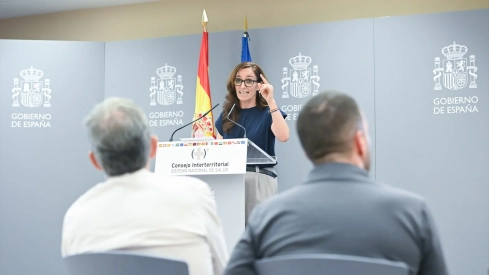
The conflict over the new Framework Statute has once again dominated the Interterritorial Council of the National Health System. The 17 autonomous communities, along with Ceuta and Melilla, have demanded that the Ministry of Health withdraw the current proposal and restart negotiations from their initial phases, a request that Mónica García has flatly rejected.
"I am not going to break the law, nor am I going to put on standby the working conditions of professionals who have been waiting for 20 years," the minister responded after the meeting. García maintains that returning to the starting point would mean abandoning the improvements already negotiated and breaking the agreement reached with CCOO, UGT, CSIF, and SATSE, the organizations present at the union table for statutory personnel.
The political photograph is unusual. Communities governed by the PP, PSOE, and other formations have closed ranks to demand another negotiation method, with greater participation from the administrations that manage health services. Autonomous unity increases pressure on the minister, although Health reminds that the regional ministries have intervened for three years through technical groups, allegations, and meetings of the Interterritorial Council.
Communities demand to start from scratch
The letter signed by the counselors considers that the process has not achieved the institutional and professional consensus necessary to reform a norm that will affect hundreds of thousands of healthcare workers. The communities ask to open a new stage of dialogue in which the Ministry, employer administrations, and professional organizations participate effectively.
The autonomous governments also warn that the prolongation of strikes is affecting care activity and can worsen waiting lists, the quality of care, and patient safety. It is the communities that will have to reorganize shifts, hire staff, and assume the cost of a good part of the planned measures.
Mónica García believes that this request would condemn the reform to another postponement after more than two decades with the same legislation. The current Framework Statute was approved in 2003 and Health has been working on its replacement since 2022, with successive drafts and meetings with unions and regional representatives.
The minister also accuses the communities of maintaining a contradictory position. As she explained, several of their reports ask to suppress the articles linked to working hours and on-call duties, precisely two of the issues that have mobilized doctors in recent months.
"With one hand they ask us to eliminate the demands and not listen to professionals and, with the other, they blame us for not addressing those demands," García reproached, comparing the autonomous attitude to that of the "gardener's dog."
24-hour on-call shifts concentrate the fight
The Ministry of Health's text generally limits mandatory on-call shifts to 17 hours of effective work and sets a maximum weekly working day of 45 hours on average. It also contemplates calls for competitive examinations every two years, measures to reduce temporary employment, and new guarantees for work-life balance and rest.
24-hour on-call shifts would be reserved for certain weekends or hard-to-cover centers, always with the professional's consent and after a favorable evaluation of occupational risk prevention.
The communities warn that applying these limits without previously reinforcing staff could leave shifts uncovered, especially in small hospitals, rural areas, and specialties with a shortage of doctors. They also question whether care continuity can depend on the individual consent of each doctor.
The Ministry of Health responds that maintaining full-day shifts harms workers' health and increases the risk of errors. García considers it "destructive" to keep 24-hour on-call shifts as an ordinary part of the system and argues that the reform must take advantage of the increase in university places and specialized health training.
Some autonomous communities have closed their own agreements with medical unions in recent weeks. Galicia, the Valencian Community, and the Basque Country have agreed on labor improvements to reduce conflict in their territories, movements that the Ministry views with suspicion when they alter balances previously negotiated with general unions.
A dispute that has dragged on for months of strikes
The agreement reached by the Ministry of Health with CCOO, UGT, CSIF, and SATSE allowed progress in the processing, but left open the confrontation with medical organizations. The State Confederation of Medical Unions and the Andalusian Medical Union demand specific regulation for doctors and facultative staff, with their own table that takes into account their training, responsibility, and permanent availability.
Among their demands are the ordinary 35-hour workday, a different professional classification, better remuneration for overtime, and the recognition of the arduousness of certain specialties to access flexible retirement.
Facultative staff have held weeks of strikes each month between February and June. The mobilizations have caused the suspension of consultations, tests, and operations, with an impact that communities are now using to justify the need to restart dialogue.
Medical unions threaten to call an indefinite strike after the summer if the Ministry maintains the current draft. The Ministry of Health rejects an exclusive statute for a single profession, although it assures that it will continue negotiating specific changes within the common framework for all healthcare personnel.
The dispute leaves García supported by the agreement with the unions of the Scope, but confronted with the strike committee and all regional administrations. The text must still return to the Council of Ministers before beginning its parliamentary processing, where it may receive new modifications.
Waiting lists will have to wait until September
The Interterritorial Council has also not closed the new information system on waiting lists. The communities have asked for more time to study the indicators and the Ministry of Health has agreed to postpone the decision until September, when the advisory body will be convened again.
The Ministry wants to replace a regulation it considers obsolete and offer more detailed data on the time patients wait according to the disease, test, or pending intervention. The communities demand that the criteria be reviewed first in the technical bodies to avoid inaccurate comparisons between their health services.
The Ministry of Health hopes to reach an agreement after the summer and then begin drafting the new royal decree. The objective will be to standardize the information published by the autonomous communities and allow for more precise monitoring of care delays.
Mónica García responds to Feijóo regarding the anti-smoking law
The meeting has also been marked by the controversy surrounding the future anti-smoking law. Alberto Núñez Feijóo has accused the Government of using it as a "smokescreen" in the face of cases affecting the PSOE and has criticized that the project has advanced without the prior support of the communities.
Mónica García has responded to him that "a smokescreen is what people have to breathe when they sit on a terrace next to someone who is smoking". The minister has defended that hospitality workers and customers deserve the same protection from smoke as those who perform their job in any indoor space.
García has also rejected warnings about the economic impact of the smoking ban on terraces. She recalled that in 2010, bar closures and massive job losses were predicted when tobacco was removed from inside establishments, but those forecasts were not met.
The future law will expand smoke-free spaces to terraces, beaches, collective swimming pools, and sports facilities, in addition to subjecting vapes to similar restrictions as conventional cigarettes. The project must now pass through Congress and the Senate, where the Government will have to gather the necessary support to approve it.
