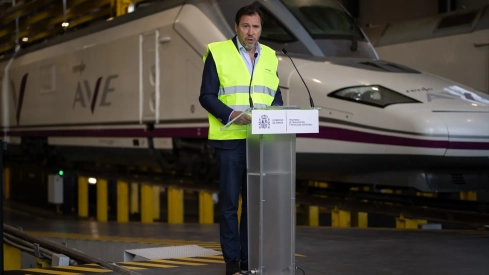
Óscar Puente has set this Tuesday a new priority for Renfe's international expansion. The public company has begun the process to homologate its Talgo series 106 and 107 high-speed trains in Portugal, an essential first step to be able to operate in the neighboring country in the coming years.
The two models offer an important advantage for the Government's plans. Their ability to run on different track gauges facilitates adaptation to the Portuguese network, which still retains numerous sections of Iberian gauge. "They are models very adaptable to the Portuguese environment," Puente explained in an interview with 'Europa Press'.
The move represents a change of priorities after the difficulties encountered in France. Renfe currently operates the Barcelona-Lyon and Madrid-Marseille connections, as well as several stops in the south and east of the country, but regulatory hurdles and homologation problems continue to delay its arrival in Paris.
Puente has chosen to concentrate efforts on a market with greater technical facilities and a more fluid institutional relationship. "We must analyze reality and not insist on things that seem difficult," said the minister, who considers Portugal a territory where Renfe will be able to work with greater comfort and find an easier entry.
Portugal prepares its high-speed rail
The shift comes at a particularly favorable time for Portuguese railways. The country is developing the new high-speed line between Lisbon and Porto, designed to reduce the journey between its two main cities to approximately an hour and a quarter. The network also contemplates future international connections with Vigo and Madrid, according to the planning of Infraestruturas de Portugal.
Spain, Portugal and the European Commission have agreed to have a direct connection between Madrid and Lisbon by 2030 with an approximate time of five hours. The full deployment of high-speed rail, planned for 2034, should reduce the journey to three hours. Brussels considers this corridor a priority piece to fully integrate the two countries into the European railway network.
The Atlantic axis between Porto and Vigo is also advancing. Portugal has completed the preliminary and environmental studies for the two phases of the future line and submitted them to its Environment Agency during June and July. The project will also require a new railway bridge over the Miño between Tui and Valença, an essential infrastructure to connect Galicia with the Portuguese network.
Renfe's schedule will depend on homologation and the availability of trains. Talgo still has to deliver the units of series 107, which are about two years behind schedule. Puente has avoided announcing new sanctions and will wait to know the definitive reception date before applying the contract clauses.
With Portugal as a new priority, Renfe opens a growth path linked to two of the main railway projects on the Peninsula. The operator must now complete the certification of its trains and specify its future services as the neighboring country implements the new infrastructure.
