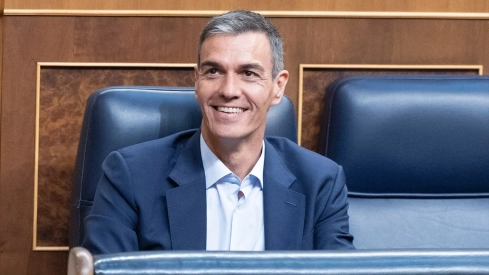
The President of the Government, Pedro Sánchez, will preside this Tuesday over an event focused on the extraordinary regularization process for migrant people, coinciding with the last day of the period enabled to submit applications. The definitive number of files will be known this Wednesday, after the Executive had already counted around 900,000 petitions in mid-June.
The procedure was launched last April 16 and has been accompanied by intense institutional and social mobilization. The Government now plans to close the initial processing phase and begin the evaluation of the received applications, in a context in which the Executive defends the measure as a structural response to the country's demographic and labor challenges.
“Today, again, I feel proud to be Spanish”: Sánchez defends regularization as an “act of justice”
The President of the Government, Pedro Sánchez, disseminated a letter addressed to citizens through the social network X, in which he stated: “Today, again, I feel proud to be Spanish”. In that message, he announced the approval in the Council of Ministers of the Royal Decree that has made possible the extraordinary regularization process for people in an irregular situation, an initiative that, he stressed, has been driven by “hundreds of organizations” and “more than six hundred thousand people.”
In his writing, the head of the Executive defended regularization as “above all, an act of normalization”, considering that it recognizes an already existing reality: that of hundreds of thousands of people who are already part of the country's daily life. He also described it as “an act of justice with our own history”, recalling that Spain has historically been a country of emigration.
Sánchez also added that “it is not only an act of justice. It is also a necessity”, in reference to the aging population and the importance of integrating these people into the labor market to sustain the contribution system and public services. In his message, he defended that “the path is clear: better integrate, better organize and channel all the potential of those who already live among us”, while ruling out that “neither technology nor automation” can replace this process. The objective, he pointed out, is for regularization to allow “recognizing rights, but also demanding obligations”, guaranteeing participation “on equal terms”.
Pope Leo XIV's visit reinforces the debate on migration and human dignity
In parallel, the recent visit of Pope Leo XIV to Spain, put the international spotlight on the migration debate. During his tour, the pontiff defended "human dignity" and expressed his support for reception policies, also fulfilling the wish of his predecessor, Pope Francis, to visit the Canary Route and meet with migrant survivors of one of the most dangerous routes in the world. In the archipelago, one of his last acts was a visit to the Las Raíces reception center.
In this context, the Minister of Inclusion, Social Security and Migration, Elma Saiz, highlighted in a speech the Government's work on migration and vindicated the role of migrants in Spanish society with the expression: "Contribute, work, build and be part."
Saiz also stressed that "Welcoming with love is also making it possible for each person to give their best. Integration is not the renunciation of who we are but the shared construction of who we want to be," in an intervention in which she defended the Executive's approach to integration and rights.
