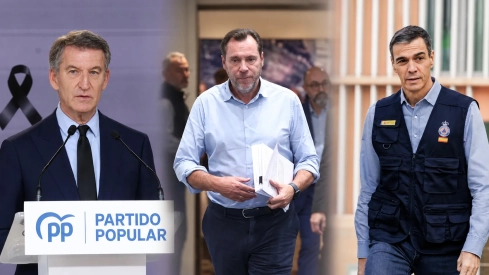
The families of the victims of the Urda railway accident are still waiting for answers while Spanish politics enters the last day of official mourning with an open debate on the responsibilities for the tragedy. The president of the PP, Alberto Núñez Feijóo, has called for the resignation of the President of the Government, Pedro Sánchez, and the Minister of Transport, Óscar Puente. The head of Transport has ruled out leaving office and has defended that his obligation now is to provide explanations and work to restore confidence in the railway.
The pressure on Puente also comes from the left. The candidate of Frente Amplio for the Presidency of the Government, Ada Colau, has demanded his resignation "as soon as possible" and has conveyed that request to La Moncloa. Furthermore, some voices within the PSOE have privately expressed their doubts about the minister's continuity after the second serious high-speed accident in less than a year.
Sánchez currently maintains his confidence in Puente, who offered his resignation to the president after the accident. The head of the Executive asked him to continue, according to several media outlets. The minister himself stated this Friday that, if Sánchez had asked him to resign, he would not have put up any obstacles.
The collision between a Renfe AVE train and an Iryo train, which occurred on Wednesday in the province of Toledo, has caused at least 69 deaths, according to the latest available balance. Among the victims is former Minister of Employment Fátima Báñez, who was bid farewell this Friday by family, friends, and colleagues in Huelva. The official mourning decreed by the Government extends until midnight this Saturday.
Feijóo points to Sánchez and Puente defends his continuity
The leader of the PP met this Friday with experts in infrastructure and railway transport and demanded accountability from the Government for the situation of the network. Feijóo directed his criticism at both the minister and the president who appointed him and keeps him in office, less than a month before the general elections on November 29.
"If they don't resign, we will remove them at the polls," said the popular leader, who questioned the management of railway safety and rejected that the explanation for the accident be reduced to the actions of a single worker.
Cambiar es demostrarle a la gente que podemos ser un país que funcione.
— Alberto Núñez Feijóo (@NunezFeijoo) October 30, 2026
Gobernar no es ninguna broma. Es saber que cada decisión y que cada error puede tener un coste que no se mide en votos, sino en daños. pic.twitter.com/R1IRbTfmCF
The petition came after Puente appeared at the Ministry of Transport to offer new details about what happened. The minister assured that he understands the public's concern and demands for accountability, but defended his decision to remain at the head of the department. "My way of taking responsibility is to show my face," he maintained.
In the afternoon, in an interview with Esther Palomera on TVE's 'Malas Lenguas' program, Puente responded to Feijóo and reproached him for applying a different criterion than that maintained by the right after the Angrois accident, which occurred in 2013 when the PP was in power. He also defended the PSOE's actions in opposition after that tragedy, in which 80 people died.
The minister also lashed out at the leader of the far-right Vox, Santiago Abascal, who has maintained his pre-campaign events and has used the tragedy to attack the Government. In a rally held on Thursday in Ávila, Abascal called Puente "Óscar Muerte" (Oscar Death) and referred to him and Sánchez as a "sinister couple".
On TVE, Puente criticized the insults and personal accusations of the far-right leader. Abascal has even presented what happened as a "crime against the interests of Spain", while the judicial investigation and the technical investigation are still open and have not yet established the causes of the accident.
Colau calls for his resignation and pressure grows in the PSOE
Frente Amplio's demand has added a difficulty for the Government. Colau explained this Friday that she had already conveyed to La Moncloa the request for Puente to leave the Ministry of Transport, considering a political response necessary after the accidents in Urda and Adamuz.
"We believe it should happen as soon as possible," said the candidate in statements to the media in Barcelona. The former mayor recalled that Sánchez had acknowledged that confidence in high-speed rail had been broken and defended that, in the face of two tragedies of this gravity, a quick response is necessary.
La gravedad de los dos accidentes ferroviarios en tan poco tiempo exige una respuesta política.
— Frente Amplio (@Frente_Amplio_) October 30, 2026
La confianza en la alta velocidad se ha quebrado y no podemos mirar hacia otro lado. pic.twitter.com/hAAClUpwPi
Colau specified that she attributes political responsibility to Puente, even if he did not have a direct intervention in the accident. She also expressed her concern about the tone of the minister's appearance and considered it "unacceptable" that workers are singled out while investigations are still underway.
The federal coordinator of Izquierda Unida, Antonio Maíllo, supported that position and demanded Puente's resignation or dismissal. In his opinion, the minister's permanence hinders the resolution of the crisis of confidence opened after the accident.
The request is particularly significant due to the relationship between both forces. Frente Amplio is running in the elections as its own candidacy, while Sumar continues to be part of the coalition government with the PSOE. Colau's position marks a public distance from Sánchez in the middle of the pre-campaign, although it is necessary to distinguish between the electoral coalition she leads and the ministers who remain in the Council of Ministers.
There is also concern within the PSOE. Various reports published these days indicate that some socialist leaders, without identifying themselves publicly, believe that Puente should resign or be dismissed. Other officials close ranks with the minister and the party leadership maintains its support. For now, these discrepancies have emerged through anonymous sources, while Sánchez has chosen to keep him at the head of Transport.
The criticisms extend to other political spheres. Podemos candidate, Irene Montero, has questioned that what happened is attributed solely to a worker. ERC spokesperson, Gabriel Rufián, has demanded accountability and has placed the debate on investments and the railway model. From the PNV, Maribel Vaquero demanded maximum political responsibilities, which could involve a resignation or dismissal.
The pending explanations about the accident
The debate takes place while essential questions still remain unanswered. On Wednesday, a Renfe AVE train traveling to Seville hit an Iryo train that was stopped on the same track, on the Madrid-Seville high-speed line.
According to the explanation offered by Puente, before the crash there had been a failure in the LZB safety system, which caused the trains to stop in the affected section. The minister pointed to a decision by Adif's control center to allow the AVE to resume its journey. The investigation will have to clarify the complete sequence, the operation of the systems, and the circumstances in which the decisions were made.
The initial explanations have generated criticism from those who believe that railway personnel were blamed too soon. Puente maintained in his appearance that he would not use any worker " as a shield" and, in 'Malas Lenguas', assured that he had merely conveyed the available information.
"I have not blamed anyone", he stated in the interview. The minister added that an individual or collective action that has contributed to the result does not exclude other possible responsibilities, including his own, and defended the need to study mechanisms to prevent or correct errors.
The Urda tragedy comes just ten months after the Adamuz accident, in Córdoba, where 46 people died. Sánchez acknowledged this Friday that confidence in the high-speed system is "broken" and pointed out that the Government must offer solutions to prevent a similar tragedy from happening again.
Puente will appear at his own request on Tuesday, November 3, at 5:00 p.m. before the Permanent Deputation of the Congress, the body that continues to function after the dissolution of the Cortes. There he will have to explain what is known about the accident and the measures his department is preparing to reinforce security.
