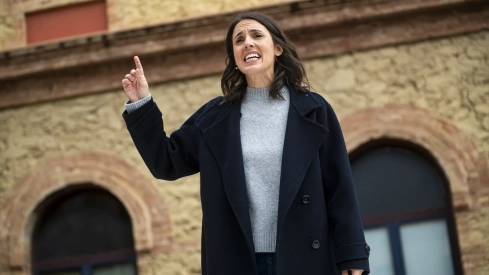
The Podemos candidate for the general elections, Irene Montero, has rejected that responsibility for the Urda railway accident in Toledo be focused on a single worker. The leader has demanded that the security and maintenance problems of the network be examined, after the Minister of Transport, Óscar Puente, pointed to an order from the Adif control center in his initial explanations.
"Do they really want us to believe that all the responsibility lies with one worker?" Montero asks in a video released this Thursday on her social media. The candidate reminds that Spain has suffered two serious railway accidents in less than a year and maintains that there are problems in the entire system that must be addressed.
¿De verdad nos van a decir que toda la responsabilidad de un accidente así es de un trabajador? pic.twitter.com/qwx4RTthD9
— Irene Montero (@IreneMontero) October 29, 2026
In the video, the Podemos leader questions the leaking of communications prior to the collision between the Atocha control center and the train drivers. "Leaking audios to target a worker [...] is indecent," she states, and asks for respect for those who work in the sector. For now, it has not been publicly established who leaked those recordings.
Montero maintains that railway professionals have been warning for years about staff shortages, working hours, and safety problems. In this context, she recalls the train drivers' strike called for this Thursday, announced before the accident, with which the Spanish Union of Railway Drivers (Semaf) demands safety measures and the fulfillment of pending commitments.
Montero questions maintenance and railway liberalization
The candidate cited in her speech a comparison of trains affected by failures in signaling installations. According to the data she presents, the figure went from 243 trains affected in 2018 to 3,633 in 2025. Montero uses these numbers to ask for an analysis of the network's condition; the figures refer to trains affected by incidents and do not by themselves establish the causes of the Urda accident.
The leader attributes the problems she denounces to a network with more circulation, maintenance that she considers insufficient and outsourced, and safety systems awaiting updates. She also criticizes the liberalization of railway transport and argues that privatization can pose a danger to safety.
Renfe, for its part, has defended that it complied with the obligations it assumed after the Adamuz accident, in Córdoba, and that it has reinforced maintenance teams and hired more workers. The railway infrastructure remains under public management by Adif, while several companies operate certain high-speed services.
Montero's criticisms come after Podemos and Esquerra Republicana de Catalunya (ERC) registered a joint request for Puente to explain the accident in the Congress's Permanent Deputation. The minister will appear at his own request on Tuesday, November 3, at 5:00 p.m. and will offer a press conference this Friday.
The Compromís deputy Alberto Ibáñez has also censored the dissemination of the workers' conversations. He has asked for respect for the deceased, the injured, and the emergency teams, and has defended that political responsibilities be assumed.
The Frente Amplio candidate, Ada Colau, has also demanded that the functioning of the security system be investigated and that Puente provide explanations. The judicial and technical investigations remain open to determine what happened before the collision between a Renfe AVE and an Iryo stopped on the track, which has left a provisional toll of 69 fatalities.
