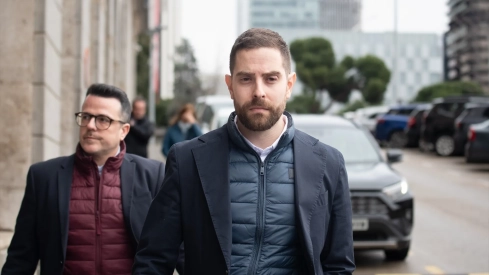
The Spanish Railway Drivers' Union (Semaf) regretted this Thursday the leakage of information that, as it stressed, "in theory should have been guarded," including the audio recordings of conversations between the Adif control center and the drivers of the Renfe and Iryo trains involved in the accident that occurred yesterday in Urda (Toledo).
The general secretary of Semaf, Diego Martín, advocated for an "independent and rigorous" investigation and insisted that the causes of the accident must be determined from a complete analysis of the available information. "We, as always, defend an independent and rigorous investigation of the entire accident, and the causes will be determined by the investigation," he said in an interview with EFE.
Martín added that, so far, what the union knows "for sure" is that the LZB signaling system failed, which caused trains to stop and subsequently a Renfe train to collide with the Iryo train. "What we have is the same information that has been leaked to the press, that is, information that in theory should have been guarded, like those audios, and we must have the responsibility not to make hypotheses without analyzing all the information, not just what has been leaked to the media," he stressed.
"Risk is being exported to professionals"
The general secretary of Semaf maintained that the accident once again highlights a situation that the group has been denouncing for some time, because, he said, risks are being transferred to professionals and trains are running "more habitually in degraded situations" than they used to. "Unfortunately, there has been another tragic accident due to causes that should not have happened," he stated.
Regarding the Adif control center, Martín explained that when safety systems fail, management becomes "chaotic" due to the number of trains that must be coordinated in a short time over a wide section of track, which generates "a lot of tension" and "a lot of stress" among those responsible for the command post. "We understand that there is a tense situation in the command post itself," he said.
Fear for two colleagues and reference to the Adamuz accident
The union also warned that it fears the loss of two colleagues, although "no official communication has been received from the authorities or companies." "We know that, at this point and from experience, unfortunately, we will have to mourn two new colleagues who have lost their lives doing their job, and we do not want to mourn any more," Martín indicated.
The new accident adds to the one that occurred on January 18 on the same high-speed line, in the Andalusian town of Adamuz (Córdoba), in which 46 people died, including a Renfe driver. Semaf has linked both accidents to the lack of sufficient progress in railway safety and to the rejection that, according to the union, the group is showing towards the current management.
The 24-hour strike is still on
Semaf had called a 24-hour strike before yesterday's accident, supported this Thursday by Renfe drivers precisely in defense of railway safety. Martín recalled that the strikes had been called in advance of the accident and assured that the measures agreed after the Adamuz accident have not progressed enough. "Unfortunately, we had called for strikes for today before this tragic accident occurred," he said.
The union leader maintained that there are still pending cross-cutting measures throughout the sector, "mainly safety," to reduce the risks faced by workers and users. "We are basically fed up with the fact that in the end everything that improves the railway system has to be delayed or paralyzed in offices or in certain places," he stated.
LZB, ERTMS and the situation of the Madrid-Seville line
Regarding the replacement of the LZB system with ERTMS, Martín explained that the nominal system of the Madrid-Seville line is still LZB and that ERTMS, which was being implemented, should already be installed. "It's something we don't understand why it has taken so long to implement, and what we see has failed is the nominal system of the line, which is LZB," he said.
When that system fails, the general secretary of Semaf specified, circulation is carried out in a degraded system, conditions that, he argued, transfer the risk to professionals and should not become habitual on a high-speed line. "That's what's not normal," he stated.
Martín insisted that these situations should be exceptional, but that "unfortunately we are experiencing them much more habitually than should be experienced on high-speed lines with the quality standards they must have." He also demanded investments and timely execution, and stressed that, in his opinion, "blame does not prevent accidents, causes do."
Service impact and collective discontent
Semaf currently does not have real-time information on the strike's follow-up, but Martín affirmed that "we know there is a lot of service impact." In his opinion, this response is logical because, for the group of drivers and all railway personnel, the accident represents "another new trauma in such a short space of time" and, he said, highlights the consequences of assuming responsibilities that do not correspond to the workers.
