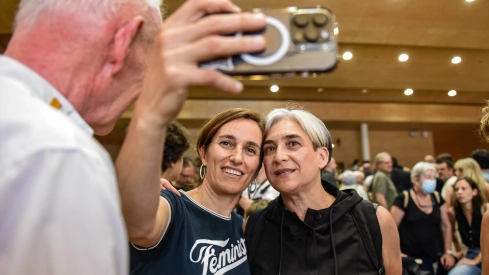
Ada Colau wants to help the Broad Front "inside or outside the electoral lists", although she clarifies that she has not put herself forward as a candidate. The former mayor of Barcelona and leader of Comuns defended this Monday in an interview for 'Malas Lenguas' on TVE that left-wing forces accelerate agreements for the general elections on November 29 and gather the largest possible number of parties and referents. Her intervention comes with the leadership of the space still unresolved.
"And if it's within the electoral lists, I don't care about the number," she explained. Colau thus keeps open her participation in the candidacy without claiming to lead it or occupy a specific position. Her priority is that the project can inspire and defend brave and structural measures, with the right to housing and the response to the far-right as shared objectives.
🗳️ @AdaColau, exalcaldesa de Barcelona, ¿regresará a la primera línea política?
— Malas Lenguas (@MalasLenguas_Tv) October 5, 2026
💬 "Nos ha penalizado ir por separado", afirma en #MalasLenguas pic.twitter.com/Kb4RBaMHxC
The former mayor has asked all progressive people and organizations to put themselves at the service of this confluence. In her opinion, citizens don't care "a fig about small differences" between parties when they agree on issues such as guaranteeing decent housing. The message comes after the weekend's demonstrations and Congress's rejection of the housing decrees, which has led to the early election announced today by the President of the Government, Pedro Sánchez.
Asked if she would reject a candidacy without Podemos MEP Irene Montero, Colau avoided making her participation a condition linked to a name. She defended, instead, an alliance that brings together as many people and formations as possible. "We all have to be there. The more, the better," she insisted.
She also stated that she "would love" to count on Gabriel Rufián, spokesperson for Esquerra Republicana de Catalunya (ERC) in Congress, if his party does not prevent it. She also mentioned Compromís, Més and Chunta Aragonesista (CHA), in addition to the organizations that make up the coalition government. Her proposal broadens the view beyond the four parties that initially promote the Broad Front, Movimiento Sumar, Izquierda Unida (IU), Más Madrid and Comuns.
The leader has called for discreet, closed-door conversations without cross-vetoes, to ensure that each organization finds its space. She has asked for generosity and courage to prevent the "fights of the past" from reappearing. With the elections already set, the parties have to resolve both who will head the candidacy and which forces will participate in it.
A leadership without closed consensus
The names of Mónica García and Ernest Urtasun, Ministers of Health and Culture, remain among the options being considered to lead the space. This Monday, García has left open her availability on 'Hoy por Hoy', on 'Cadena SER', and has indicated that the decision must be made between the parties. The Broad Front is preparing a presentation event on October 17, although the minister has indicated that some decisions will have to be known before then.
García's option finds reservations in sectors of Sumar's own space, according to internal sources from the Broad Front who have informed 'ElConstitucional.es'. These voices question whether her profile gathers the necessary consensus and electoral momentum and consider that she arrives at the debate with wear and tear from her time in Health. Added to this is a prior political commitment, as García was already chosen as Más Madrid's candidate for the Madrid Assembly for the regional elections in May 2027. Her jump to the general elections would force a review of that commitment.
In terms of public evaluation, the July barometer of the Center for Sociological Research (CIS) gave her a 4.5 out of ten, compared to 4.61 in April. In the same measurement, Pablo Bustinduy obtained a 5.36 and Urtasun a 5.02. These are evaluations of their performance as ministers among the population, a different question from the preference for who should lead a left-wing candidacy.
Among the open conflicts of her management is the reform of the Framework Statute, which regulates the working conditions of healthcare personnel. The project arrived at Congress in September with the rejection of medical unions, after five weeks of strikes in the first half of the year. Doctors demand their own statute and negotiation framework and consider the improvements insufficient. The reform, for its part, has the support of the unions of the general sector table, including CCOO, UGT, and Satse.
While that debate continues, Pablo Bustinduy is again receiving internal support to take the step. As 'ElConstitucional.es' exclusively reported last Friday, his defense of housing measures and his interventions in Congress have reinforced the valuation of the Minister of Social Rights, Consumer Affairs, and Agenda 2030 within the space. This support has reopened his name against the alternative of Urtasun, although Bustinduy has reiterated his refusal to lead the candidacy.
The negotiation also includes the relationship with Podemos. Irene Montero has proposed open primaries on October 14 and 15 to choose a shared candidacy, while the four parties of the Broad Front continue to seek their agreement formula. Colau's willingness to help from any position is added to these conversations and to her request that no organization be left out due to disputes between leaders.
Colau has also warned of the risk of concentrating the entire campaign on a single figure. When a well-known face centralizes everything, she argues, "economic 'lobbies' and major adversaries, the far-right, dedicate all their hatred and all their resources to harming" that candidacy. That is why she calls for agreements between parties based on respect and mutual recognition, with a space and a role for each one.
