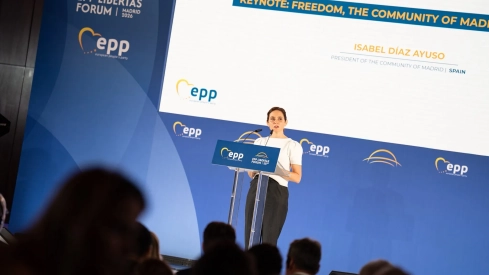
Isabel Díaz Ayuso has used her speech before the leaders of the European People's Party (EPP) to transfer outside of Spain the most extreme version of the PP's discourse against Pedro Sánchez. With Alberto Núñez Feijóo seated in the front row, the Madrid president has assured that the country is governed by a "movement of destruction of the Rule of Law" and has compared its political situation with that experienced in Venezuela and Cuba.
The popular leader has accused the Government of using the media, companies, and public institutions to harm its adversaries. She has also denounced an operation of "harassment and demolition" against the Judiciary with which, according to her version, Moncloa intends to discredit the investigations affecting the president's inner circle.
Ayuso later extended her intervention to immigration. She spoke of millions of people who would be entering Europe "without control", pointed to Barajas airport, and even included Gibraltar after the withdrawal of the Fence. She also accused the Executive of granting nationality with the intention of "vitiating electoral censuses", without explaining what data supports that statement.
Ayuso elevates the discourse that Feijóo opened in the morning
The chosen setting was the first Libertas Forum organized in Madrid by the European People's Party, a meeting with conservative leaders from Europe and Latin America. Among the attendees were the president of the EPP, Manfred Weber, and the vice president of the Italian Government, Antonio Tajani.
Feijóo had intervened in the morning and had presented Sánchez as an "authoritarian president". The leader of the PP described Spain as a weakened democracy and asked European conservatives to respond against communists, populists, radicals, and dictators.
Ayuso picked up on that approach hours later and hardened her tone. "I understand that it is hard for us to believe what is happening in a member country of the European Union, but this is how it is. Venezuelans and Cubans also did not want to believe it in their day," she stated.
.@IdiazAyuso asks to create again a Europe that inspires the world: «Let's be again the leadership in the world, where everyone looks for answers, as a place of opportunities and prosperity». 🇪🇸 pic.twitter.com/NIpb7h27hw
— EPP (@EPP) July 15, 2026
The Madrid president has asked her European allies to listen to the warnings issued over the last few months by Feijóo and the PP. According to her account, the Spanish situation could extend to other countries if community institutions consider it a matter of internal politics.
"The authoritarian drift that Spain is suffering will have catastrophic consequences," she proclaimed. Ayuso has presented the confrontation with the Government as a dispute between the rule of law and the arbitrariness of power, and has warned of a supposed contagion effect within the European Union.
From the attorney general to a figure of 130 investigated
Ayuso has built her accusation based on several judicial and political matters. She has cited the conviction of the former Attorney General of the State, the absence of new General Budgets and the time elapsed since the last Debate on the State of the Nation.
She has also assured that there are close to 130 investigated in different corruption schemes, although during her speech she did not detail how she obtained that figure or what procedures she includes in the count.
The Madrid leader has accused the Government of using public and private companies to "buy wills" and has maintained that the PSOE has carried out actions aimed at destroying the reputation of magistrates, journalists, politicians and members of the security forces.
Her speech came a day after the nine-year disqualification sentence imposed on David Sánchez, the president's brother, for a crime of administrative prevarication. The resolution can still be appealed and rules out that Pedro Sánchez or his entourage exerted pressure to obtain the investigated position.
The Government and the PSOE have criticized the political origin of several popular accusations appearing in the procedure. David Sánchez's own lawyer rejected this Wednesday attributing 'lawfare' to the court, although he pointed out an "absolutely clear political bias" in the organizations that promoted and sustained the accusation.
Ayuso has placed these criticisms within a supposed Moncloa campaign to present all investigations as political persecutions. Her intervention avoided distinguishing between objections directed against popular accusations and those referring to the actions of judges.
Immigration and Gibraltar enter her offensive
The second part of her speech focused on immigration. Ayuso has stated that millions of citizens are entering Europe irregularly and massively, especially through Barajas, the rest of the borders and, since this Wednesday, Gibraltar.
The mention of the Rock coincides with the provisional entry into force of the agreement between the European Union and the United Kingdom that eliminates routine controls at the land border. The treaty transfers Schengen verifications to the port and airport of Gibraltar, where Gibraltarian authorities and Spanish agents responsible for protecting the European external border will intervene.
The removal of the Fence facilitates the movement of those who live and work on both sides, but it also does not turn Gibraltar into an uncontrolled entry point to the Schengen area. The new system maintains checks for people arriving from outside the European free movement area.
Ayuso has spoken of more than three million people arriving irregularly, according to calculations she generically attributed to "many officials." The Madrid president also did not specify the time period, the countries included, or the statistical source used.
Based on that figure, she warned of a supposed increase in insecurity and a threat to coexistence and public services. The PP leader thus repeated an association between immigration and crime that is a regular part of her discourse, despite the fact that during the intervention she did not offer data that would allow establishing that relationship.
The accusation of altering the electoral census
Ayuso has also mixed the regularization of foreign persons with the granting of nationality to descendants of Spaniards protected by the Democratic Memory Law. These are different legal procedures with different requirements.
Administrative regularization allows obtaining a residence and work permit. Residence also does not automatically grant the right to vote in general elections, which is reserved for Spanish citizens.
The Democratic Memory Law opened a temporary path for children and grandchildren of exiled Spaniards or those who lost their nationality to recover it. Ayuso has maintained that the Government intends to use this mechanism to orient the census towards a certain political tendency.
"Citizenship can be granted under a criterion that seeks to bias electoral censuses towards a specific political tendency, that of the Sánchez Government," she stated. The Madrid president presented this alleged operation as a practice typical of the Executive's populist allies, although she also did not provide evidence that nationalities are granted according to the ideology of those who request them.
Her intervention was completed with a defense of the conservative turn in Latin America and with her support for the elected president of Peru, Keiko Fujimori. Ayuso expressed her wish that this result extend to countries that, in her words, remain "mired in nationalism, Bolivarian socialism, and drug trafficking."
The Libertas Forum will continue this Thursday in Madrid with new panels between representatives of the European People's Party and conservative leaders from Latin America.
Add ElConstitucional.es as a preferred Google source for free.
Stay informed about all the latest breaking news with the best information. Against disinformation, for democracy and social rights.
