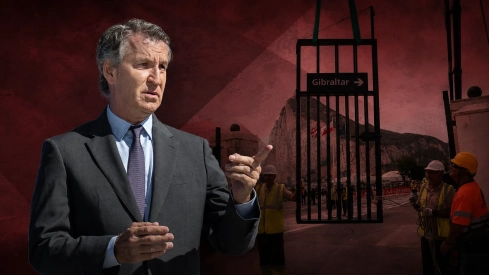
The Partido Popular has chosen the day the Gibraltar Fence began to disappear to launch an offensive against the agreement that allows the border to open. While neighbors and workers crossed for the first time without showing their passport, Génova has called the treaty a "great lost opportunity" and its provisional application a "fraud".
The popular party's position clashes with the celebration experienced since midnight in La Línea de la Concepción and Gibraltar. The treaty signed by the European Union and the United Kingdom provisionally entered into force this Wednesday after five years of negotiations and put an end to routine controls at the land crossing.
The President of the Government, Pedro Sánchez, attended the removal of one of the border gates along with the Minister of Foreign Affairs, José Manuel Albares; the Chief Minister of Gibraltar, Fabian Picardo; and the mayors of Campo de Gibraltar. "Today the last wall of continental Europe falls", he proclaimed before defending that the agreement closes a "three-century wound" and opens a stage of opportunities for the entire region.
The PP speaks of a "double trap"
The leadership of Alberto Núñez Feijóo argues that the treaty should have been debated and voted on in the Cortes as it affects matters covered in article 94.1 of the Constitution. According to their interpretation, the Government has used a "double trap" to avoid parliamentary control.
Génova accuses Sánchez of having formally left Spain out of an agreement signed between the European Union and the United Kingdom. It also reproaches the Executive for accepting its consideration as an exclusive EU treaty, instead of defending that it be processed as a mixed agreement with national and European competencies.
"What affects Spaniards must be decided by Spaniards", say popular sources, who consider that the provisional application has begun without the endorsement of the Cortes or the definitive approval of the European Parliament.
The qualification of "fraud", however, overlooks the procedure followed by community institutions. Member States authorized the provisional application from July 15 and the text will be submitted to the consent of the European Parliament, whose vote is initially scheduled for December.
Spain has not remained outside of political negotiation either. The Government participated alongside the European Commission, the United Kingdom, and Gibraltar in the contacts developed since 2021. Albares was present at the signing of the treaty and Moncloa maintains that the Spanish claim over the sovereignty of the Rock remains intact.
The PP disagrees with this legal architecture and considers that Spain has squandered the negotiating position it obtained after Brexit. In their opinion, London and Gibraltar receive more favorable treatment than when the United Kingdom was part of the European Union and the Government has renounced using that advantage to advance in the dispute over sovereignty.
An open border for 15,000 workers
The main change began to be noticed from this very early morning. Passport controls disappear from the land border and physical barriers will be progressively removed. The measure especially affects some 15,000 cross-border workers, more than half of the Rock's workforce and mostly residents in Spain.
Schengen controls are moved to the airport and, when necessary, to the port of Gibraltar. There, Gibraltarian authorities will act first, followed by Spanish agents responsible for protecting the external border of the European space. Spain will also have the capacity to intervene in the approval and renewal of residence permits that allow circulation through Schengen.
The agreement protects unemployment benefits and includes mechanisms to guarantee pensions for those who have worked on both sides of the border. Sánchez has assured that they can be complemented to reach Spanish minimums and has announced a cohesion fund aimed at correcting imbalances between Gibraltar and the municipalities of the region.
The PP questions whether this "shared prosperity" has sufficient content and demands greater specificity on investments, fishing, environment, pensions, and financial services. Some of these matters will require development over the coming months, although the treaty already establishes the framework for the movement of people and goods, labor cooperation, and administrative coordination.
Taxation, military base, and sovereignty
Genoa also maintains that the agreement leaves Gibraltar's tax advantages intact and that it lacks instruments to combat its tax competition. The text, however, incorporates commitments on taxation, public aid, environmental protection, and economic competition.
The customs model will allow the elimination of usual controls on goods at the land border. In return, Gibraltar must bring certain indirect taxes closer to European levels and most of the products destined for the Rock will be pre-cleared by the Union's customs in Spain.
The PP also focuses on the British military base and denounces that its personnel will be exempt from ordinary migration controls. The treaty includes a specific regime for military personnel and preserves the autonomous operation of the United Kingdom's facilities, one of the points demanded by London during the negotiation.
This protection also does not formally modify the Spanish position on sovereignty. The Government presents the agreement as a practical solution for the daily life of the Campo de Gibraltar, separate from the historical dispute that Madrid and London keep open.
The contrast was exposed this Wednesday at the border itself. The Government, the mayors of the region, and the Gibraltarian authorities have celebrated the disappearance of a barrier that conditioned the lives of thousands of people. The PP has responded by trying to discredit the agreement and has not yet clarified what position it will defend when the final vote reaches the European Parliament, scheduled for December.
