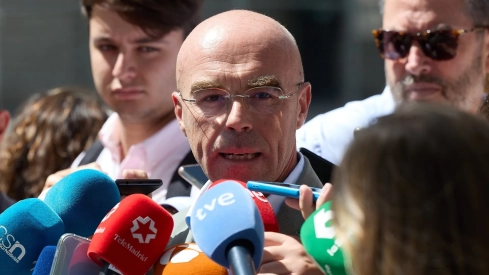
Jorge Buxadé has once again presented as a plan to manipulate the upcoming elections what until now is a legal and administrative controversy over the granting of nationalities. The head of the far-right Vox delegation in the European Parliament accuses the Government of having prepared an "alteration of the electoral process" through the so-called 'Grandchildren's Law', although he has not provided any proof of fraud in the census or in a vote.
The far-right leader maintains that the instruction that develops the Democratic Memory Law has opened Spanish nationality to an uncontrolled number of descendants of emigrants. During an interview on 'Mañanas en Libertad', he went so far as to demand that those who participate in the elections be "effectively Spanish and not by tricks".
The phrase introduces a difference that the Spanish legal system does not contemplate. Whoever legally acquires nationality is Spanish and has the same political rights as any other citizen, provided they meet the age and the rest of the electoral requirements. This was reminded to Vox by the Central Electoral Board when it rejected its request to suspend postal voting for residents abroad.
The 2.5 million are not new voters
Buxadé has placed the number of people who could benefit from this route at 2.5 million and uses this estimate to fuel suspicion about the upcoming elections. The figure brings together potential beneficiaries and people who requested an appointment before the deadline, but it does not equate to the number of nationalities approved or the number of citizens incorporated into the electoral census.
The latest official data from the Ministry of Foreign Affairs, updated on June 23, count 1,225,188 applications formally submitted to consular offices. Of these, 571,761 had been approved and 333,696 registrations had been completed in the consular civil registries.
Between requesting an appointment, submitting the file, receiving a favorable resolution, being registered in the Civil Registry, and appearing in the Electoral Census of Absent Residents, there are several procedures. Vox presents the entire pool of potential applicants as if they were millions of ballots ready to enter the ballot boxes, also omitting that the files must prove the corresponding Spanish ancestry.
The so-called 'Grandchildren's Law' is also not an electoral law designed for the upcoming general elections. It is the eighth additional provision of the Democratic Memory Law, approved in 2022 to allow the recovery of nationality for descendants of Spaniards who left the country and other groups affected by historical rules on its transmission.
What the Electoral Board actually decided
The Central Electoral Board studied the matter on July 16 and rejected Vox's requests to stop the preparation of the CERA or suppress postal voting for Spaniards residing outside the country. The majority recalled that the suffrage of Spanish citizens abroad is protected by the Constitution and regulated by electoral law, so the body cannot eliminate it while that legislation remains in force.
The Electoral Census Office also reported that there are update, control, and traceability mechanisms. The JEC did detect the need to better specify how an electoral province and municipality are assigned to those who have never resided in Spain, a relevant decision because it determines the constituency in which their vote is counted.
For this reason, it has ordered the preparation of a new instruction for consulates to apply objective, homogeneous, and documented criteria when determining the place of greatest roots of the elector or their ancestors. The existence of a technical issue that needs to be corrected also does not prove that the Government is fabricating votes or altering results, as Vox claims.
Four members of the JEC issued a more severe dissenting opinion. They consider that the 2022 instruction unduly expanded the content of the law by separating access to nationality from the accreditation of exile and argued that the electoral body should intervene to stop new registrations in certain cases.
It is a relevant legal discrepancy that may end up before the courts. The position of these four members was not assumed by the majority of the Board nor does it demonstrate the existence of the 'rigged election' that Vox has been taking for granted for weeks.
From legal debate to electoral conspiracy
Vox has built around this issue an offensive that combines judicial resources, social media campaigns, and actions in European institutions. The party has appealed to the Supreme Court against the JEC's refusal to restrict external voting and has asked the Ministry of Justice to annul the instructions issued in 2022 and 2024.
It has also created a working group led by Buxadé and has opened six avenues of pressure in Brussels. These include a petition in the European Parliament, a complaint to the Commission, parliamentary questions, and a planned meeting with community justice officials.
Santiago Abascal's party has gone from asking for controls on the census to directly accusing the Executive of wanting to "steal the elections," following a framework used by Donald Trump and other far-right forces to discredit in advance electoral procedures that could offer them an adverse result.
Its most extreme proposal consisted of preventing Spaniards abroad from voting by mail and forcing them to travel to a consular office. The measure would have made voting difficult or impossible for those living hundreds or thousands of kilometers from a consulate, and it was rejected by the Electoral Board.
The PP approaches Vox's framework
The Popular Party has not gone so far in its proposals, but it has contributed to spreading suspicion. Alberto Núñez Feijóo has spoken of "electoral engineering" and his party has also requested the annulment of the 2022 instruction and the suspension of new registrations until the census criteria are clarified.
The 'populares' disagree with the legal path chosen by the Government, although they support that nationality also extends to descendants of Spaniards who emigrated for economic reasons. Feijóo himself defended in Buenos Aires, in 2022, a broader reform than the one limited exclusively to the families of political exiles.
The PP did distance itself from Vox when the far-right party tried to separate mail-in ballots in the count and when it proposed leaving voters residing outside Spain without that option. The competition between both parties has ended, however, by establishing a suspicion of manipulation for which neither has presented evidence.
Buxadé also fires against Europe and climate policies
The theory about the census was part of an intervention in which Buxadé once again deployed other usual arguments of the far-right. He accused Pedro Sánchez of having "surrendered the southern border," presented Hungary and Poland as victims of persecution by Brussels, and railed against European integration because, according to him, it diminishes the power of national governments.
In another intervention this Wednesday, he directly linked forest fires to the environmental policies of the European Union and described measures against climate change as an "ideological disease" and "fanaticism." Forest management, depopulation, and the abandonment of rural areas influence the spread of fires, although their use to deny or downplay the effect of global warming contradicts available scientific evidence.
The Electoral Census Office must now present its proposal to the JEC to strengthen the municipal registration of residents abroad. In parallel, the Ministry of Justice will have to respond to the nullity requests registered by PP and Vox, while Abascal's party prepares new appeals to keep the 'Grandchildren's Law' at the center of its campaign until the general elections.
