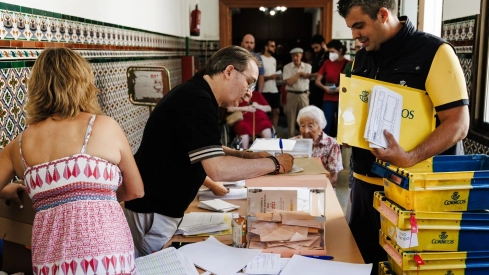
The Central Electoral Board has closed the door to the attempt by the far-right Vox to suspend postal voting for Spaniards residing abroad. The body has reminded Santiago Abascal's party that it lacks the authority to invalidate a procedure regulated by law and that the electoral administration must facilitate the exercise of suffrage as long as the regulations remain in force.
The agreement adopted this Thursday also demands greater precision in the incorporation into the Electoral Census of Absent Residents, known as CERA. The Electoral Census Office will have to complete the information sent to the Board and prepare common instructions to determine the municipality in which citizens who have obtained nationality through the so-called 'Grandchildren Law' are registered.
The resolution thus addresses two distinct issues that PP and Vox had mixed during recent weeks. External voting will continue to function and registrations in the CERA are not paralyzed. At the same time, consulates must apply homogeneous rules, accredit the rootedness of each applicant, and justify the choice of municipality when it does not coincide with their last residence in Spain.
The document released this Thursday does not confirm electoral manipulation nor does it order the elimination of already made registrations. The report from the Census Office certifies that there are mechanisms for updating, control, and traceability, although the Board considers that a sufficiently clear response is still lacking regarding the legal correctness of the procedure used to assign the electoral district.
The Constitution curbs Vox's electoral cut
The far-right Vox had asked to prevent postal voting for those registered in the CERA and to force them to go in person to consulates or embassies. It also demanded the suspension of new additions to the census while the procedure related to the 'Grandchildren Law' was reviewed. The Electoral Board has rejected these claims and has reminded that the right to vote of Spaniards residing outside the country is protected by the Constitution.
The articles 13.2, 23 and 68.5 of the Magna Carta recognize this right and entrust the State with facilitating its exercise. The Organic Law of the General Electoral Regime also regulates the functioning of external voting. With this framework, the Board cannot eliminate a voting modality approved by the legislator, even if a party questions its guarantees or intends to convert its political suspicions into a general restriction for millions of citizens.
The body also underlines that the rules used to elaborate the CERA have been applied since 2011 without the claims now raised by Vox having been registered during these years. The ultra party had linked the growth of the census with an alleged "rigging" and even defined the application of the 'grandchildren's law' as a "slow-motion coup d'état".
The Board's response leaves these accusations out of its agreement and refers any challenge against the granting of nationalities to the competent courts. The conditions for obtaining nationality exceed the functions of the electoral administration, so those who question the law or its development rules must go to the Constitutional Court or the contentious-administrative jurisdiction.
The functioning of external voting also has different supervision phases. Consulates receive the votes, but do not open the envelopes or carry out the scrutiny. The ballots are transferred sealed to Spain and the corresponding electoral boards are responsible for carrying out the recount.
Common rules for deciding where each elector votes
The central part of the resolution deals with the assignment of the electoral municipality, a relevant decision because it determines the province and the constituency in which each vote will be counted. Those who have lived in Spain must be registered in the municipality of their last residence. For those who have never resided in the country, the place of greatest personal roots or those of their ancestors is taken as a reference.
When an elector requests registration in a different municipality, they must present an explanatory declaration and documentation that justifies their choice. If these elements are insufficient, the consular office can determine the municipality ex officio based on the available data.
The Census Office submitted an initial report on July 10. That document confirms the existence of control and traceability systems, but the Board understands that it does not clarify who examines the declarations submitted, what criteria the consulates use, or how the assignments made ex officio are supervised.
For this reason, the body demands to know if the decisions of the consulates are recorded in the files and if they are subsequently reviewed by the Census Office. It also asks for proposals to strengthen the uniform application of the rules and avoid differences between consular offices.
The new instruction must specify how personal or family roots are accredited, what documents interested parties can submit, and in what cases the municipality should be assigned ex officio. The Board will review the text before it is sent to the consulates.
According to information published by 'El País', this section of the agreement was approved by nine votes to four after a debate of about two hours. The four dissenting members questioned the legal coverage and precision of the instructions issued by the Ministry of Justice. The rejection of Vox's claims, however, was unanimous.
The PP tries to appropriate the agreement
The Popular Party has presented the decision as a confirmation of the doubts raised by Alberto Núñez Feijóo. Génova maintains that the Board has given them "the reason" by demanding more transparency and has demanded that no new additions be made to the census until the requested instructions come into force.
This paralysis, however, does not appear in the agreement of the Electoral Board. The body expressly rejects suspending the preparation of the CERA and reminds that the Administration must continue to apply the procedures provided for in the legislation. The PP's demand therefore constitutes a political interpretation added to the resolution.
Miguel Tellado has assured that his party will remain "very vigilant" to avoid changes in the census "without tricks", while Alma Ezcurra has demanded a complete review of the instruction from the Ministry of Justice and the publication of the registrations made through this channel. The 'populares' thus maintain the language of suspicion about the process, despite the fact that the Board certifies the existence of control and traceability mechanisms.
Feijóo had accused the Government of practicing “electoral engineering” and of wanting to “manufacture new voters”. Days later, he modulated his discourse and acknowledged that the PP supports granting nationality to the grandchildren of emigrants when they can prove kinship. The measure also appeared in the popular electoral program and was defended by Feijóo himself during a visit to Buenos Aires.
The figures used during this controversy also require nuances. Around 2.45 million descendants requested an appointment to start the procedure, a quantity that does not equate to the number of nationalities granted or the number of new additions to the census. By the end of March, nearly 545,000 files had been approved and about 306,000 people had been registered in the Civil Registry.
CSIF demands resources for consulates
The Independent and Civil Servants Trade Union Federation has welcomed the Board's demand for common rules. The union had requested legal certainty for consular workers in charge of processing registrations and determining the municipality of greatest roots for new citizens.
CSIF believes that public employees need precise instructions to prevent sensitive decisions from depending on different interpretations in each office. It has also demanded an urgent reinforcement of personnel and resources in consulates, given the volume of pending files and the risk of some dependencies becoming overwhelmed.
The Census Office must now complete its report and prepare the instruction requested by the Electoral Board. While that work is underway, the CERA will remain operational, new registrations will continue to be processed, and Spanish residents abroad will retain their right to vote by mail.
