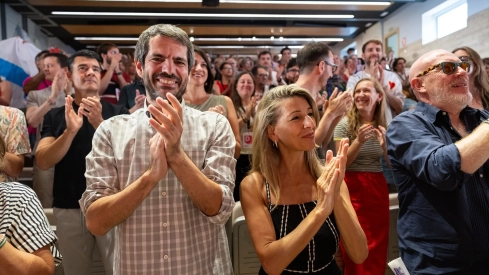
Ernest Urtasun has been in recent weeks at the center of the search for an alternative left candidate for the next general elections. Internal sources of Sumar consulted by 'ElConstitucional.es' place the Minister of Culture as the preferred profile at the moment to lead the unitary candidacy being prepared by Movimiento Sumar, Izquierda Unida, Más Madrid, and the Comuns.
The decision is not yet finalized, nor is there a formal announcement or a public acceptance from the minister. The involved leaderships want to preserve the process during August and expect to resolve in September both the name of the candidate and the brand that will replace or reformulate Sumar, after several postponements and months without a clear reference following Yolanda Díaz's step back.
Urtasun's name has gained strength as alternatives diminished. Pablo Bustinduy, the option that generated broader consensus among the different families, has on several occasions refused to head the list. Mónica García will focus on the Madrid elections, Ada Colau has ruled out returning to the front line, and the general secretary of CCOO, Unai Sordo, intends to finish his union mandate.
Verónica Martínez Barbero will also not be the candidate for the Presidency of the Government, according to the consulted sources. The new coordinator of Movimiento Sumar will maintain her role at the head of the party and as parliamentary spokesperson, but her name has been left out of the race to electorally succeed Díaz.
A favorite who still avoids presenting himself as a candidate
Urtasun has so far tried to stay out of any proclamation. In February, he stated that his role would be to accompany the chosen person, and during the press conference held this Monday with Antonio Maíllo, he again avoided a definitive answer.
"I am not going to enter into the game of confirmations and discards, because we have already done this too much in the past," he replied when asked about his possible candidacy. The phrase did not confirm any aspiration, although it also did not reproduce the categorical rejection that other names, placed in the pools in recent months, have expressed.
The minister added that his space has "a lot of people with the capacity to exercise leadership" and that he will be helping in every possible way. The prudence also responds to the strategy agreed upon between the four organizations, which want to avoid another succession of burned names before initiating a formal negotiation.
Antonio Maíllo has indicated that membership in one of the parties will not be a requirement. The objective will be to find who brings the greatest "potential" to the project, reflects its political proposal, and achieves a popular connection that the coalition currently does not have assured.
This openness allows for continued searching for profiles in civil society, but the progressive discarding of the main alternatives has ended up reinforcing an option that is already within the Government, knows the coalition, and participates in its two most relevant structures.
The bridge between the Comuns and Movimiento Sumar
One of Urtasun's main strengths lies in his dual political fit. The minister belongs to the leadership of the Comuns and has just also joined the new Coordinating Group of Movimiento Sumar, elected at the extraordinary assembly held this month.
This position allows him to represent at the same time a consolidated territorial organization and the party founded by Yolanda Díaz. Few leaders can build that bridge without being perceived exclusively as the candidate of only one of the four forces driving the process called 'A step forward'.
The Comuns have been participating for years in shared candidacies with Podemos, Izquierda Unida, and other formations. Movimiento Sumar, for its part, needs to demonstrate that it retains a relevant role in the new stage after losing Díaz as a candidate and going through several months of internal crisis.
Urtasun has remained within both organizations without starring in their most bitter confrontations. In the new leadership of Movimiento Sumar, he occupies a prominent position alongside Martínez Barbero and Rosa Martínez, while in Catalonia he regularly participates in the bodies and events of the Comuns.
His election would allow Movimiento Sumar to retain its own reference and would offer the Comuns the first state candidacy headed by one of its leaders. The formula must also have the approval of IU and Más Madrid, who reject building a project organized around a single party again.
A diplomat with a decade in Europe
Ernest Urtasun was born in Barcelona in 1982, studied Economics, and entered the diplomatic career through competitive examination. He worked as an advisor in the Ministry of Foreign Affairs and in the General Secretariat of the Union for the Mediterranean before fully transitioning to institutional politics.
Between 2014 and 2023, he was a Member of the European Parliament. There, he specialized in economic affairs, financial regulation, women's rights, and foreign policy, and came to hold a vice-presidency of The Greens-European Free Alliance group.
His career developed first within Iniciativa per Catalunya Verds and then in the Comuns space. The ecologist, federalist, and pro-European profile he built in Brussels fits with the ecosocialist laborism that Movimiento Sumar has adopted as its political definition for its new stage.
Yolanda Díaz chose him as spokesperson for her candidacy in 2023, and Pedro Sánchez appointed him Minister of Culture after the re-establishment of the coalition government. Since then, Urtasun has combined his portfolio with the functions of political spokesperson for Sumar, a role that has required him to intervene on housing, corruption, international politics, and negotiations with the PSOE.
His serene style and institutional experience are among the arguments used by those who defend his candidacy. Compared to the wear and tear suffered by other leaders, Urtasun maintains an image less exposed to internal clashes and has a continuous presence in the Council of Ministers.
One of the few ministers who approves in the CIS
The latest CIS barometer offers another piece of data that reinforces his position. Urtasun obtains an average rating of 5.02 points and is among the only three ministers who pass, along with Vice President Carlos Cuerpo and Pablo Bustinduy.
The score has limited value for measuring his electoral capacity. The study asks about his management as minister and does not present Urtasun as a candidate for the Presidency of the Government, so it does not allow knowing how many votes he could mobilize on his own. Even so, the rating is significant within a very worn-out Executive. The Minister of Culture surpasses leaders with much more notoriety and avoids the strong rejection accumulated by other cabinet members, a circumstance that can be useful when the alternative left seeks a face capable of broadening its base.
His main weakness appears precisely on the other side of that discretion. Urtasun lacks experience as a lead candidate in state elections so far and has never built a direct relationship with the electorate across Spain similar to that of Pablo Iglesias or Yolanda Díaz.
The campaign would have to make known the diplomat and MEP who exists behind the minister. It would also force to convert a negotiation and spokesperson profile into a leadership capable of disputing space with the PSOE, stopping demobilization and competing with a far-right that continues to grow in the polls.
The complicated reunion with Podemos
The roadmap handled by the consulted sources first involves closing the candidate and the new brand among the four organizations that are already working together. After that announcement, conversations would open with Podemos, which for the moment remains outside the process and maintains its own electoral strategy.
The purple party proclaimed Irene Montero as a candidate for the general elections in April 2025. The former minister has since defended an independent project and even maintained that Sumar should run with the PSOE because it is "closer to Pedro Sánchez than to Podemos".
A negotiation would force a review of a rupture that remains very present. Podemos abandoned Sumar's parliamentary group in December 2023 after months of clashes and still considers Montero's exclusion from that year's lists to be a political veto.
The purples would not accept their candidate being sidelined again as a condition for reaching an agreement, so any shared candidacy would have to recognize her a central role. This point may clash with a space that intends to enter the conversation with its own chosen lead candidate.
The eventual election of Urtasun would also not erase the differences. The minister was spokesperson for Sumar's candidacy in 2023, has defended remaining in Sánchez's government, and has criticized Podemos for some of its positions during the legislature.
The disagreement is political and strategic. Podemos believes that the left should maintain much greater autonomy from the PSOE, while Urtasun represents the experience of governing within the coalition and disputing partial advances from the ministries in housing, labor rights, culture, or social policies.
A left close to 10% and divided into two candidacies
The election arrives with the alternative left in a very delicate electoral situation. A simple average of the six national polls published between July 1 and 19 by Target Point, CIS, GESOP, Hamalgama, Sociométrica, and NC Report places Sumar around 6.3% and Podemos around 3.2%.
The arithmetic sum reaches approximately 9.6%, although this calculation does not represent a forecast of what a joint candidacy would obtain. Part of the electorate could be mobilized by unity, while another segment could abandon it if the agreement does not convince them.
The starting point is below the 2023 elections, when Sumar brought together Podemos and most of the territorial forces, achieved 12.3% of the votes, and won 31 deputies. The latest 'Target Point' poll now reduces Sumar to eight seats and Podemos to two if they run separately.
Seat estimates vary widely among pollsters, but the voting trend is much more stable. The candidacy that succeeds Sumar starts with about half the support achieved by Díaz, and Podemos moves around a quarter of that result.
The division exacerbates the problem due to the provincial functioning of the electoral system. In 2023, with more than three million votes, Sumar was already left without representation in the 29 constituencies that distributed between one and five deputies. Two lists competing for reduced percentages could lose practically all their votes outside Madrid, Barcelona, and a few large provinces.
September as the last opportunity to organize the space
The four organizations intend to take advantage of August to discreetly close conversations and arrive in September with a prepared proposal. In addition to the candidate, they will have to decide on the brand, the distribution of power, the mechanism for drawing up the lists, and the participation of territorial forces such as Compromís, Chunta Aragonesista, or Més.
IU has asked to accelerate because it believes that the lack of a reference prevents capitalizing on the progress made by the Government. Más Madrid wants to preserve its territorial autonomy, and the Comuns are simultaneously working to regain space in Catalonia, where they are seeking a broader alliance for the upcoming municipal elections.
Movimiento Sumar needs to demonstrate that it has overcome its internal crises and that it still has the capacity to articulate a state project. The election of Urtasun would offer a shared solution to several of these needs, but it would also concentrate on a little-tested leader the task of rebuilding a space that has lost votes, organization, and trust.
The minister will continue during the summer avoiding confirming a race that still depends on several directions. In September, the organizations will have to decide whether to turn his name into a formal proposal and, once that step is resolved, sit down with a Podemos that already has a candidate and that this time will not accept starting the negotiation by leaving Irene Montero out of the field.
