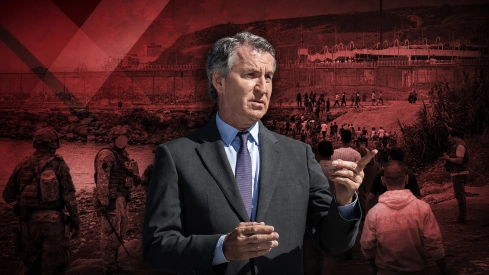
Alberto Núñez Feijóo presented this Friday six measures to respond to the migratory crisis in Ceuta and accused Pedro Sánchez of offering a late, improvised and insufficient reaction. The president of the Popular Party demands to activate the National Security Law, reinforce the border, deploy Frontex, organize returns to Morocco and reform the Immigration Law through a fast track.
The opposition leader has focused his criticism on the buoy system announced by Sánchez for the Tarajal breakwater. "A border is not secured by improvising buoys in the sea to fit a sentence," said Feijóo, who considers that the president "is not up to the task" of an emergency he describes as a sovereignty crisis.
His statement maintains that the Spanish border has been overwhelmed and that "Spanish territory is being occupied." Feijóo maintains a more institutional tone than other right-wing leaders, although he adopts part of the same framework used by the far-right Vox and by several popular officials who have defined the arrival of thousands of people as an "invasion."
Six measures against Sánchez's buoys
The PP's first proposal is to declare Ceuta as a situation of interest for National Security. Feijóo wants the mechanisms provided in the legal system to be activated and the National Police, the Civil Guard and the Armed Forces to be provided with the necessary means to regain control of the border.
The second point demands to accept Frontex's offer and deploy its rapid intervention units. The PP presents the Ceuta border as a shared responsibility of Spain and the European Union and accuses the Government of having taken too long to resort to the European Pact on Migration and Asylum.
Feijóo also asks to enable an extraordinary device to organize the return to Morocco of those who have entered irregularly. His proposal includes providing water and food during the process and raising conversations with Rabat to the highest political level.
Legislative reform constitutes the other central piece of his plan. The PP wants to convene an extraordinary plenary session of Congress and approve in a single reading the modification of the Immigration Law that it registered on July 16. The change aims to extend border rejection to people intercepted at sea when trying to access Ceuta or Melilla by swimming.
The fifth measure demands explanations about the information handled by intelligence services and authorities before the massive arrival. Feijóo believes that the lack of response to possible warnings should lead to political accountability. If these alerts never existed, he attributes the failure to the State's information system.
Estas son las decisiones que el presidente debería haber anunciado hoy en Ceuta y no ha tomado:https://t.co/TuY8UPaF9K pic.twitter.com/SAiijwQIyV
— Alberto Núñez Feijóo (@NunezFeijoo) July 31, 2026
The PP has also requested Sánchez's urgent appearance before Congress. Their group wants to convene the Permanent Deputation to call an extraordinary plenary session where the president would detail the measures adopted and explain the conversations held with Morocco.
What the National Security Law allows
The declaration requested by Feijóo is regulated in article 23 of the National Security Law. The figure would allow for strengthening coordination between administrations, appointing a functional authority, and mobilizing public or private human and material resources under the direction of the Government.
Its application corresponds directly to the president through a royal decree. The Executive would have to define the crisis, delimit the affected territory, set its duration, and immediately inform Congress of the decisions adopted, although the Chamber would lack the capacity to authorize or reject the declaration beforehand.
The law simultaneously establishes clear limits. The situation would be addressed with the ordinary powers of the administrations and would never allow the suspension of fundamental rights or public liberties. Nor would it, by itself, enable the immediate expulsions demanded by some popular leaders.
The Supreme Court confirmed on July 8 that current legislation prevents the application of 'hot returns' to those who try to reach Ceuta or Melilla by swimming and are intercepted at sea. The Chamber understood that the special regime provided for in the Immigration Law requires physically overcoming the border containment elements.
The reform registered by the PP seeks to change precisely that point, but it still has to go through the entire parliamentary process. Until it is approved, identifications, possible asylum applications, the protection of minors, and returns must comply with current regulations.
Tellado links the arrival to an already closed regularization
Miguel Tellado has taken the party's discourse beyond the program presented by Feijóo. The general secretary of the PP has directly linked the massive arrival with the extraordinary regularization approved by the Government, to which he attributes a supposed "pull effect".
"No one can be surprised that thousands of people want to enter a country that regularizes more than a million irregular immigrants overnight," Tellado wrote on 'X'. During an event in Oviedo, he also assured that the crisis is a consequence of "giving away papers for everyone".
The people who have now arrived in Ceuta are outside that procedure. The deadline for submission ended on June 30, and among its requirements were being in Spain before January 1, 2026, and proving at least five months of continuous stay.
The figure used by Tellado also far exceeds the official government estimates regarding potential beneficiaries. The causal relationship presented by the popular leader lacks support in the requirements and dates of the process itself.
Génova's number two has called for closing the border, massively reinforcing security forces, and applying Article 23 of the National Security Law. He has also demanded that Sánchez "leave and step aside" if he lacks the capacity to defend Spain.
From Juan Bravo's "invasion" to Ayuso's attacks
The deputy secretary of Economy of the PP, Juan Bravo, has repeatedly used the word "invasion" during his interventions from Ceuta. In 'Espejo Público' he recounted the closure of businesses, the fear of residents, and the difficulties of security forces to attend to a completely overwhelmed city.
Bravo has requested a thousand additional agents, including national police and civil guards, the temporary closure of the border, and the activation of security mechanisms. He has also asked for explanations regarding the Government's relationship with Rabat and the summoning of the Italian ambassador after the words of Giorgia Meloni's Executive.
Isabel Díaz Ayuso has further hardened the message. The Madrid president has accused Sánchez of allowing "the invasion of Spain through Ceuta" to hide his judicial procedures, a statement that attributes to the head of the Executive the will to facilitate a border crisis to alter the news agenda.
The invasion of Spain through Ceuta is further proof of Sánchez's left and Sánchez's far-left to destroy Spain
— MÁR (@marodriguezb) July 30, 2026
His Chief of Staff, Miguel Ángel Rodríguez, has presented the arrival as another proof of an alleged strategy by the left and the "far-left" to "destroy Spain". The message diverts responsibility from the specific management of the border to a general accusation against the entire political spectrum to the left.
Cayetana Álvarez de Toledo points to Morocco
Cayetana Álvarez de Toledo has placed the origin of the crisis in a possible pressure operation organized from Rabat. The deputy spokesperson for the PP has compared the situation to the Green March of 1975 and has described Sánchez as a "twilight caudillo" leading a "decomposing" government.
According to her approach, Morocco would be using the border to test how far Spain can yield. Álvarez de Toledo links migratory pressure with the government's change of position on Western Sahara and argues that the policy followed with Mohamed VI has conveyed an image of weakness.
The deputy demands to secure the perimeters of Ceuta and Melilla, reinforce the Police, the Civil Guard, and the Army, recall the Moroccan ambassador for consultations, and mobilize European partners. She also asks to suspend the extraordinary regularization, despite the fact that the deadline ended a month ago and its requirements exclude those who have entered during this crisis.
As in the Green March, Morocco takes advantage of the agony of a twilight caudillo to test our resistance.
— Cayetana Álvarez de Toledo (@cayetanaAT) July 31, 2026
What is happening in Ceuta is not a migratory crisis. It is a very serious sovereignty crisis.
Morocco uses pressure on our borders to exploit the…
Aznar's FAES has also held Morocco responsible and accused its authorities of allowing the massive entry. The foundation chaired by José María Aznar demands an Army presence and calls for the immediate departure of Fernando Grande-Marlaska and Elma Saiz for their management of the emergency.
Dolors Montserrat speaks of 20,000 "illegals" who have "invaded" Spain
The crisis has also opened a clash between the PP and the Government over Italy's response. Dolors Montserrat has reproached José Manuel Albares for summoning the Italian ambassador after Antonio Tajani proposed closing the Schengen area with Spain.
The vice-president of the European People's Party has accused the minister of confronting an allied country before reporting on the measures adopted in Ceuta. Her message uses particularly harsh language when speaking of "20,000 illegals who have invaded our country", an expression that reduces people to their administrative situation and directly adopts the xenophobic framework of invasion.
Montserrat has demanded that Albares end the "international scandal" and has stated that his incompetence is proving too costly. The PP maintains that the main diplomatic front should be in Morocco and calls for coordinating any response with European partners.
Es una vergüenza que el primer tuit del ministro de Exteriores de España en la crisis migratoria más grave de nuestra historia sea para confrontar con un país socio antes que explicar a los ciudadanos qué está haciendo para recuperar el control de nuestras fronteras y devolver a… https://t.co/BE3thzngyu
— Dolors Montserrat (@DolorsMM) July 30, 2026
Feijóo will travel this Saturday to Ceuta to personally verify the situation and defend his proposals from the autonomous city. His parliamentary group has already registered Sánchez's urgent appearance and expects the Permanent Deputation to open Congress in mid-summer.
Add ElConstitucional.es as a preferred Google source for free.
Stay informed about all the latest breaking news with the best information. Against disinformation, for democracy and social rights.
