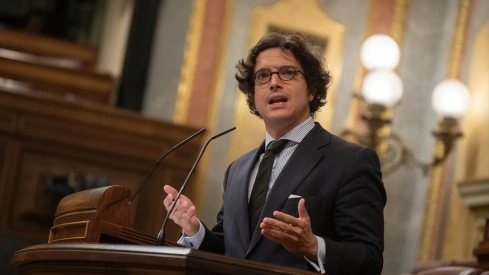
José María Figaredo, economic spokesperson for the far-right Vox, resorted this Sunday to alarmism to attack public pensions. "The pension system is a zombie. They have broken it," he stated in an interview in 'El Debate', in which he defended a reform to combine the current pay-as-you-go model with individual capitalization. His proposal would make a part of retirement dependent on the money accumulated by each worker and its performance.
The statements take on special relevance after the call for general elections for November 29 announced this Monday by the President of the Government, Pedro Sánchez. The interview was published before the announcement and places on the table one of Vox's economic priorities to change a system that sustains the income of millions of households.
Figaredo maintained that "in almost 30 years no corrective measure has been applied" to address the weaknesses of pensions. The statement omits reforms that have changed both benefits and their financing, including those approved in 2021 and 2023. The deputy questioned the system without specifying what guarantees future pensioners would retain with the model he proposes.
The reforms Figaredo omits
The Toledo Pact, the parliamentary agreement to guide pension reforms, was born in 1995. Since then, legislative changes and revisions of its recommendations have followed. Among the most recent, the 2021 law recovered the updating of pensions according to inflation, to protect their purchasing power, and modified the incentives and conditions for early and deferred retirement.
The 2023 reform strengthened income through additional contributions and a greater contribution from higher salaries. It included the gradual increase of the Intergenerational Equity Mechanism, the quota intended to strengthen the system in view of the retirement of the largest generations, and a solidarity contribution on salaries that exceed the maximum base. It also incorporated improvements for minimum pensions and to cover certain periods without contributions.
Financial challenges remain present. The Independent Authority for Fiscal Responsibility (AIReF) warned in May that compliance with the pension expenditure rule alone does not guarantee the sustainability of public accounts. In September, it reiterated that aging will pressure spending, which it projects to be above 16% of the gross domestic product in 2050. Its analyses call for medium-term planning and jointly examine revenues, expenditures, and debt.
This debate on financing affects a system that paid 10.55 million pensions to more than 9.5 million people in September, according to Social Security. The monthly payroll amounted to 14,498.2 million euros, and the average retirement pension stood at 1,576.1 euros. The figures dimension the scope of a reform that Figaredo presented with a declaration of bankruptcy, without explaining how he would finance the transition.
From distribution to individual savings
Currently, the contributions of those who work finance the benefits of those who already receive them, along with other public contributions. In individual capitalization, a part of the money is accumulated and invested for each person's retirement. The change means that this part of the benefit depends on what was contributed during working life and the returns obtained, a relevant difference for those with low salaries or interrupted work careers.
Vox already took this bet much further in its 2019 program. It proposed allocating half of the contributions to individual accounts managed by private companies, the so-called Pension Fund Administrators, and keeping the other half in the distribution system. The document reserved for the State the obligation to supplement benefits that did not reach a minimum pension. That formula expressly opened up the business of managing a part of the contributions to private entities.
The 2025 economic program introduced another formulation. It proposed capitalizing a public pension fund with private profitability criteria, moving towards a mixed system similar to the Swedish one, and exempting personal savings for retirement from taxes. Figaredo did not clarify in the interview what design he would apply now, who would administer the individual accounts, or what percentage would remain in the distribution system.
The cost of that transition remains unexplained. There would still be pensions to pay while part of the contributions were reserved for the future, an issue to which Figaredo does not put figures. His defense of the mixed model is based on the generic assertion that other European countries have successfully applied it, without identifying which ones or developing the comparison.
The attack on pensions is part of a broader discourse of state reduction. Figaredo stated that "the margin for cutting public spending is enormous" and defended eliminating subsidies over 100,000 euros annually to finance Vox's tax reform. The proposal he presented includes a tax-exempt minimum of 22,000 euros in income tax and two brackets, 15% up to 70,000 euros and 25% above that amount.
Regarding housing, the deputy again placed immigration at the center of his explanation and spoke of an "migratory invasion" and a process of "rapid and streamlined remigration". He included among his targets foreign individuals who, according to him, refuse to integrate or live off public subsidies. He also defended that the owner immediately recovers the property in the event of non-payment, breach of contract, or expiration of the term.
