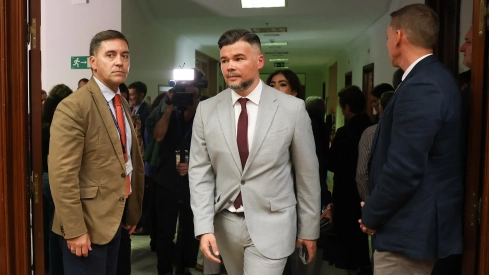
Gabriel Rufián this Wednesday positively assessed the labor reform promoted by the coalition government of Pedro Sánchez and Unidas Podemos, despite his party voting against it when it was approved in Congress in February 2022. The spokesperson for Esquerra Republicana de Catalunya (ERC), who at the time even called the norm "makeup", now maintains that "it was good" due to the evolution of employment.
"The labor reform was good, inasmuch as there are many people working, more than ever, but the labor market remains super precarious, it is still very cheap to dismiss people abusively," he stated at the doors of the Ateneo de Madrid, when asked about the general strike called for next November 11.
The republican leader assured that he will be "in favor of any labor demand" and insisted that there is still "a lot of precariousness." His words combine a favorable assessment of the norm with criticisms of problems that his party already pointed out in 2022, when it argued that the reform did not go far enough.
The newspaper archive, however, shows a contrast with the tone he used then. Rufián rejected the reform, questioned the Government's negotiation with employers, and criticized the second vice president and Minister of Labor, Yolanda Díaz, the main person responsible for an agreement reached with unions and employers.
From "makeup" to recognition
"The labor reform is not even a reform, it's makeup," Rufián said before the vote. ERC reproached the Executive for having closed the text with the Spanish Confederation of Business Organizations (CEOE) and the unions without later accepting the changes demanded by the republicans in the parliamentary negotiation.
Among their demands were higher severance pay, the recovery of processing wages, and more tools to curb employment regulation files that they considered abusive. They also demanded to strengthen the Labor Inspectorate and give prevalence to regional agreements.
Rufián directed part of his criticism at Yolanda Díaz, whom he accused of promoting a "personalist" project. "ERC does not negotiate or vote on personal projects," he warned. Already during the debate in Congress, he compared the norm with the one that, according to him, the then leader of Ciudadanos would have agreed upon. "The hard truth is that this reform is exactly what Albert Rivera would have negotiated and voted for had he been vice president," he stated.
On February 3, 2022, the 13 ERC deputies voted against validating the decree. The PP, Vox, PNV, EH Bildu, Junts, CUP, and BNG, among others, also did so. On the "yes" side were PSOE, Unidas Podemos, Ciudadanos, and other formations that allowed the Executive to gather a majority different from that of its investiture.
The vote was decided by a single vote difference, with 175 in favor and 174 against. The two deputies of Unión del Pueblo Navarro (UPN), whose party had agreed to support the reform, finally voted against it. The "yes" cast telematically by mistake by PP deputy Alberto Casero proved decisive for the norm to go ahead.
The reform, agreed between the Government, CCOO, UGT, and the business organizations CEOE and Cepyme, limited the use of temporary contracts, eliminated the contract for work and service, and strengthened indefinite hiring. It also recovered the extension of collective agreements while their renewal is negotiated and gave priority to the sectoral agreement over the company agreement in salary matters.
Temporality decreased sharply after its entry into force, although the debate on employment quality, working hours, and the use of permanent-discontinuous contracts remains open. The latest Active Population Survey from the National Institute of Statistics places employment at 22.85 million people in the third quarter of 2026, with 2.59 million unemployed people. The evolution of employment responds to several economic factors, in addition to legal changes.
Rufián's statements come in the midst of the pre-campaign for the general elections on November 29 and after the agreement reached between ERC and Podemos. The purples will not present their own candidacy in Catalonia and will support the republicans there, while Rufián will share events with Podemos candidate, Irene Montero, outside the community.
Montero was part of the coalition Government that approved that reform and Unidas Podemos voted in favor of validating it. Now, both formations defend a shared agenda focused on housing, wages, and labor rights, one week before the general strike called by CCOO, UGT, and other organizations.
