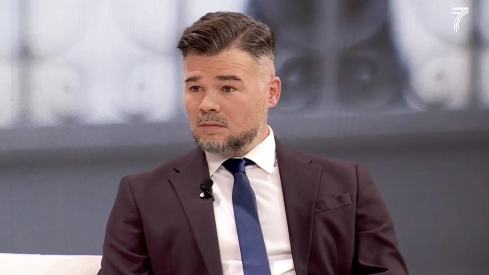
Gabriel Rufián has been the first guest of Sarah Santaolalla on the premiere of 'En Línea' on La Séptima. In an interview that covered current railway affairs and the electoral scenario, the ERC spokesperson recalled Óscar Puente's personal gesture that explains part of the closeness he showed towards the former minister after his resignation and has asked left-wing forces to leave behind reproaches and focus on the problems of citizens.
Santaolalla began by asking him about Puente's departure, announced this Tuesday at the end of his appearance in Congress on the Urda railway tragedy. Rufián acknowledged that the decision partly surprised him, although he believes that the minister's position had been compromised after the accidents in Urda and Adamuz.
"I believe he faced the music, which is much more than what other representatives, especially from the right, have done," he pointed out. At the same time, he maintained that Puente's situation was "unsustainable" after the two tragedies, in which 69 and 46 people died, respectively.
Gabriel Rufián y Óscar Puente: "Creo que ha dado la cara desde el momento uno, que es un buen político, pero su situación era insostenible". #LaSéptima pic.twitter.com/ttc6wjjNe0
— La Séptima TV (@la_septima_tv) November 5, 2026
The presenter later recovered one of the most commented moments of the appearance. Rufián was the first deputy to approach Puente after hearing his announcement and dedicated some words of support to him. Asked if he maintains that he was a great minister, the republican spokesperson stressed that "he has shown his face from minute one" and that he considers him "a good politician", even though he has assumed responsibility for what happened.
The story he kept about Puente
In La Séptima's first major interview, Rufián shared with Santaolalla a story that, as he explained, he had not told until now. The son of an ERC colleague had disappeared and the last time he had been seen was at a bus station in Catalonia. Faced with the family's concern, the deputy decided to call Puente, who had been in charge of Transport for a short time.
According to his account, the then minister spent that Sunday contacting station managers and transport services to try to locate the young man. Finally, he appeared in Madrid and was able to return by train to Catalonia.
"There is a human component that I think is good to remember," explained Rufián, who wanted to separate that personal memory from the political responsibility assumed by Puente. Santaolalla valued during the conversation that this human side is also recognized in those who occupy different political spaces.
The ERC spokesperson added that his gesture in Congress responded to a way of understanding politics. "I try to be normal," he said, before defending the importance of showing empathy and not limiting public interventions to repeating talking points.
The conversation also addressed the railway model. Rufián recalled that Renfe and Adif are public companies, although he criticized the outsourcing of part of the maintenance and the opening of passenger transport to competition. The deputy linked this model to a deterioration of safety; investigations into the causes of accidents will have to clarify the specific circumstances of each incident.
Disunity in the alternative left before 29N
Santaolalla also asked Rufián about the fragmentation of the left and his attempts to promote agreements before the general elections. The republican leader acknowledged that he would have liked a broader confluence, although he was proud of the pact reached between ERC and Podemos in Catalonia.
"In Catalonia there could have been three left-wing lists, there are only two," he defended, before admitting that he would have liked the agreement to also include the 'comunes'. Rufián regretted that a similar formula could not be extended to other territories, but asked to now concentrate efforts on the campaign.
The presenter asked him if it was inconsistent to demand unity and end up agreeing with only one left-wing force. Rufián replied that, in his opinion, the discussion between parties has occupied too much space and asked to talk about housing, taxes, corruption, security, and migration.
"If someone has to be scolded, blamed, okay, I'm to blame. From now on, let's get to work, please," he said, in one of the most expressive moments of the interview. He also assured that he never considered leaving ERC or replacing Yolanda Díaz at the head of another political space.
Regarding Santaolalla's questions about the criticism received from other parties, Rufián expressed his respect for Ada Colau and wished her "the best". At the same time, he defended that there must be an alternative to the left of the PSOE capable of demanding measures from it. "I want the PSOE to do well, but I don't work for the PSOE," he stated.
Regarding the result of 29N, the ERC spokesperson indicated that he aspires to re-establish a left-wing majority and called for a progressive vote. He also warned of the consequences that, in his opinion, a PP and Vox government would have for social rights. During the conversation, Santaolalla asked him about the difficulties shown by the polls to form that majority and about the electoral call, which Rufián again considered an "enormous irresponsibility".
The deputy defended that the campaign address issues that affect daily life, especially access to housing. "There are families in this country who live in rooms, that is a shame," he pointed out, demanding taxes on wealth and large profits.
The interview also left space for more personal questions. When asked by Santaolalla about the comments he receives about his way of dressing and his appearance, Rufián admitted that allusions to his body bother him and reflected on the aesthetic pressure that women suffer. "I ask people not to do it because it's not well received," he stated.
