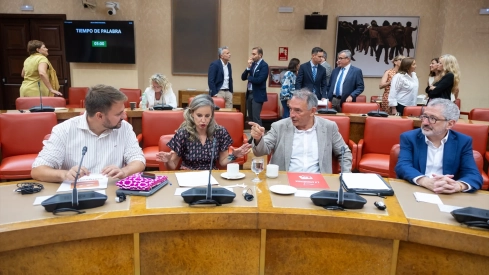
Sumar has decided to vote against the decree that regulates, for the first time in Spain, the activity of interest groups before the General State Administration. The minority partner of the Government has finally ruled out abstention and leaves the PSOE without the necessary support to save one of its main transparency measures.
The decision places Sumar in the same voting direction as the Popular Party, Junts, and the far-right Vox, although the four formations reach rejection for different reasons. Parliamentary arithmetic makes validation practically impossible and opens another confrontation within the coalition after several weeks of public discrepancies.
Royal Decree-Law 21/2026 was approved by the Council of Ministers on August 25 and came into force two days later. Like any decree-law, it needs the backing of Congress before 30 days have passed. If the Chamber confirms the rejection, the norm will lose its validity and the Government will have to recover the parliamentary route to try to push through the regulation.
Sumar denounces that it harms trade unions
The origin of the clash lies in the broad definition of interest group included in the text. The norm considers as such any person, company, association, platform, or network that tries to influence public officials and employees. Trade unions have been included within this framework because the decree only expressly excludes administrations, political parties, foreign authorities, and certain public law corporations.
Sumar considers that this wording equates collective bargaining and social dialogue with the ordinary activity of pressure groups. Sources from the formation describe the situation as "madness" and accuse the PSOE and the Ministry for Digital Transformation and Public Function of having avoided real negotiation before bringing the norm to the plenary session.
Comisiones Obreras (CCOO) and the Unión General de Trabajadores (UGT) had also requested the withdrawal of the decree. In a joint statement, the unions defined it as "nonsense" and warned that its content ignores the functions attributed to them by articles 7 and 28 of the Constitution, in addition to the right to collective bargaining recognized in article 37.
Minister Óscar López has denied that social dialogue will be subject to the obligations of 'lobbies'. His department offered to clarify through a subsequent regulatory development that meetings between the Government, unions, and employers would remain outside the register. Sumar considers this promise insufficient and demands that the exception be directly included in a law-ranking norm.
The rejection also serves the minority partner to express its discomfort with the working methods of the socialist wing of the Executive. The party maintains that it received a closed text and criticizes that the PSOE only sought agreements when the vote was already lost.
A public register that was already functioning
The decree created a state, public, and mandatory register managed by the Council for Transparency and Good Governance. Registered companies, associations, and platforms had to report on their identity, funding, representatives, objectives, and meetings held with senior officials or public employees.
The norm also required the publication of a regulatory footprint with the contributions made by each interest group and the changes introduced in laws or regulations as a result of these efforts. Former senior officials were prohibited from working for two years for entities that sought to influence matters related to their previous competencies.
The sanctioning regime contemplated fines of up to 40,000 euros, expulsion from the register, and a prohibition from re-registering for five years. Among the most serious infractions were offering favors, providing false information, pressuring a public official to violate the law, or engaging in influence activities without being registered.
The system had begun to function before the vote. The Council for Transparency has received more than 250 registration applications since the opening of the procedure. Its continuity now depends on a validation for which the Executive has lost one of its two partners.
The Government had also linked the norm to the fulfillment of the European milestone CID 432 of the Recovery Plan, which requires a law-ranking regulation on the relations between interest groups and the public sector. The PSOE has warned that its fall could complicate the arrival of community funds associated with that commitment.
The PP argues that Spain needs a 'lobbies' law, but rejects the use of the decree-law after what it describes as "572 days of neglect". Its spokesperson, Edurne Uriarte, has called for resuming the project sent to Congress in 2025 and has criticized the duplication of state and regional registries.
Junts has denounced that the Government did not incorporate its amendments and considers that the text benefits large companies over small organizations and citizens. Vox has presented the appeal against the decree as an attempt to act "behind the back of Parliament".
Óscar López has accused the PP and Vox of protecting "the business model of Montoro y Asociados", in reference to the firm linked to former Minister of Finance Cristóbal Montoro, investigated for his alleged influence peddling activity in favor of several companies. His offensive against the right, however, coexists with the rejection of Sumar and the country's two main unions.
The new clash comes after the PSOE abstained from Sumar's proposal to limit the purchase of homes by companies and investment funds. The disagreement over the expansion of El Prat airport has added another dispute this week. After the fall of the 'lobbies' decree, the regulation will have to return to the bill paralyzed in Congress and start another negotiation from scratch.
Add ElConstitucional.es as a preferred Google source for free.
Stay informed about all the latest breaking news with the best information. Against disinformation, for democracy and social rights.
