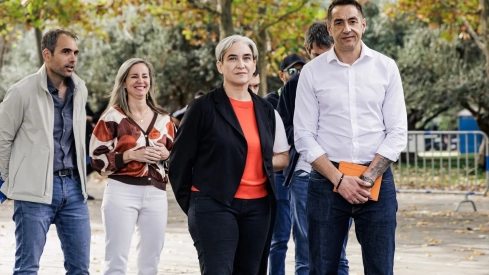
The list of the Broad Front for Madrid takes shape with a distribution among its main organizations. Emilio Delgado and Tesh Sidi will occupy the first two positions, Toni Valero the third, and Verónica Martínez Barbero the fourth, while the fifth is reserved for Más Madrid. The reorganization gives entry to the electoral referents of Izquierda Unida and Movimiento Sumar in a candidacy that will have to compete with Irene Montero's for the vote to the left of the PSOE.
The movement goes beyond Mónica García's departure, who this Tuesday confirmed that she will not run for Congress and will focus her candidacy on the Madrid regional elections in 2027. The minister has backed Sidi to replace her as number two. The planned distribution combines the territorial leadership of Más Madrid with the presence of its state partners, although the candidacies must still be presented to the electoral boards and more movements could occur before the deadline closes.
A list for three parties
The order has direct consequences for the weight of each organization in the future parliamentary group. With two deputies for Madrid, both would correspond to Más Madrid; a third would incorporate Izquierda Unida and the fourth would give representation to Movimiento Sumar. Barbero's position is thus linked to the coalition's ability to reach that fourth seat, while Más Madrid would re-enter the distribution with the fifth. These are representation scenarios, subject to the outcome of the polls.
For Valero and Barbero, the candidacy would also mean a change of constituency. The IU leader was elected deputy for Malaga in 2023 and Sumar's parliamentary spokesperson, for Pontevedra. Madrid distributes 38 seats this year, compared to eleven for Malaga and seven for Pontevedra. This difference offers more possibilities of representation to medium-sized candidacies, although it also requires gathering the necessary votes for each position.
Más Madrid retains the lead with Delgado and Sidi, but shares representation with its allies from the third position. Its regional implementation explains much of its negotiating capacity, although the strength of a party in the Madrid elections does not automatically translate to general elections. Candidates, adversaries, and voter priorities change. The Broad Front will need to attract both those who identify with Más Madrid and voters of IU, Sumar, and the entire space.
Sidi provides continuity with the outgoing legislature and a profile focused on human rights and digital transformation. Valero represents an organization with its own structure and trajectory; Barbero arrives with the experience of parliamentary spokesperson and his time at the head of the General Directorate of Labor. The four participated in Saturday's launch alongside Ada Colau, with interventions that anticipated a campaign focused on housing, wages, and public services.
Positions depend on votes
The 2023 reference helps measure the challenge. Sumar obtained six deputies for Madrid within a candidacy that also included Podemos. That representation belonged to a broader alliance than the current one and does not constitute a guaranteed floor for the Broad Front. The new ballot will have to dispute support with Montero, retain voters from its organizations, and mobilize those who have distanced themselves from the alternative left.
Madrid allows for competition that is much more difficult in small provinces. Its 38 deputies offer a more proportional distribution and facilitate the entry of forces with modest percentages. But the legal threshold of 3% does not equate to having a guaranteed seat, and each additional deputy depends on the relationship between the votes of all candidacies. Division can change the last seat even when both lists achieve representation.
The Madrid precedents also show that unity must be accompanied by the capacity to regain support. In November 2019, Unidas Podemos obtained five deputies and Más País-Equo, two; in 2023, Sumar brought that space together in the same candidacy and achieved six. The sum of organizations facilitates concentrating the vote, but the result depends on how many voters the project manages to gather, on participation, and on the strength of its competitors.
Outside of Madrid, the margin is narrower. Álava elects four deputies; Navarra, five; Gipuzkoa, six, and Bizkaia, eight. In 2016, Unidos Podemos obtained six representatives in Euskadi and two in Navarra, compared to the single seat that Sumar obtained between both territories in 2023, for Bizkaia. This setback combines loss of support and changes in political competition. Recovering representation requires studying each province, because an additional seat can be disputed by different parties and have different effects on the majority that can finally form a Government.
The break with Podemos continues in the campaign
The precedent of the 2024 Basque regional elections continues to weigh on the discussion. Sumar won one deputy and Podemos was left out of Parliament, after running separately; in Galicia, neither had achieved representation a few months earlier. These are different elections from the general ones, but they illustrate the risk of competing for a weakened electorate while other forces consolidate their presence. The division of candidacies adds to previous difficulties in leadership, organization, and connection with voters.
Podemos has meanwhile confirmed that it will have its own list in Madrid, with Irene Montero as number one and Tito Morano as second. Pablo Fernández rejected this Monday the possibility of integrating candidates from his party as independents in the candidacies of Aragon and the Balearic Islands. He also again blamed the Broad Front for the failure of the territorial agreements and reproached it for its pact with the PSOE for the Senate, while Colau's coalition maintains that the negotiation should have allowed a joint alliance.
On Saturday, in the Manzanares Linear Park, that rupture was present both in the speeches and in the huddles. Colau acknowledged the disappointment for not having brought together all the organizations and Delgado asked to change the focus. "The time for uniting parties is over. The time for uniting people begins," said the Madrid candidate. The distribution of the list now concretizes the balance between the partners who did reach an agreement, while the task of convincing the voters who demanded a broader candidacy remains pending.
Housing was the main ground chosen for that campaign. Colau demanded more ambition from the PSOE, Delgado defended indefinite rentals and greater investment in public housing, and Bustinduy called for mobilizing the working class. The lists must be submitted between October 21 and 26. Until that deadline, organizations retain room to complete names and adjust candidacies.
