
The migratory crisis in Ceuta has reopened an old rift between the left and Fernando Grande-Marlaska. Sumar, the minority partner in the Government, has demanded more reception resources and guarantees for minors and asylum seekers, while Podemos has increased pressure on the Interior Ministry and has called for the minister's resignation if the Executive continues to not respond to the situation.
The two formations agree on demanding immediate humanitarian attention, although they have chosen different political paths. Sumar pressures from within the Council of Ministers and focuses its position on respect for human rights. Podemos, outside the Executive, demands declaring a national emergency, reinforcing the State Security Forces and Corps, and sending doctors and health personnel.
Movimiento Sumar considers that the priority is to protect the lives of the people arriving in Ceuta and to reinforce the resources allocated to the reception and care of children. The formation also demands coordinated action between the central Government, the autonomous city, and the rest of the administrations involved.
Party sources have warned that there can be no returns of minors or people who may seek asylum. Sumar rejects the so-called 'hot returns' when they prevent examining each individual situation and recalls the judicial pronouncements that oblige respect for legal guarantees.
The formation also blames the European Union's migratory model, based on the externalization of border control to countries like Morocco. In their opinion, this dependence makes it easier for some governments to use migratory movements as a tool for political pressure. Their alternative involves opening legal and safe routes and establishing a real distribution of responsibilities among member states.
Podemos demands Marlaska's resignation
Podemos has launched a much more direct offensive against the Minister of the Interior. Its spokesperson, Pablo Fernández, has described it as "incomprehensible" that the Government rules out a national emergency when Ceuta lacks the capacity to attend to all the people who have crossed the border in recent days.
"It is unquestionable that Ceuta cannot cope with attending to all these people," Fernández stated on Cuatro's 'En boca de todos' program. The purple leader has requested more police officers and an urgent expansion of the humanitarian operation with doctors, health personnel, and specialized staff to attend to those who have arrived injured or are at risk.
Fernández has directly blamed Marlaska for the Executive's response. "If the Government is not attending to this emergency, it is reason for Marlaska to resign and for many more people to resign," warned the Podemos spokesperson.
MEP Irene Montero has placed the origin of the massive entries on the absence of legal channels to access Spain and the European Union. The purple leader has described European migratory policy as "totally criminal" and has argued that those who arrive in Ceuta assume these risks due to the seriousness of the situation in their countries of origin.
"We must understand that the only reasonable and respectful policy is to open legal and safe entry channels and treat people as people, not as if they were animals that we don't care if they die in the Mediterranean," Montero declared on TVE.
A dispute that comes from the previous coalition
Migration policy has caused continuous clashes between Marlaska and the PSOE's left-wing partners since the first coalition government. Unidas Podemos already questioned the returns made during the Ceuta crisis of May 2021 and demanded special protection for minors who had crossed from Morocco.
The confrontation reached its most serious moment after the Melilla fence tragedy of June 2022, in which at least 23 people died. Unidas Podemos demanded an independent investigation into police actions and Yolanda Díaz even stated months later that she would have made Marlaska resign over those events.
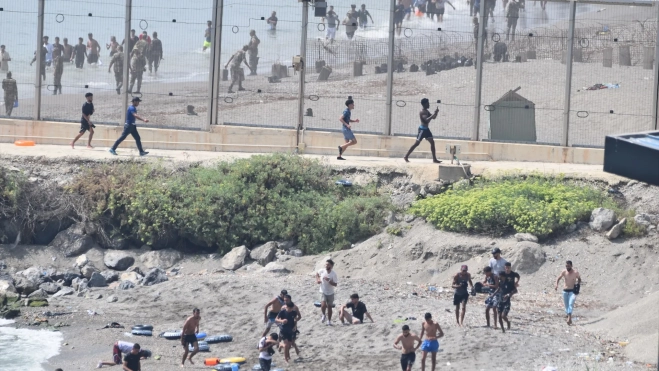
The reaction of Sumar and Podemos also contrasts with the agreement reached this Thursday by all parties represented in the Ceuta Assembly. PP, PSOE, Vox, MDyC and Ceuta Ya! have jointly requested the closure of Tarajal, the deployment of the Army and the declaration of a situation of interest for National Security.
The consensus includes both the PSOE and Ceuta Ya!, a party to the left of the local government. Podemos shares the request to declare an emergency and reinforce the presence of security forces, although it has not called for closing the border or deploying the Armed Forces. Sumar has distanced itself from that approach and has focused its response on reception, asylum, and child protection.
Marlaska will travel to Ceuta this Friday to meet with the city authorities and the commanders of the National Police and the Civil Guard. The minister will arrive with the pressure from the Ceuta Assembly, the criticism from Podemos, and the demands of his own government partner on the table.
Add ElConstitucional.es as a preferred Google source for free.
Stay informed about all the latest breaking news with the best information. Against disinformation, for democracy and social rights.
