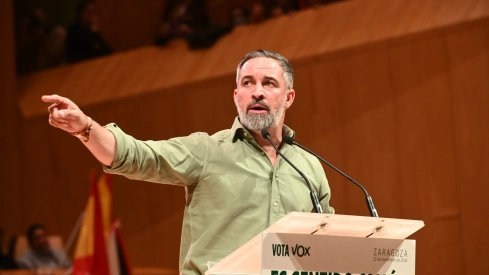
The far-right Vox intensified its accusations against the electoral process of November 29 this Monday, with the external vote as the main target. Santiago Abascal has assured that Pedro Sánchez will try to alter the elections and that, if he fails, he will seek to challenge them. Jorge Buxadé has accused the president of having been determined for years to "steal the elections" and has announced new demands for control over consulates. None of these statements have provided evidence to support a plan to manipulate the result.
Abascal has extended his suspicions to the entire last week of the campaign, the voting day, and the counting of votes from Spaniards residing abroad. "I am absolutely convinced," he stated in Segovia, before attributing to the head of the Executive "any type of trick that we cannot yet foresee." He then added that, "if the tricks don't work out for him, he will try to challenge the electoral process."
The ultra leader used Sánchez's interview on 'Salvados', broadcast this Sunday, as an argument, in which the president expressed his confidence in a PSOE victory. Abascal has demanded that he explain what data he is handling and has insinuated that his certainty comes from knowing how the new naturalized voters under the 'grandchildren's law' have been distributed among the different provinces. This insinuation attributes an electoral maneuver to a campaign statement, without identifying a specific action that demonstrates it.
"Sánchez has an attitude that scares the devil," added Abascal, who called for "a gigantic mobilization" against alleged "tricks, intimidation, and violence." He also presented the elections as a possible last opportunity to leave behind what he calls "the mafia, corruption, ideological fanaticism" and has again criminalized immigration by linking it to a supposed invasion "that ruins and kills."
In parallel, Buxadé announced in Córdoba that Vox has submitted a written request to the Central Electoral Board (JEC) to demand daily participation data from all consulates, both for in-person deposits and votes received by mail. The head of the ultra delegation in the European Parliament says he intends to "guarantee vote traceability" and prevent "a lot of votes from suddenly appearing on the last day."
Buxadé has justified this request due to "the fear that has taken hold of a large part of the population regarding the eventual possibility of fraud". He has also accused the Government of hiding the data from the Center for Sociological Research (CIS) and the daily figures for postal votes. The leader has grouped these statements under the expression "Sánchez's fraudulent strategy," without documenting in his appearance how they would prove an alteration of the ballots or the scrutiny.
Buxadé threatens consuls while using consulate boxes to fuel suspicions
The MEP has accused the Government of failing to comply with the resolutions of the Supreme Court and has pointed to the use of "cardboard ballot boxes". "Any consul who carries out actions against the law and against the Supreme Court will face the corresponding complaint," he warned, demanding officials who comply with judicial resolutions and who, in his words, are not at Sánchez's service.
The controversy affects the execution of the precautionary suspension of the vote of a group of naturalized citizens under the 'grandchildren law'. The Supreme Court has ordered the exclusion of those affected who do not prove the required conditions and last Friday specified that the measure also applies to those residing in Spain. The suspension does not affect all Spaniards abroad nor all those naturalized by this means.
The procedure ordered by the court allows the electoral documentation of those affected to be received, but requires it to be kept separate and outside the ballot box of authorized voters. The Ministry of Foreign Affairs maintains that this collection is carried out in differentiated and labeled boxes to comply with the resolution. The existence of these containers does not prove that their envelopes are incorporated into the count; the obligations of separation and custody remain enforceable throughout the process.
The counting of external votes corresponds to the electoral boards and allows for party control
Abascal's accusations present the scrutiny as an operation that Sánchez could decide by himself. The law establishes that the vote of absent residents is scrutinized by the competent electoral board, constituted as a polling station and with the representatives designated by the candidacies. The general scrutiny begins on the fifth day after the elections, so the incorporation of external votes after election night is part of the planned calendar.
Article 75 of the Organic Law of the General Electoral Regime regulates the custody of consular ballot boxes, their sealing at the end of each day, and the preparation of the minutes. The sealing, the counting of the envelopes, and the preparation of the consular minutes are public. Candidacies can supervise the procedure and submit the claims provided for in the law; the results disseminated by the Government on election night are provisional.
Buxadé has also questioned that people who have never resided in provinces like Córdoba vote there. However, not having previously lived in Spain does not in itself prevent being part of the external census. The regulations contemplate registration in the municipality of greatest personal roots or those of ancestors and, in the foreseen cases, its ex officio determination by the consular office, with criteria that the JEC has required to specify and justify.
Contact
We are listening. Get in touch.
