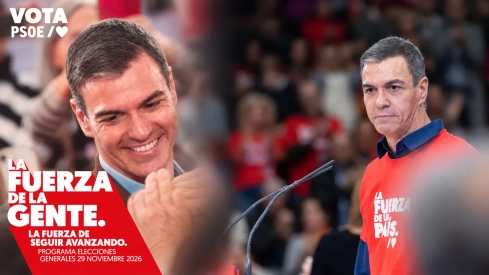
Pedro Sánchez wants large property owners to pay more for keeping homes empty, dedicating them to tourist rentals, or renting them at abusive prices. The President of the Government highlighted this tax this Sunday in Alcorcón, where he presented the PSOE program for the general elections on November 29. Before 5,500 people, according to the party, he also announced four weeks of paid parental leave and defended incorporating the revaluation of pensions and the right to abortion into the Constitution.
The document brings together 500 commitments and places housing as the first priority of the legislature. Along with the new tax, it proposes that rental contracts last longer and temporarily freeze rents above reference indices in stressed markets. The program revives measures that were pending in the coalition with Sumar, such as the reduction of working hours, and sets an unemployment target of 8% by 2030. The latest Active Population Survey places it at 10.18%.
A state park of 100,000 homes and a tax on large holders
The main figure of the program is to mobilize 1% of the gross domestic product each year to guarantee access to housing, with the participation of public administrations and the Official Credit Institute (ICO). The PSOE wants the public company CASA 47 to gather a state park of 100,000 homes through construction and purchase, to sell or rent them at affordable prices. To this, it adds a fund that would be nourished by 1% of the annual public works tender and a line of more than 25,000 million in guarantees, loans, and financing through the ICO. The size of the challenge is evident in the data from the Bank of Spain: between 2021 and 2025, about 750,000 fewer homes were completed than households created.
The new tax would progressively tax the ownership of homes that funds and large owners keep empty, dedicate to tourism, or rent at abusive prices. Sánchez has argued that this would bring more affordable residential rental apartments to the market. The program leaves the tax rates and how abusive rents would be determined unspecified. It would also enable municipalities that wish to do so to tax overnight stays in tourist apartments and proposes a tax on idle residential land.
For tenants, the PSOE proposes to extend contracts and temporarily freeze rents that exceed reference indices in stressed markets. The duration of new contracts and the term of this freeze remain open. The Ministry of Housing would draw up a map of stressed areas and a register of contract prices. Socialists also want to offer public default insurance to facilitate renting for young people and deploy an intermediation service that guarantees small landlords the collection of rent in exchange for putting an empty home up for affordable rent.
The PSOE aims to give stable character to the protection against evictions of vulnerable households without housing alternatives and for the cost to be assumed by administrations when the landlord is a small owner. Congress already validated the decree on Thursday that protects against certain evictions and limits certain purchases by large holders, while repealing the separate decree on rental extensions. In the chapter on Justice, socialists also set a maximum of three months for trials for dismissal and eviction and propose evictions of occupied homes within 48 hours, relying on the fast-track trials already underway.
37.5-hour workday, four weeks of parental leave, and public dentist
The maximum 37.5-hour workweek without salary loss returns to the program after PP, Vox, and Junts overturned its processing in Congress in September 2025. The PSOE proposes to agree with social agents on the calendar and transition periods and to leave advances towards 35 hours to collective bargaining. It also wants to legally establish a minimum wage higher than 60% of the average wage, implement a digital time registration, and reform compensation for unfair dismissal to take into account the damages caused. For the self-employed, Sánchez has advocated for continuing to advance in contributions based on real income.
Social Security would pay four weeks of parental leave to care for children under eight years old, at 100% of the regulatory base. This is the specific parental leave, different from birth and care leave, which was extended to 19 weeks per parent in 2025, with two of them usable until the child turns eight. The program adds one week to the second parent if both enjoy their birth and care leaves without overlapping them. It also proposes that interns have the right to unemployment protection and that sick leave for oncological processes be covered at 75% of the regulatory base from the first day.
The program incorporates a child-rearing benefit for all households with minors, a measure that Sumar already defended during the legislature. The text establishes a reinforcement for low incomes, although it leaves the amount open. It also proposes depositing 1,000 euros at birth into a public account that could be used from the age of 18 to study or finance one's own project. The PSOE links part of the financing of the child-rearing aid to higher taxation of large fortunes and capital income, whose maximum rate would rise to 35% above 300,000 euros. It also proposes doubling the tax on financial transactions and increasing the taxation of large technology companies and listed companies with larger internal wage gaps.
In healthcare, Sánchez wants to incorporate basic dental treatments for adults into the public system, such as fillings and root canals, with a transitional aid of up to 200 euros per person per year that would start with middle and low-income households. The PSOE also commits to guaranteeing a first free psychological consultation within a maximum of 30 days and to giving preference to the direct management of health services. The deadline for psychology would require reinforcing staff, especially in primary care, as the program itself recognizes.
The expansion of public services also involves universalizing education from zero to three years, promoting free enrollment in the first year of university, and increasing public vocational training places. The program foresees a social services law with a common portfolio agreed upon with the communities and more home support for dependent people. To finance regional services, it revives the proposal to contribute nearly 21,000 million additional euros with a new model and for the State to assume about 83,000 million in regional debt. Both initiatives were pending due to the early election.
Shielding abortion and pensions, voting at 16, and strengthening railway safety
"We are going to enshrine in the Constitution the revaluation of pensions and women's right to abortion," Sánchez announced in Alcorcón. The update of contributory pensions with the consumer price index is already recognized by law. For abortion, the PSOE wants to resume the reform of article 43 that lapsed with the dissolution of the Cortes and whose approval would, in principle, require three-fifths in each Chamber. The document also proposes strengthening the legal protection of equal marriage and euthanasia and resuming the penal reform against so-called conversion therapies.
Another novelty that Sánchez has presented is the "union of friendship," a figure that the PSOE wants to introduce in the Civil Code to protect those who commit to caring for each other without being partners or relatives. The program leaves the specific benefits for legal development. In participation, it proposes lowering the voting age to 16 and creating a non-voting citizen seat in Congress and the Senate to ask questions and present initiatives. That same age, 16, would be the minimum for using social networks, with a public verification tool that would avoid handing over data to platforms.
The institutional agenda includes an Independent Public Integrity Agency, a mandatory lobbyist registry, and a new public safety law to replace the 2015 one. The PSOE wants to give the Attorney General's Office a five-year mandate detached from the legislative term and for prosecutors to lead criminal investigations under judicial supervision. It also proposes completing the exhumation plan for victims of Francoism, criminalizing the creation and dissemination of sexual fakes generated with artificial intelligence, and deploying an integration plan for migrants initially endowed with 500 million, with more legal avenues for asylum and humanitarian visas.
In energy, the socialists maintain the nuclear shutdown schedule until 2035 and set renewable electricity generation at 81% by 2030. They propose strengthening grids, storage, and self-consumption, modernizing irrigation without increasing total water consumption, and creating a fund against the effects of climate change. The industrial commitment includes raising public investment in research and development to 1.25% of GDP and strengthening semiconductor production. In foreign policy, they advocate reducing unanimous blockades in the European Union, sustaining support for Ukraine, and promoting European sanctions against those who hinder the two-state solution in Israel and Palestine.
Following the accidents in Adamuz and Urda, the PSOE proposes a State pact for railway safety and victim assistance. The program includes about 19,000 million euros until 2030 linked to agreements with Adif and Adif Alta Velocidad, and commits to publishing annually how much has been executed and the state of the network. The pact would start with an audit that a technical commission would have to prepare in two months. The socialists also want to process as law the decree approved on November 10, which strengthens the inspection powers of the State Railway Safety Agency.
Contact
We are listening. Get in touch.
