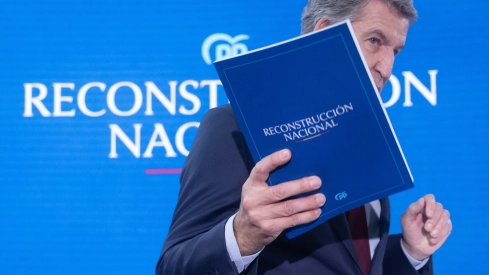
The program with which Alberto Núñez Feijóo aspires to govern after November 29 sets far-reaching objectives and postpones several decisions that would determine its impact. The PP promises to build one million homes, add 4,500 Primary Care doctors, and mobilize more than 300,000 million euros in infrastructure. It also wants to repeal the Housing Law and prioritize certain aid for those who prove their roots in Spain. The document gathers 249 numbered points on 82 pages. Eight are reserved for the campaign, and the whole lacks an economic report that allows calculating the cost of the measures.
The margin to apply it will depend on the support the PP gathers in Congress. 40dB. places the popular party at 131 seats and the far-right Vox at 61, a total of 192, 16 above the absolute majority. Sigma Dos projects between 131 and 137 deputies for the PP and between 62 and 70 for Vox. Both polls draw a clear path for Feijóo's investiture through an agreement with Abascal. It remains to be seen whether that support would translate into a coalition or an agreement from outside the Government. Feijóo advocates governing alone and has avoided closing the door to the first option.
One million homes and a shift in rent with the repeal of the law
The PP wants to accelerate construction with a new Land Law, mobilize public and private land, and resolve building permits in three months. It also proposes transforming offices and premises into homes, financing land urbanization, and promoting industrialized construction. The scale of the objective is appreciated when compared to the 51,406 homes completed in Spain in the first half of 2026. Completing one million in four years would require an average of 250,000 per year, nearly two and a half times the pace of the first half. The program promises to publish initiated and completed homes but lacks annual goals and its own figure for public rental within that million.
For those who already live in rented accommodation, the most immediate change proposed by the PP is legislative. It wants to abolish regulated areas and the reference index applied to certain contracts. Instead, it proposes an income tax deduction for tenants based on their income and tax advantages for private landlords who, upon contract expiration, renew it for three years with an increase below the CPI. The effect of this second measure would depend on how many landlords agree to accept it. The text also does not clarify what transitional regime would apply to contracts subject to current limits.
The greatest fiscal effort in housing is directed at purchase. The PP proposes to reduce the VAT on the first new home for those under 40 from 10% to 4% and allow its fractional payment. It also offers a savings account with a deduction and expands the public guarantee to facilitate the down payment of the mortgage. These are measures that can help those who have income to face the installment but lack savings. For households that still cannot finance a purchase, relief would depend on the rental deduction and the affordable supply that gets built.
Outside of housing, Feijóo proposes to update income tax with inflation, reduce it for low and middle incomes, and grant workers and self-employed individuals aged 18 to 35 a reduction that would start at 100% during their first year of taxation and decrease in the following three. He also proposes a 0% VAT for basic foodstuffs, including meat and fish, as long as the loss of purchasing power persists. The document also does not quantify the loss of income or the savings it expects to obtain with the reduction of ministries, the review of subsidies, and the fight against fraud. The audit of the first hundred days would serve to prepare the first budgets, when these promises would have to be translated into figures.
In the labor chapter, the program foresees that the personal income tax (IRPF) threshold will rise with the minimum wage, although it does not specify how much the minimum wage itself should increase nor does it propose a general reduction of working hours. For sick leave, it combines coverage of up to 100% of the regulatory base in serious and prolonged illnesses with a greater role for mutual insurance companies and rewards for companies that best manage temporary disability. The text leaves pending how this management would be measured. Feijóo also announced at the presentation an activation income that would group the minimum vital income and various subsidies, compatible with working from day one.
The PP includes in its program priority for rootedness and opens up the loss of nationality for serious crimes
Measure 98 establishes that the link with Spain will give priority in access to certain aid, benefits, and public resources. The PP cites registration, years of contributions, time of residence, and contribution to the system, but does not specify which benefits would be affected, how many years would be required, or what weight each criterion would have. The formula approaches the "national priority" defended by the far-right Vox, with an express difference in the PP's text, which prevents using nationality as the sole criterion. The scope of this caution would depend on how the norm is drafted and who it practically excludes.
The closest precedent is in the Valencian Community. This very Tuesday, the Council of Ministers has taken the step to appeal before the Constitutional Court 20 precepts of the autonomous law approved by PP and Vox, including those related to access to housing. The Executive perceives an equality problem in the rootedness requirements. The Valencian appeal refers to a specific law and does not resolve in advance what would happen with a state regulation, whose content is yet to be defined.
In immigration, the PP proposes annual hiring quotas by sector, point-based visas, and temporary permits to seek employment. The program itself admits that construction might need workers hired at origin to meet its objectives. At the same time, it toughens the other path to the labor market, that of those who already live in Spain without authorization, by proposing that rootedness be exceptional and prohibiting regularizations it describes as massive. For unaccompanied migrant minors, it wants to replace the distribution among communities as the main response with a system of individualized protection that facilitates return, with alternative mechanisms to accredit reception guarantees.
The most far-reaching change appears in the future Nationality Law. Feijóo wants to require, among other requirements, being up to date with the Treasury and Social Security. He also proposes that those who are not Spanish by origin may lose their nationality after a firm conviction for certain serious crimes, avoiding statelessness. The Civil Code already provides for causes of loss for those who have acquired nationality, but a conviction for these crimes is not among them. If the measure implied also losing EU citizenship, European jurisprudence on the individual examination of the consequences would come into play.
The program also proposes to prohibit the burqa and niqab in public spaces, eliminate the free self-determination of sex registration, and count the conceived but unborn to determine family aid. The measure on registration represents a change from the current law, which allows people aged 16 and over to request rectification themselves and establishes specific procedures for minors. The PP does include measures against trafficking and forced marriages and plans to strengthen the protection of victims of gender violence. In the published document, it does not announce a repeal of the abortion law or the euthanasia law, although it does propose a national palliative care law.
Two extensions and elections, more power for judges, and a fifteen-year investment plan
Feijóo proposes that a second consecutive extension of the Budgets obliges the dissolution of the Cortes and the calling of elections. The Constitution currently establishes the automatic extension of the previous accounts when the new ones are not approved at the beginning of the fiscal year. The program promises to promote the necessary reforms to introduce this limit, but leaves unspecified how it would do so. It does specify another obligation that would affect any negotiation after November 29, which is to fully publish investiture pacts and parliamentary support agreements.
In Justice, the PP wants judges to elect the twelve judicial members of the General Council of the Judiciary and for the attorney general to have a single five-year term, detached from the Government that proposed him. In this latter case, it incorporates two relevant conditions: a binding report from the Council for appointment and automatic dismissal if the attorney general is prosecuted. It also proposes that candidates for the Constitutional Court must have been out of political office for five years. Along with these reforms, the PP commits to repealing the Amnesty and Democratic Memory laws, replacing the latter with a law of concord, and reforming RTVE and EFE in the first hundred days, without specifying in the program how their managements would be chosen.
The territorial chapter promises more resources for all communities, a transitional equalization fund, and a multilateral negotiation of the new financing system. The PP rejects new singular regimes negotiated bilaterally outside the common system. Part of its commitments in health and education would depend on this agreement. Incorporating at least 4,500 Primary Care doctors requires coordinating hirings with the autonomous communities, and free early childhood education from zero to three years is proposed with 50% funding between the State and the communities. Regarding pensions, Feijóo commits to maintaining revaluation with the CPI, a guarantee already included in current legislation.
The largest figure of the program, more than 300,000 million euros for infrastructure, is projected over fifteen years and combines public and private resources. The PP promises to prioritize maintenance and review the temporary speed limits of the railway network. It remains to be seen what part of that investment would be executed in the first four years and how much the State would assume. The calendar is more concrete in energy. In one hundred days, the PP wants to begin the process to extend the life of Almaraz, Ascó, Vandellós, Cofrentes, and Trillo, with the approval of the Nuclear Safety Council. It maintains decarbonization as an objective and announces a review of the energy and climate plan.
In foreign policy, the PP maintains military, economic, and humanitarian support for Ukraine and commits to submitting international defense commitments to the Cortes, without setting a percentage of military spending on GDP in these pages. For Gaza, it calls for the protection of the civilian population and a diplomatic solution with Israel and Arab countries. Regarding Western Sahara, it promises to support the efforts of the United Nations for a solution acceptable to the parties and to return to a policy of balance between Morocco and Algeria, without specifying whether it would reverse the Sánchez government's support for the Moroccan autonomy plan.
Contact
We are listening. Get in touch.
