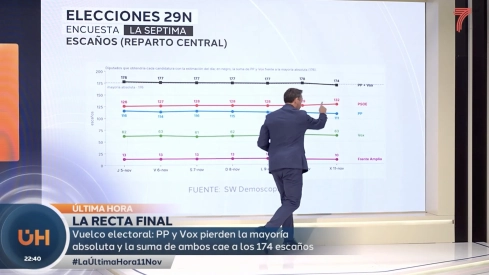
The PSOE extends its electoral advantage in La Séptima's daily poll and, for the first time since the series began, the PP and the far-right Vox fall below an absolute majority in their central estimate. The SW Demoscopia survey, which Javier Ruiz presented this Wednesday night on 'La Recta Final' of 'La Última Hora', places the socialists at 31.4% of the votes and 132 seats. The PP would obtain 28.1% and 111 deputies, while Vox would remain at 17.5% and 63. Together, they would add up to 174, two short of the 176 that mark an absolute majority in Congress.
The day before, the same poll gave 129 deputies to the PSOE, 113 to the PP, and 65 to Vox. In one day, the socialists have gained two tenths in the vote estimate and the PP has lost another two, thus widening the gap between them from 2.9 to 3.3 points. Vox's far-right maintains its percentage but loses two seats in the projection. The sum of the right thus goes from 178 to 174, although Santiago Abascal's party would still be close to doubling the 33 deputies it obtained in the 2023 general elections.
Vuelco electoral: PP y Vox pierden la mayoría absoluta. La Recta Final. #LaÚltimaHora11nov pic.twitter.com/9RVEd254Bf
— La Séptima TV (@la_septima_tv) November 11, 2026
The turnaround was announced on the night of the general strike for housing and wages, with thousands of people in the streets of Madrid, Barcelona, and Valencia. Ruiz has linked the socialist advance to the mobilization of recent days, although the 6,500 telephone interviews for the survey were conducted between October 26 and Tuesday, November 10, before the 11N marches. The series incorporates 500 new interviews per day since November 5 and maintains the previous ones. The margin of error of 1.2 points corresponds to the entire sample, so the daily advance of two tenths is still too small to measure a change in trend.
Four seats can change sides with small movements because the distribution is decided province by province. SW Demoscopia estimates that in 23 of the 52 constituencies the last deputy is disputed by less than one point. In Zaragoza and Albacete, the difference between the PSOE and the PP for that seat would be less than a thousand votes in both cases. In Madrid, however, the last deputy would be disputed by the PSOE and the Broad Front. In the simulations incorporated in the study to reflect the uncertainty of the sample, PP and Vox reach 176 seats in 34% of cases.
For Feijóo, the first count goes through Navarra. The 111 seats that the survey attributes to the PP are published separately from the two that the joint candidacy of the popular party and Unión del Pueblo Navarro (UPN) would obtain. With the support of both deputies, PP and Vox would reach exactly 176. The Coalición Canaria seat would raise that figure to 177. The Navarrese electoral agreement already designates Feijóo as a candidate for the Presidency, although it reserves UPN voting autonomy in Congress. In the Canary Islands, the regional president, Fernando Clavijo, has ruled out governing with the far-right Vox.
For Pedro Sánchez, the first place also does not resolve the investiture. The Broad Front drops one tenth, to 7.4%, and loses one deputy, leaving it with ten. The PSOE and that candidacy would add up to 142 seats. The broadest combination studied by SW Demoscopia for Sánchez, which includes, among others, Esquerra Republicana, EH Bildu, the PNV, Coalición Canaria, and Junts, would reach 174. In a second vote, 48 hours after the first, more votes in favor than against would suffice, so abstentions would also enter into the negotiation.
The PSOE's rebound also appears in other studies this week, with a different distribution. The 40dB. survey for 'El País' and Cadena SER, published on Monday, placed the socialists at 29.9%, two points behind the PP, and gave more than 190 seats to PP, Vox, and UPN. The Ateneo del Dato poll for 'elDiario.es' also showed an improvement for the PSOE, up to 28.6%, with the PP in the lead and an absolute majority together with Vox. Both fieldworks closed in the first week of November, in the days after the resignation of the Minister of Transport, Óscar Puente, after the Urda railway accident.
This Thursday, the day after the strike and a few hours before the official start of the campaign, housing returns to Congress. The Permanent Deputation will vote on the two government decrees on rents. The PNV has announced its support for the one that allows certain contracts to be extended for up to two years and protects vulnerable households without housing alternatives from eviction. The second, which includes compensation for tenants in certain cases of non-renewal of the contract, still lacks sufficient support. The 29N campaign begins this midnight.
Contact
We are listening. Get in touch.
