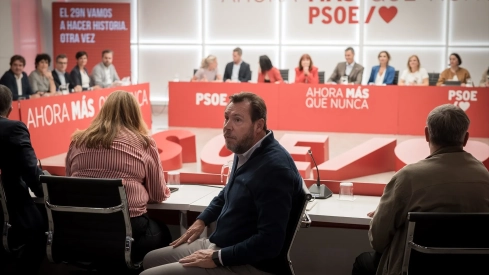
The resignation of Óscar Puente has given the PSOE a response to the political crisis that threatened to absorb its entire pre-campaign. Socialist officials consulted by 'Europa Press' receive the minister's departure with relief and hope that it will allow them to regain ground ahead of the November 29 elections. They agree that responsibilities had to be assumed after the railway tragedies of Adamuz and Urda and find in the decision an argument to address their electorate again.
Pedro Sánchez had already anticipated the message in his farewell to the former minister. "Not all of us are the same," the President of the Government wrote after thanking Puente for having given explanations and decided to step aside. This comparison with the PP's conduct in the face of other catastrophes begins to order the discourse of a party that needs to recompose its campaign, change its tone, and respond to the deterioration of confidence in public management.
The concern has an electoral background. As 'ElConstitucional.es' reported this Wednesday, internal PSOE sources acknowledge that the tracking polls managed by the party offer unfavorable prospects after the Urda accident. This information helps to understand the socialist concern, although by itself it does not prove that the polls determined Puente's decision.
The former minister and La Moncloa maintain that Sánchez learned of his resignation minutes before he announced it at the end of his appearance in Congress. Some of the officials consulted doubt this version and believe that the departure had been agreed upon. This is an internal interpretation that contradicts the official narrative, without these sources providing elements to resolve the discrepancy.
There is indeed agreement on the need to assume responsibilities and on the recognition of the method chosen by Puente. The consulted leaders highlight his presence during the emergency, the public explanations, and the more than four-hour appearance before the Permanent Deputation. A socialist deputy believes that resigning was "the best decision he has made", while a member of the Executive maintains that he acted "with political honesty and attending to people's pain".
The polls portray the previous wear and tear
The dimension of the problem appears in the Sigma Dos poll for El Mundo, conducted through 2,505 interviews between October 29 and 30, after the Urda accident. The estimate places the PSOE at 24.6% of the vote and between 97 and 103 deputies, compared to 31.1% for the PP, with between 133 and 139 seats, and 19.3% for the far-right Vox, with between 63 and 69.
For the socialists, this represents a drop of 1.5 points compared to the previous measurement by that company, which gave them 26.1%. The distance with the PP thus widens from 4.5 to 6.5 points. The ranges for the popular party and the far-right draw a comfortable majority above the 176 deputies needed for an investiture in the first vote.
The reading requires attention to the dates. That fieldwork ended four days before Puente resigned, so it describes the scenario that preceded his departure. It does not yet allow knowing whether the replacement will stop the loss of support, mobilize discouraged voters, or have a limited effect on those who had already decided to change their option.
The political consultant and former director of Sánchez's Cabinet, Iván Redondo, warned this Tuesday on RNE, before the resignation, that the tragedy had altered the electoral scenario. "The campaign that is being told is absolutely suspended," he stated. His assessment invites a review of the calculations prior to the accident, although it does not constitute proof that the PSOE will recover.
The socialist problem has two levels. One is to stop the immediate wear and tear caused by a crisis that had put the Government on the defensive. The other, more difficult, is to recover enough votes and seats to prevent a PP and Vox majority. Puente's departure clears up the daily controversy about his continuity, but the result will also depend on participation, the strength of the other left-wing parties, and the provincial distribution of deputies.
The concentration of votes in the PSOE alone does not guarantee an improvement for the progressive bloc as a whole. If it comes from former abstainers or voters who had moved to other options, it can broaden their possibilities. If it is limited to absorbing support from Frente Amplio or Podemos, the effect on seats will depend on each constituency and whether any candidacy is left out of the distribution.
From resignation to answers
The PSOE is trying to find its new discourse by comparing itself with other political responsibilities. The officials consulted contrast Puente's departure, one week after the accident, with the permanence of Carlos Mazón for a year after the DANA in Valencia. The recognition of the former minister allows them to claim that an emergency can be managed, explanations given, and then the position abandoned.
It is an argument capable of uniting their own, especially after days of defending the minister's continuity. It also has a limit for the rest of the voters. The resignation assumes political responsibility, while the conclusions of the investigations into the accidents and the implementation of the necessary measures to prevent them from recurring are still pending.
The right has made it clear that it will maintain pressure on Sánchez. In the statement distributed after the resignation, PP sources affirmed that Puente was leaving "because of the polls" and resorted to José Félix Tezanos to present the decision as an electoral operation. The party did not provide evidence of an intervention by the president of the CIS, but it did set its next objective with a phrase addressed to the head of the Executive. "We will make him resign at the polls".
Therefore, the idea that PP and Vox have been left "without a discourse," defended by a member of the socialist Executive, expresses an expectation of the PSOE. The Popular Party has been attributing responsibility to Sánchez for days for having appointed and maintained those responsible for Transport. The dispute will continue over the Government's ability to guarantee safe services and over who offers a credible response.
In that discussion, Redondo focused on institutions. "When there is a system failure, the country looks to the State," he pointed out on RNE. The political scientist José Miguel Rojo, from the University of Murcia, has also warned that the succession of catastrophes can extend distrust from the railway to the functioning of the State and favor discourses that present all public services as a failure.
Frente Amplio and Podemos are precisely intervening in that debate. Both formations demand to recover public control of the railway and review liberalization, with proposals that pressure the PSOE to explain what model it defends. The competition between the left thus shifts to investments, maintenance, network management, and attention to Cercanías and medium distance.
The change in Transportes begins, moreover, with new decisions. Carlos Cuerpo has provisionally assumed the ministry's responsibilities and the president of Adif, Luis Pedro Marco de la Peña, presented his resignation this Wednesday. The reorganization of railway officials accompanies a crisis in which victims and their families continue to need attention and answers.
This context forces the PSOE to review the optimistic and lighthearted campaign it had designed before Urda. Planned appearances in entertainment spaces and festive images give way to a more subdued tone. According to the agenda advanced by socialist sources, Sánchez will resume events this Friday in Valencia, continue on Saturday in Tarragona, and close the weekend in Bilbao.
