The possibility that the PSOE and the parties to its left share candidacies for the Senate has gained strength after the call for the general elections on November 29. The platform 'Senators for Democracy' presented this Tuesday at the Ateneo de Madrid a proposal to concentrate the progressive vote in provinces where running separately makes it easier for the PP to win three of the four seats at stake. Its promoters assure that they are already talking to the parties and have gathered about 6,000 adhesions.
The proposal has found a first favorable response in María Jesús Montero, deputy general secretary of the PSOE. The socialist leader considers "interesting" what is being explored in the Valencian Community and has defended that parties dialogue in those constituencies where votes to the left of the PSOE do not become senators. It is a willingness to negotiate, although there is still no state agreement nor are candidacies closed.
Among those promoting the initiative are lawyer Cristina Almeida, constitutionalist Javier Pérez Royo, economist Cristina Monge, and trade unionist Bruno Estrada. They have been working on it for months, but the early election has turned their conversations into a race against the calendar. Their objective also does not require a common candidacy throughout Spain: they seek agreements in constituencies where they believe that the sum can change the distribution of seats.
The electoral rule that can decide three out of four seats
In most provinces, four senators are elected, but each voter can mark a maximum of three candidates. The ballot allows choosing names from different parties; in practice, many voters vote for all three from the same party. Therefore, the party that comes first usually gets three seats and the second takes the fourth. A small advantage in votes can end up leading to a difference of two senators. Those directly elected are joined by those designated by the regional parliaments.
The promoters of the platform argue that a shared candidacy would allow competing for those first three positions where the progressive vote is divided among several ballots. Estrada assures that their calculations point to a possible change in results in up to 30 provinces. This is an estimate by the promoters, which depends on the agreements reached by the parties and how voters finally cast their ballots.
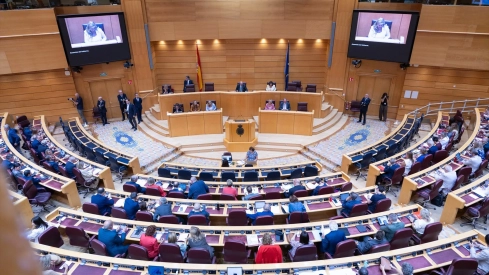
The composition of the Senate has had effects during the recently concluded legislature. The absolute majority of the PP has allowed it to promote investigation commissions and delay laws coming from the Congress. The Upper House also participates in the election of members of constitutional bodies, subject to reinforced majorities. Hence, the debate on these candidacies goes beyond the distribution of posts among party acronyms.
Valencia and Ibiza sound out agreements while the deadline runs
The Valencian Community is one of the territories where the formula is being studied. In 2023, the PP obtained eight of the twelve senators elected in Alicante, Castellón, and Valencia, compared to four for the PSOE. People linked to the PSPV and Compromís have held contacts to explore a shared candidacy, although their leaderships still need to resolve how to run together for the Senate while competing separately in the Congress. A similar agreement was attempted in 2016 and did not go through then.
Representatives of IU, the PSOE, and Ara Eivissa in the Pitiusas have also spoken in favor of collaborating, where there was a unitary candidacy in 2023. Now Ibiza and Formentera will elect their own senator separately. The socialists of the islands await the approval of their leadership before closing a pact, a condition that shows how much is still needed to go from good disposition to a registered candidacy.
Parties have until October 16 to communicate electoral coalitions and until October 26 to present candidates. Within that period, they must decide where they will run together, under what formula, and who would occupy the ballots for the Senate.
