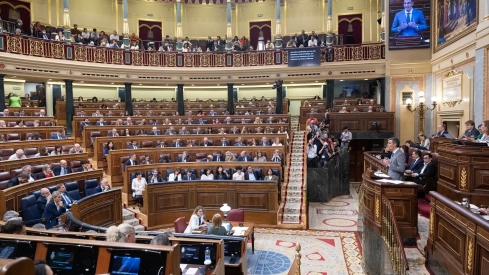
The Official State Gazette (BOE) has published this Tuesday Royal Decree 806/2026, of October 5, by which the Congress of Deputies and the Senate are dissolved and general elections are called for next Sunday, November 29. The norm, signed by King Felipe VI and the President of the Government, Pedro Sánchez, formalizes the early election announced on Monday and activates the calendar that will lead to the formation of the new Cortes.
The decree establishes that the Chambers elected on July 23, 2023, are officially dissolved and also sets the main dates of the electoral process. The campaign will last fifteen days: it will begin at 00:00 on Friday, November 13, and will end at 24:00 on Friday, November 27, while the new Cortes will meet in a constitutive session on December 23 at ten in the morning.
The publication of the decree thus formally opens the way to early general elections that will be held in the midst of the processing of some of the main measures that the Executive intended to push through before the end of the legislature. Among them are the housing decrees rejected by Congress last Friday and which the Government intends to approve again this Tuesday.
The electoral decree sets the calendar until the constitution of the new Cortes
Royal Decree 806/2026 applies Article 115 of the Constitution and Article 42.1 of the Organic Law of the General Electoral Regime to formalize the dissolution of both Chambers and the electoral call. The norm also determines the distribution of deputies and senators corresponding to each constituency.
In the case of Congress, Madrid will elect 38 deputies; Barcelona, 32; Valencia, 16; Alicante and Seville, 12 each; and Malaga, 11. The rest of the seats are distributed among the different constituencies according to the annex incorporated into the decree. Ceuta and Melilla will elect one deputy each.
For the Senate, the norm maintains the system provided in the Organic Law of the General Electoral Regime: four senators in each provincial constituency, three in Gran Canaria, Mallorca and Tenerife and one in the remaining island constituencies, while Ceuta and Melilla will elect two senators each.
The electoral calendar is, therefore, defined from the publication of the decree. After the vote on November 29, the new Chambers must be constituted on December 23. The royal decree establishes that the elections will be governed by the current electoral legislation that came into force on the same day of its publication in the BOE.
Housing becomes the first parliamentary battle after the dissolution
The electoral call does not mean, however, that the Executive stops developing its activity or that all legislative decisions are paralyzed. The dissolution of the Cortes modifies the body that can exercise certain functions of the Congress and places the Permanent Deputation at the center of the first political battle after the early elections.
The Government plans to approve again this Tuesday two royal decree-laws on housing after the Plenary Session of the Congress rejected last Friday the texts promoted by the Executive. The intention is to introduce technical modifications and maintain the main protections agreed between PSOE and Sumar to try to ensure that the measures can now be validated by the Permanent Deputation. Government sources had confirmed that the Council of Ministers would address the decrees again after the early elections.
The change is relevant because, with the Cortes already dissolved, the validation of the decree-laws corresponds to the Permanent Deputation. The Congress itself explains that this body acts as a substitute for the Plenary when the Cortes have been dissolved and assumes, among other functions, the validation or derogation of royal decree-laws.
The Permanent Deputation of the XV Legislature is composed of 69 members, including the President of the Congress. Its composition is different from that of the Plenary and especially reduces the weight of some formations that were decisive in the vote on Friday's housing decrees. The body has 27 representatives from the PP, 24 from the PSOE, six from Vox, six from Sumar, and one from ERC, Junts, EH Bildu, PNV, and Mixed Group.
With this composition, Junts ceases to have the same weight it had in the Plenary, while the PNV acquires a decisive position for the majority that the Executive needs to push through at least part of the measures. According to the positions conveyed so far, the Basque nationalists are inclined to support the first package, although they maintain requests for guarantees for small owners and have not definitively closed their position.
The arithmetic thus leaves a different scenario from last Friday. PSOE and Sumar add up to 30 representatives in the Permanent Deputation, to which the representatives of ERC, EH Bildu, and Podemos are incorporated, reaching 34 supports. The PNV has the vote that would allow reaching 35 against the 34 that PP, Vox, and Junts would add if they maintain their previous positions.
The margin, therefore, would be especially narrow. An abstention could modify the result, and the second decree, related to the renewal of rental contracts, faces a different scenario from the first due to the positions maintained by the PNV during the vote in the Plenary.
An electoral calendar that will culminate on December 23
The decree published this Tuesday completes the calendar for the coming months. The electoral campaign will officially begin on November 13 and end at midnight on November 27, two days before citizens go to the polls.
On November 29, the deputies and senators who will make up the Cortes Generales will be elected again. Once the elections are held, the new Chambers will meet for the first time on December 23 at ten in the morning to hold their constitutive sessions.
Until then, the Permanent Deputation will be the parliamentary body responsible for assuming the functions that the Constitution and the Congress Regulations attribute to it during the dissolution. Its first major decision will be precisely linked to the housing measures that the Government intends to recover after their rejection in the Plenary.
Royal Decree 806/2026 thus remains as the norm that formalizes the end of the current legislature and sets the path towards the general elections of 29N, while the Executive tries to use the new parliamentary scenario to bring its housing measures to a vote again before citizens return to the polls.
