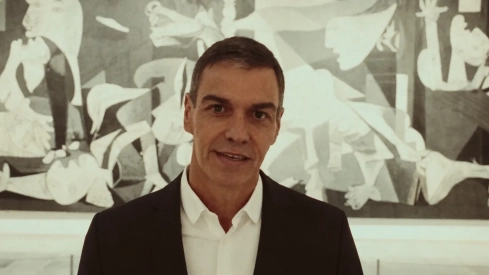
Pedro Sánchez has recovered this Saturday the "No to war" before Picasso's 'Guernica' to claim his foreign policy and defend that Spain has maintained its principles despite international pressures. In a video published on his social networks, the President of the Government and PSOE candidate for the November 29 elections links the rejection of war conflicts, the denunciation of the genocide in Gaza and his opposition to NATO's 5% spending target.
"When some were betting on bombs, we said no to war," Sánchez states. The socialist leader also claims his refusal to sacrifice welfare state resources to increase military investment. "When many kept silent, we denounced the genocide of the Palestinian people in Gaza," he adds.
The video shows the president walking through the Reina Sofía Museum until he stops before Picasso's painting, in which he says he sees the consequences of "barbarism imposing itself on reason." From that scenario he defends that no war is inevitable, that no life is worth less than another and that looking the other way should never be an option.
Durante estos años, España ha defendido en el mundo el sentir de su gente: que ninguna guerra es inevitable, que ninguna vida vale menos que otra.
— Pedro Sánchez (@sanchezcastejon) October 24, 2026
Los mismos principios. En todos los conflictos. Sin dobles raseros. pic.twitter.com/b2J1uHCYjf
In the text accompanying the publication, Sánchez summarizes his assessment with "the same principles" in all conflicts and "without double standards". The message brings foreign policy to the pre-campaign and offers the PSOE an argument to dispute the progressive vote, by linking international decisions with the defense of public services.
What NATO demands and how much Spain increased its investment in Defense
The reference to 5% refers to the commitment approved by the allies at the Hague summit in June 2025. The agreement sets this objective for 2035 and divides it into at least 3.5% of GDP for defense and up to 1.5% for security-related areas, such as infrastructure, networks, and civil preparedness. The text foresees reviewing the spending trajectory in 2029.
The Spanish government then argued that it could meet the capabilities required by the Alliance with 2.1% of GDP. Sánchez presents this position as a way to preserve social spending, although his Executive had also approved increasing military investment. In April 2025, it announced an additional 10.471 billion euro plan to reach 2% of GDP in security and defense that same year.
The Spanish balance also includes military support for Ukraine against the Russian invasion. For 2026, the Government committed another 1 billion euros in bilateral assistance, a contribution that Margarita Robles reaffirmed in April. The position that Sánchez claims thus combines the defense of the invaded country with opposition to other military interventions and to raising spending to the objective agreed by NATO.
Gaza and Iran give context to a message with roots in the "No to war" of 2003
The slogan used by Sánchez retains a strong political charge in Spain since the mobilizations against the invasion of Iraq in 2003. The president used it again on March 4 of this year, after the attacks by the United States and Israel against Iran and the Iranian response against countries in the region. In that statement, he called for a halt to hostilities and defended international law and the protection of the civilian population.
In the Palestinian case, its balance includes diplomatic and commercial decisions. Spain recognized the State of Palestine on May 28, 2024 and approved in September 2025 a decree with restrictions on arms transfers with Israel and measures against products from settlements in occupied Palestinian territory. The norm contemplates exceptional authorizations from the Council of Ministers for certain material transfers.
The video concentrates these positions in an appeal to values and coexistence. "Together we are stronger", Sánchez maintains, ending by resorting to "the light of our values" in the face of the darkest moments. The piece presents his international action as part of the political identity with which he runs for 29N and places the protection of people at the center of his electoral message.
The chosen scenario refers to a specific massacre. Picasso painted 'Guernica' in 1937, after the German Condor Legion and Italian aviation bombed the Basque town on April 26, in support of the Francoist army. The work was made for the Spanish Republic's pavilion at the International Exhibition in Paris that year.
