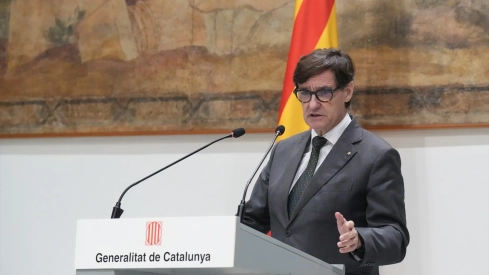
Salvador Illa, president of the Generalitat, has placed the amnesty at the center of the control session and defended this Wednesday that, if the Government of Spain had been headed by PP and Vox, the leaders of 1-O would not have recovered their political rights.
In response to Junts' spokesperson in the Parliament, Mònica Sales, Illa stated that "if it were up to the PP and Vox, you would not have recovered" those rights today, a direct reference to the application of the amnesty law to the main leaders of the procés by the Supreme Court. The president presented this decision as a political turning point: "Everyone can participate and exercise all their political rights," he said, before asserting that Catalonia "closes one stage and opens a new future."
Junts demands that the amnesty reach everyone and criticizes Illa's shift
Mònica Sales celebrated the return of former minister Lluís Puig and the application of the norm to Jordi Turull, Oriol Junqueras, Raül Romeva, and Dolors Bassa, but stressed that the Supreme Court did so "obliged, late, and reluctantly." In her opinion, the measure still needs to be extended to everyone, including Carles Puigdemont.
The Junts leader also maintained that the amnesty represents a victory for independence and a defeat for the powers of the State. She also reproached Illa for his evolution on this measure: "First he opposed it, then he swallowed it, and now he wants to take credit for it," she said.
Illa replied that Junts' votes were necessary, but not the only ones: he also recalled the support of the PSC, ERC, and the Comuns. And he sent a message of political contrast to the independence movement: "If it were up to Feijóo and Abascal, with whom you seem to have some dealings, you would not be here," he pointed out, before asking them to reflect on whether it is intelligent to maintain equidistance in an electoral context.
ERC and CUP demand that the conflict not be postponed while full application remains pending
The president of the ERC group, Josep Maria Jové, framed the lifting of arrest warrants against Puigdemont, Toni Comín, and Lluís Puig, along with the amnesty for Junqueras, Turull, Romeva, and Bassa, as a sign that the "prevaricating resistance" of the Supreme Court is ending. He also reminded Illa of the commitment to address the resolution of the political conflict and asked him not to use excuses, such as general elections, to postpone that debate.
Illa has responded that he shares some points with ERC and disagrees on others, but has insisted that "political issues must be resolved in the political sphere". At the same time, he has committed to defending strong self-government for Catalonia. The president of the CUP group, Pilar Castillejo, has defended the return of Puig and the application of the norm to Junqueras, Turull, Romeva, and Bassa, but has warned that the amnesty is being applied "at two speeds". She has denounced that, while it was automatically applied to the aggressor police officers, there are still activists and protesters who are still waiting amidst judicial obstacles, and has demanded that full amnesty reach all those repressed now.
The control session has thus been marked by the same underlying dispute: the application of the amnesty has already reached several leaders of the procés, but the discussion about its full scope and about the political response that should come next remains open.
