
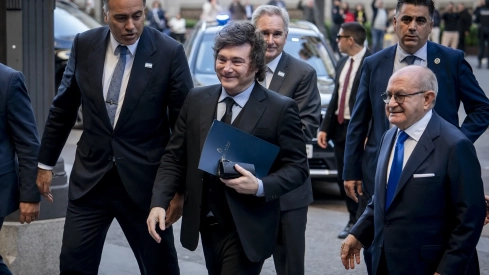
It has happened again. The president of Argentina, Javier Milei, has come to Spain to insult, first, Pedro Sánchez, President of the Government, whom he has called an “unpresentable dictator”.
But he has also come, consequently, to insult Spain. Because whoever arrives in our country as president of a foreign state and calls the President of the Government a “dictator” is also attacking the institutions of our country. Whether one likes Pedro Sánchez more or less, he is the President of the Government of Spain.
Even more: what Javier Milei means to say with those words is that Spain is a dictatorship. Because if Pedro Sánchez is, as he says, an “unpresentable dictator,” the logical consequence of his statement is that Spain would be governed by a dictatorship. And no.
Spain is not a dictatorship. Spain is a consolidated democracy. A democracy belonging to the European Union which, moreover, has general elections just around the corner, called for next November 29.
Elections whose call, development, and subsequent result are subject to legality and multiple checks and balances. In Spain, no matter how much certain discourses try to sow doubts, there are sufficient legal and electoral guarantees to prevent that supposed “rigging” that some have been talking about for a long time, also when referring to postal voting.
But the worst thing is not that the president of Argentina comes again to Spain to insult the President of the Government and, in my opinion, also the country itself. The worst thing is that those who permanently boast of patriotism cheer him on, applaud him, or, at the very least, allow it.
We know that at the New Economy Forum event attended by Javier Milei there was a presence of Vox leaders, including representatives of the party in the Madrid Assembly. But there were also representatives of the Popular Party. And we are not only talking about Esperanza Aguirre, of whom some might say that she already acts as a loose cannon within the PP. The president of the Senate, Pedro Rollán, of the Popular Party, was also there.
So, how is it explained that those who permanently display the flag of Spain, something completely legitimate because everyone can carry the symbols they want, and those who publicly present themselves as great patriots applaud or allow the president of a foreign country to come to Spain, once again, to call the President of the Government a “dictator”?
At the very least, it is inconsistent with the patriotism they claim.
And the absurdity does not end there. This very afternoon we learn that Isabel Díaz Ayuso, president of the Community of Madrid, will hold a private meeting with Javier Milei. A meeting that also has the backing of Alberto Núñez Feijóo, national leader of the Popular Party.
It is further proof of the relevance that the PP gives to Javier Milei's visit. And they justify it by recalling that Argentina is a sister country to Spain. Of course Argentina is a sister country.
But Argentina is one thing and its current president is another. That two countries maintain extraordinary historical, cultural, and human ties does not oblige one to accept that one of its presidents comes to insult the head of government of the other country.
That is why it can be said that this visit by Javier Milei is being, at the very least, received with approval by Vox and by important sectors of the Popular Party. And from all this another problem also arises.
The opposition in Spain —PP and Vox fundamentally— can legitimately aspire to govern after the elections on November 29. Precisely for that reason, they should distinguish something basic: making opposition is not insulting.
Making opposition in a democratic country like Spain consists of scrutinizing the executive power, in this case the Government of Pedro Sánchez.
And that is very good.
Let the opposition scrutinize Pedro Sánchez. Let it even make a tough, detailed, demanding opposition. I think it's great. It falls fully within democratic margins and is exactly what can be expected from a healthy democracy. What is not characteristic of a healthy democracy is to confuse opposition with insult.
Nor is it to distort facts or convey to public opinion statements that question without proof the very functioning of the democratic system. For example, sowing the idea that there is a risk of electoral "rigging" through postal voting in the next elections.
That is not scrutinizing the Government.
A democratic opposition must control the Executive, demand explanations, denounce its errors, and present alternatives. It can do so with all the political harshness it deems necessary.
But insulting, poisoning, or fueling unfounded doubts about the guarantees of our democratic system is not making opposition.
