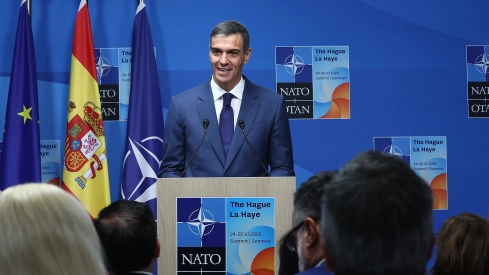
The NATO summit enters its key day in Ankara this Wednesday with Pedro Sánchez sitting at a table crossed by three political fronts: the first, the clash with Donald Trump over military spending. The second, Mark Rutte's pressure for allies to translate their commitments into more capabilities. The third, the absence of Begoña Gómez, who has not traveled to Turkey after Juan Carlos Peinado's substitute judge denied her authorization to accompany the president.
Sánchez arrived in the Turkish capital on Tuesday afternoon accompanied by José Manuel Albares and Margarita Robles. The president attended the official dinner offered by Recep Tayyip Erdogan at the Beştepe presidential complex in the evening and now faces the meeting of the North Atlantic Council with a firm position. Spain will not accept raising defense spending to 5% of GDP, as Trump demands, and will argue that 2.1% is enough to meet the capabilities required by the Alliance.
The difference with the opening of the summit is in the scenario. The leaders of the 32 allies will today review the progress of defense commitments, military support for Ukraine, industrial production, and European dependence on the United States. Moncloa arrives with a folder of data to argue that Spain complies more than the right says and much more than Trump admits.
Spain defends 2.1% against the 5% race
The Government maintains that the debate cannot be reduced to a percentage of GDP. Sánchez's thesis is that NATO asks for specific capabilities, not a budgetary competition dictated by Washington. Spain has already reached around 2% and maintains that it can meet the assigned objectives with an investment of 2.1%, without pushing military spending towards a figure that Moncloa considers incompatible with the country's social and budgetary balance.
The Executive displays several data to defend this position. Spain presents itself as one of the allies that has most increased its defense investment since 2018, with more presence in international missions, a strong deployment on the eastern flank, and a relevant contribution to military support for Ukraine. It also recalls that the country participates in the Alliance's naval, air, and land capabilities and that a good part of the investment returns to Spanish industry.
That argument unsettles Rutte, who has called for clear and credible plans towards the new allied objective. The NATO Secretary General insists that Europe must produce more, invest faster, and assume more military responsibility. In Ankara, he has conveyed to the industry that money is already arriving and that now it is time to respond with more weaponry, more innovation, and more production capacity. NATO wants to convert spending into factories, drones, missiles, planes, and air defense.
There, Spain tries to shift the focus. Sánchez does not want to appear as the partner falling behind, but as the leader who questions a spending race proposed by Trump in almost disciplinary terms. Moncloa reminds that some countries still struggle to meet the old 2% threshold and that others have accepted 5% without having guaranteed how to pay for it. The Spanish message is simple: comply yes, bow down no.
Trump stirs the summit with Greenland
The other big noise of the summit has been made by Trump again. The President of the United States arrived in Ankara criticizing his European allies and bringing back one of his most dangerous obsessions: Greenland. In the middle of the Alliance meeting, he insisted that the autonomous Danish territory should be under US control and not Denmark's, alleging security reasons due to the presence of Chinese and Russian ships in the Arctic.
The Danish Prime Minister, Mette Frederiksen, responded clearly: "Greenland is not for sale", and allies must respect the sovereignty of the Kingdom of Denmark. The scene once again shows the paradox of this NATO under Trump: the same president who demands absolute loyalty from European partners threatens to review the military relationship if his conditions are not accepted and reopens a territorial dispute with an ally of the Alliance itself.
For Sánchez, the Greenland episode has political utility. Spain no longer appears alone against Trump's discontent. The US president has clashed with Denmark over Greenland, with several European governments over Iran, with Italy over the use of bases, with Germany, France, and the United Kingdom over burden-sharing, and with Spain over military spending. The problem is no longer just the Spanish 2.1%, but the way Trump understands the relationship with Europe.
The Ankara summit was supposed to show unity, but the first day already made it clear that unity comes with cracks. Trump has again suggested that the United States could withdraw troops from Europe and has criticized allies for not joining him in his offensive against Iran. At the same time, NATO is trying to showcase joint purchases, industrial muscle, and support for Ukraine to convince Washington that Europe is moving.
Ukraine returns to the center stage
Volodymyr Zelenskyy is also in Ankara and has again demanded that Ukraine become part of NATO. The Ukrainian president argues that the military experience accumulated by his country during the Russian invasion would make the Alliance stronger. Meanwhile, allies are preparing new commitments of military support for Kyiv, and this Wednesday, the main meeting is expected to address a far-reaching annual funding to sustain Ukrainian defense.
The first day already brought several announcements. Canada announced new military aid for Ukraine. Estonia and Ukraine signed a cooperation agreement on drones. Zelenskyy spoke with Rutte about the urgent need for air defense and with Friedrich Merz about European anti-ballistic capabilities. The war in Ukraine continues to be the main argument to justify NATO's industrial and military leap.
Spain wants to position itself as a reliable ally there. The Government recalls the aid sent to Kyiv, the training of Ukrainian military personnel, and the Spanish deployment on the eastern flank. The issue is that Trump and Rutte primarily look at the final bill. Sánchez wants them to also look at what capabilities are delivered, where the troops are deployed, and how much of that investment serves to strengthen European industry instead of inflating purchases without strategy.
The Defense Industry Forum, held on the first day of the summit, set the tone. Allies announced military investments of at least 50 billion dollars and focused on drones, air defense, surveillance aircraft, military transport, and accelerated production. Spain joins the Airbus A400M project and arrives in Ankara with an interest in strengthening its own defense industrial base.
Begoña Gómez is left out of the picture
The absence of Begoña Gómez has also accompanied Sánchez since his arrival in Turkey. Turkish protocol had prepared a second bouquet of flowers for the president's wife, which ultimately remained without a recipient at the foot of the plane. The image does not change the content of the summit, but it does fuel the internal political front that the right has already tried to bring to Ankara.
Judge Antonio Viejo allowed Gómez to travel to London to attend her daughter's graduation, but denied her trip to Turkey, considering that her presence was in response to an institutional courtesy invitation and that she had no active involvement in the summit. The Prosecutor's Office did not oppose her departure from Spain, while popular accusations demanded to maintain the prohibition. Moncloa described the decision as "incomprehensible".
The PP has taken advantage of the absence to strike at the Government. Alberto Núñez Feijóo spoke this Tuesday of a "reputational cost" for Spain and linked Gómez's frustrated trip with the political deterioration of the Executive. The right tries to turn a summit marked by military spending, Ukraine, and Trump into another chapter of the judicial siege of Sánchez's inner circle. The Government, for now, prevents that front from displacing the main debate in Ankara.
Sánchez appears this Wednesday at NATO without his wife, with Trump stirring up the 5% and Greenland, with Rutte pushing for more spending, and with Ukraine demanding more air defense. The central meeting of the North Atlantic Council will test Spain's real margin to sustain its 2.1% model. There, it will be seen how far the pulse goes.
