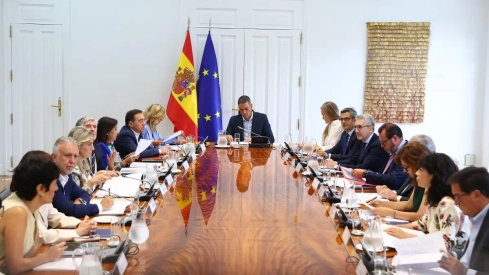
The President of the Government, Pedro Sánchez, will chair this Friday by videoconference a new extraordinary meeting of the Situation Committee in charge of managing the migratory crisis in Ceuta. The meeting will follow up on the first meeting of the body, held this Wednesday and headed by the Minister of Territorial Policy and Democratic Memory, Ángel Víctor Torres, responsible for the single command created by the Executive to coordinate the response to the situation in the autonomous city.
Likewise, throughout the day, the Minister of Interior, Fernando Grande-Marlaska, the Minister of Foreign Affairs, José Manuel Albares, and the Minister of Inclusion, Social Security and Migration, Elma Saiz, will face their explanations in the Lower House to account for the actions of their ministry after the massive entry of people into the territory between July 30 and 31.
Return of migrants "within the margins of the law"
The Minister of Territorial Policy and Democratic Memory and head of the single command for the management of the migratory crisis in Ceuta, Ángel Víctor Torres, was this Thursday the last of the three members of the Government to appear before the Congress to explain the Executive's actions after the massive entry of people on July 30 and 31. Before him, the Minister of the Presidency, Félix Bolaños, and the Minister of Health, Mónica García, intervened.
Torres detailed before the Joint National Security Commission the measures adopted by his department and the content of the Royal Decree approved on August 25 to address the situation of interest for National Security declared in Ceuta.
One of the main data provided by the minister was the number of adult people who currently have accommodation. As he explained, 1,827 adult migrants can now sleep under a roof, after the expansion of the Temporary Immigrant Stay Center (CETI) and the habilitation of new spaces ceded by the Autonomous City and the Ministry of Defense.
The CETI has incorporated 400 temporary places, reaching 1,183, while the two additional spaces have allowed for an expansion of reception capacity. Torres has also indicated that “thousands of humanitarian aid kits” have been distributed among the people remaining in the city. The deployment also includes a health device made up of more than 60 professionals, which will remain operational “as long as necessary,” as well as specific monitoring of women and girls in situations of particular vulnerability.
Torres has argued that the Executive's response now enters a second stage focused on consolidating both security and humanitarian assistance. The minister has claimed it was “a success” that between 90% and 95% of the more than 70,000 people who arrived in Ceuta returned within the first 24 or 48 hours.
For those who still remain in the city, he has set the objective of returning to Morocco, although he has insisted that it must be done respecting Spanish legislation and international law. The minister has assured that the Executive will seek “the return of all migrants who entered on the 30th and 31st” within the “margins of the law” and “international legal order.” In the case of minors, he has stressed that any action must preserve the “best interest of the child,” especially when family reunification is not possible.
The vaccination process for migrants in Ceuta
The Minister of Health, Mónica García, was the second to give explanations about the management of the migratory crisis in Ceuta this Thursday in the Congress of Deputies. In this regard, García has assured: "The system has not collapsed” and has announced that next week the vaccination process for migrants remaining in the territory will be carried out to prevent the spread of diseases that have been detected.
García began her intervention defending the health action carried out in Ceuta and assured that the city's population can be satisfied with the response received. The minister stressed that from the beginning she was informed of the situation of hospital services and that the decisions adopted were coordinated with her department.
In this sense, she has rejected that there has been a health collapse and has attributed that statement to a “self-serving narrative” and “alarmist” one. “The system has not collapsed,” García stressed, defending that healthcare has been maintained normally during the crisis.
As proof of this, the minister detailed that there are currently “17 migrants admitted” and pointed out that throughout this period “more than 100 beds have remained free.” She also assured that “emergencies attend the same number as before” and that “no consultations or operating rooms have been suspended.”
Bolaños transfers the reinforcement of Justice in Ceuta
The first to attend the Lower House to the Joint National Security Commission was Minister Bolaños who began: "I want to send a message of confidence to the citizens of Ceuta. The state is committed to restoring normality."
During his speech, the minister insisted on the need to transmit confidence to the citizens of Ceuta and defended that the Government is working to recover normality as soon as possible. “We are working tirelessly until normality is restored. We are all aware of the dimension of what happened on July 30 and 31. 70,000 people entered the city of Ceuta,” he pointed out.
Bolaños explained that the Executive is facing the crisis from three areas. "We address the challenge from three different points of view, the first being the need to ensure public order, strengthen the capacities of institutions and public services, and guarantee social tranquility in Ceuta, which is a demand from the Ceutan population that we are addressing and that for two days we have been doing with the national security declaration," he explained.
In relation to judicial resources, Bolaños detailed that the Institute of Legal Medicine of Ceuta was reinforced and increased its capacity by 300%. During the first days of the crisis, 82 autopsies and nine identifications were carried out.
On July 31, the Ministry of Justice contacted the General Council of the Judiciary to ascertain the needs arising from the situation. Bolaños specified that reinforcements must be requested at the request of the General Council of the Judiciary itself and that, as soon as that request arrives, the Government will approve the corresponding budget allocation.
The minister has also indicated that civil servant staff has been reinforced and that the Public Prosecutor's Office's deployment has also been expanded. Regarding return and family reunification procedures, he recalled that legislation establishes legal guarantees that must be respected in these processes.
Do you want us to continue investigating the topics that others keep silent about? We want to be free and independent, but we need your help. Any contribution helps us move forward. Thank you very much for being there.
