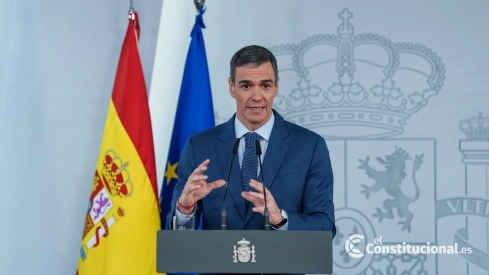
In full escalation of the Iran war and with the Strait of Hormuz blocked by Tehran, the President of the Government, Pedro Sánchez, has demanded this Sunday “the opening of the Strait of Hormuz” to prevent the entire world from paying a “energy crisis” of long duration.
Thus, in a message published on his X account, he warned: “We are at a global turning point.” Furthermore, he pointed out: “Further escalation could trigger a long-term energy crisis for all humanity.” And he concluded: “The world should not pay the consequences of this war.”
The Government of Spain demands the opening of Hormuz and the preservation of all the energy sites of the Middle East.
— Pedro Sánchez (@sanchezcastejon) March 22, 2026
We stand at a global tipping point. Further escalation could trigger a long-term energy crisis for all humanity.
The world should not pay the consequences of…
This message comes after the president of the United States, Donald Trump, has made the same demand. However, the American has done so through an ultimatum to Iran, giving the ayatollah regime "48 hours to open maritime traffic" of Hormuz. If Iran does not comply with the order, "The United States will attack and destroy its power plants, starting with the largest one!", he published on his social network Truth Social.
The Army of Iran has responded to Trump's threats assuring that “all energy, information technology and desalination infrastructures belonging to the US" in the region will become a target.
Likewise, the representative of Iran of the International Maritime Organization (IMO), has affirmed that the Strait of Hormuz remains open to international navigation, except for its enemies.
Importance of the Strait of Hormuz in the passage of oil
The trigger of the oil crisis is due to the blockade of the maritime passage between Iran and Oman, which connects the Persian Gulf with the Gulf of Oman and the Indian Ocean, perpetrated by Iran as a response to the conflict between the regime, Israel and the United States.
According to data from the U.S. Energy Information Administration (EIA), an agency of the U.S. Department of Energy, an average of 21 million barrels per day (mb/d) circulated through the strategic enclave in 2022, equivalent to 21% of global petroleum liquids consumption, mainly from Saudi Arabia, UAE, Kuwait, Iraq, Iran, and Qatar towards Asia (80%), Europe, and the U.S. Similar figures for 2024-2025: ~20 mb/d (20% of maritime crude oil trade). The closure of this route caused an increase in oil prices, which exceeded 100 dollars per barrel in international markets.
