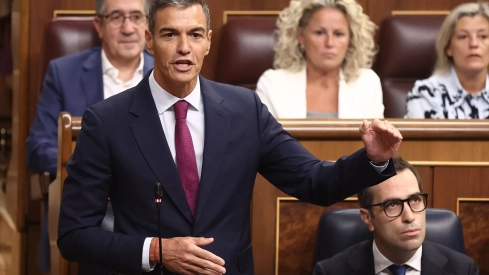
The plenary session in the Congress of Deputies has restarted this Wednesday with the migratory crisis in Ceuta in the focus of the debate. In this regard, the opposition has launched its criticisms at the President of the Government, Pedro Sánchez, for the management of the massive entry of people into Spanish territory. “You call me a dog. Unlike you, I may be a dog but I have no master", the president reproached Santiago Abascal.
In this context, the leader of Vox has taken advantage of his intervention in the Lower House to put the focus on Morocco and question whether Sánchez is being blackmailed by the neighboring country due to “the information they have about his corruption and that of his family”. Likewise, the leader of Vox has again called the president a “traitor” and “dog”.
Given these epithets, Pedro Sánchez has responded directly to Abascal: “You call me a dog. Unlike you, I may be a dog but I have no master".
🔴 Sánchez sentencia a Abascal: “Yo seré un perro, pero no tengo amo”
— ElConstitucional.es (@elc_es) September 9, 2026
🔗 Más información en https://t.co/fSqiqe3VWI pic.twitter.com/TerEvD5uY7
Sánchez accuses PP and Vox of limiting the vote of thousands of Spaniards
The parliamentary confrontation has also continued with the Democratic Memory Law and its effects on the electoral census. Sánchez has accused the Popular Party and Vox of trying to restrict the right to political participation of thousands of Spanish citizens abroad as a result of judicial actions related to registrations derived from the so-called Grandchildren's Law.
During his face-to-face with the leader of the PP, Alberto Núñez Feijóo, the president denounced that both parties "curtail the right to vote of thousands and thousands of Spanish citizens." His words come after the Supreme Court agreed to suspend certain registrations incorporated into the Census of Absent Residents (CERA) as a consequence of this regulation.
Feijóo had placed this issue among his criticisms of the Executive during his intervention in the Plenary. The PP leader accused Sánchez of being concerned "with manipulating the census with the grandchildren's law," instead of addressing problems such as access to housing, the situation of education, or the health strike.
The Supreme Court provisionally suspends registrations in the census linked to the grandchildren's law
The Supreme Court has decided to intervene in the electoral application of the known as grandchildren's law and has agreed to provisionally suspend the effects of registrations in the Census of Absent Residents (CERA) linked to this path to nationality. The measure will remain in force while the court studies the merits of the appeals filed against the application of the norm and affects those who cannot prove to the consulates that they are descendants of Spaniards who suffered exile.
The so-called grandchildren's law is part of Law 20/2022, on Democratic Memory, and opened a path for certain descendants of Spaniards to obtain Spanish nationality of origin. The provision is designed to repair the consequences of exile caused by the Civil War and the dictatorship and contemplates, among other cases, descendants of people who left Spain for political, ideological, religious reasons or reasons related to their sexual orientation or identity. The norm establishes as a reference the period between July 18, 1936, and December 28, 1978.
