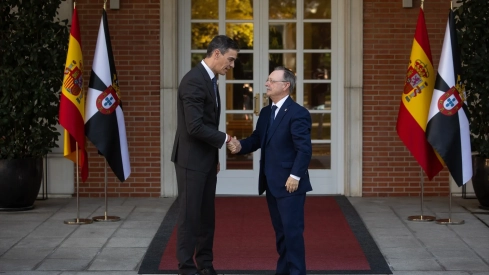
Pedro Sánchez will travel this Friday to Ceuta accompanied by the Minister of Interior, Fernando Grande-Marlaska, after the massive entry of people from Morocco has left at least nine migrants dead and overwhelmed security forces. The Government has mobilized the Army due to the most serious crisis experienced in the autonomous city since May 2021.
Security forces recovered this Thursday the bodies of nine people who had tried to reach Ceuta by swimming, according to police sources. The toll remains open while search efforts continue at sea and thousands of young people continue to gather on the other side of the border.
Sánchez will arrive at 11:40 AM at the Tarajal border, where he will learn about the deployed operation on the ground and hold a meeting with representatives of the State Security Forces and Corps. At 12:00 PM, he will participate in a coordination meeting at the Assembly Palace with the president of Ceuta, Juan Jesús Vivas, and the government delegate, Miguel Ángel Pérez.
The heads of the National Police and the Civil Guard will also attend the meeting, in addition to the directors of the Temporary Immigrant Stay Center and the Red Cross in Ceuta. Sánchez and Vivas will offer a joint statement when the meeting concludes.
The Army once again supports the Civil Guard
The Executive has ordered that the Army units deployed in Ceuta support the agents working at the border. "The Armed Forces will reinforce the Civil Guard in the exercise of its powers and those that may be necessary to maintain security in the city of Ceuta," La Moncloa reported.
The military will be coordinated by the Operations Command. Interior has also reinforced the 60 agents of the Reserve and Security Group permanently stationed at the border with three new platoons, two groups of GEAS divers, and personnel from Andalusia. National Police will increase the presence of UIP and UPR agents to 200 dedicated to citizen security tasks.
The situation has worsened during the afternoon with the arrival of thousands of people through the Tarajal breakwater. In Fnideq, the Moroccan town of Castillejos, a column mainly made up of young people already stretches about five kilometers while the security forces of the neighboring country try to contain new crossings.
Spain and Morocco have agreed to strengthen their coordination and accelerate the handover of people who have entered irregularly, within the legally established procedures. The Ministry of Interior has thanked the efforts of the Moroccan authorities, although the accumulation of people at the border maintains strong pressure on both devices.
Brussels has offered Spain financial, technical, and operational support through Frontex. The European Commissioner for Home Affairs and Migration, Magnus Brunner, has informed Marlaska that the Commission is in contact with Rabat to try to prevent new sea crossings.
The crisis is reminiscent of the one experienced in May 2021, when nearly 10,000 people entered Ceuta over two days after Morocco relaxed border controls. At that time, it was also necessary to deploy the Army. Five years later, Sánchez will return to Tarajal with nine deceased, thousands of people inside the city, and a new crowd waiting at the border.
Add ElConstitucional.es as a preferred Google source for free.
Stay informed about all the latest breaking news with the best information. Against disinformation, for democracy and social rights.
