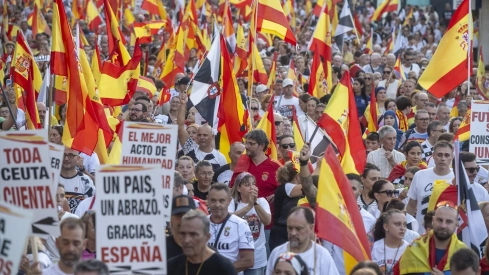
Spain was filled with flags of Ceuta this Wednesday. There were some on Ceuta's Gran Vía, among families walking towards Plaza de África; in an overflowing Plaza de Cibeles; in front of the city halls of Valencia, Malaga, Zaragoza, Valladolid or Bilbao; and also in cities where such a mobilization had not been seen for years. Hundreds of thousands of people took to the streets to support a city that has been demanding help for more than a month.
“Ceuta is not for sale, Ceuta is defended” was the cry that traveled from one concentration to another. Around it, the anthem of the autonomous city, that of Spain, requests for resources and security, cheers for the country and numerous demands for resignation addressed to the President of the Government were heard. In some places, racist slogans, insults and symbols of the dictatorship also appeared, which completely strayed from the civic spirit defended by the majority of attendees.
The mobilization coincided with Ceuta Day and stemmed from a call by the Spanish Federation of Municipalities and Provinces. The FEMP had invited the 8,132 Spanish city councils to concentrate, although just over 260 municipalities publicly announced their adherence. Their manifesto demanded extraordinary funding, more state resources, border control, returns with guarantees and greater involvement of the European Union. The text included an express rejection of hatred and racism.
The institutional support of the PP and the far-right Vox and the presence of their main leaders turned many of the events into an open protest against Pedro Sánchez and his management of the crisis. Feijóo maintained that the Government knew the warnings prior to the massive entry at the end of July and promised that “everything will be known.” Vox took the confrontation even further and accused the president of acting at the service of Morocco.
The PSOE responded by accusing the PP of taking advantage of the suffering of the people of Ceuta to “gain political profit” and “stir up tension”. Ferraz recalled the 309 million euro shock plan approved by the Council of Ministers and demanded a clear condemnation of the attacks against journalists. The socialist Organization Secretary, Rebeca Torró, denounced the presence of “hooded ultra groups,” Nazi salutes and aggressions against journalists.
Agresiones a periodistas, saludos nazis y grupos ultras encapuchados. El propósito del PP nunca fue solidarizarse con Ceuta, sino azuzar la crispación y sacar rédito político de la tragedia.
— Rebeca Torró/❤️ (@Rebeca_Torro) September 2, 2026
El odio no ayuda a Ceuta. Ayudar a Ceuta es poner recursos, coordinar administraciones…
The socialist leadership had distanced itself from the call, although mayors and councilors from the PSOE participated in different parts of the country. The mayor of León, José Antonio Díez, attended the concentration in his city and asked to put aside confrontation. Other socialist town halls organized their own events during the morning to express their support for Ceuta.
The Government assured that it would keep all available resources mobilized. Sánchez publicly thanked the “serenity, solidarity and responsibility” of Ceuta society and set as priorities getting people who remain outdoors off the streets, ensuring dignified care, and restoring calm.
Ceuta turns its 'Big Day' into an unprecedented march
Ceuta was the heart of the day. Entire families, young people, old people, and groups of friends arrived from the neighborhoods and gathered next to the Royal Walls. Urban buses were free during the afternoon to facilitate travel. Before the march began, a good part of the center was already occupied by Spanish and Ceuta flags.
The Government Delegation estimated an attendance of close to 20,000 people. Organizers and various local media raised the count to over 25,000 and even up to 30,000. The city's vice president, Alejandro Ramírez, later spoke of about 50,000. The differences between estimates were enormous, although all described the largest mobilization in the recent history of a city of just over 80,000 inhabitants.
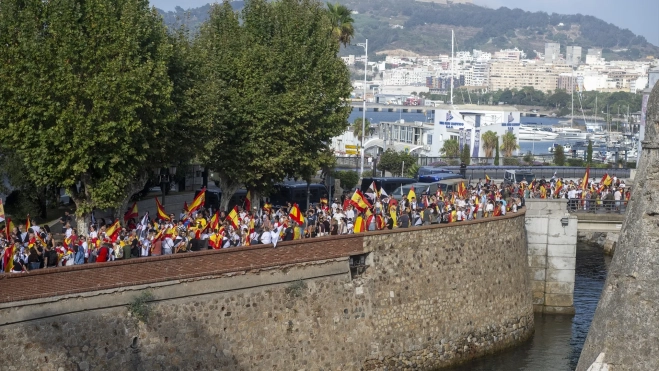
The march advanced through the center for more than four hours. “A caballa never gives up,” “Ceuta united will never be defeated,” and “Ceuta is not for sale” marked the route to the Plaza de África. There was music, applause from balconies and terraces, and visibly emotional neighbors. Cries of “Government, resignation,” harsh insults against Sánchez, and demands for the expulsion of migrants were also heard.
África, an elderly woman who attended with several friends, summarized the shared desire of many neighbors. “May we have freedom, may we return to normality,” she declared during the march, according to Ceuta media. Estefanía had traveled from Algeciras with a sign that read “This is about Ceuta.” Marian described a city exhausted after a month of tension. “We feel abandoned. Ceuta is too small to absorb so many people,” she explained.
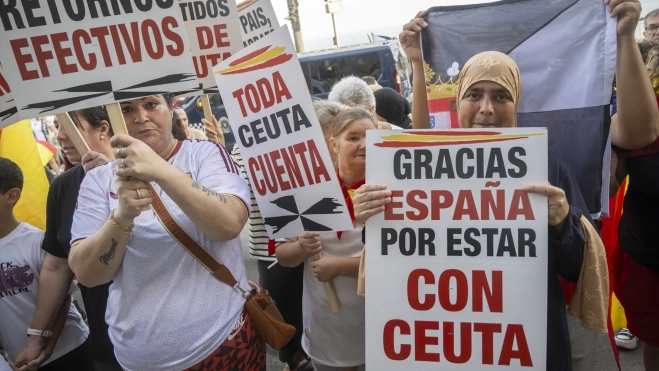
In the Plaza de África, in front of the Assembly Palace, four young people gave voice to the manifesto ‘Ceuta somos todos’ (Ceuta is all of us). Celin Arjandas, Talia Bentolila, Silvia Cordero Lagares, and Ramia Mohamed Moubarik represented the Christian, Hindu, Hebrew, and Muslim communities that are part of Ceuta's identity. The text called for resources, security, economic support, and a European response, while defending coexistence and rejecting any expression of racism.
Juan Jesús Vivas was received with applause and shouts of “You are our president”. The popular leader assured that that day should mark “the beginning of Ceuta's recovery” and highlighted the image of a united city. “Ceuta does not surrender and defends itself with all Ceutans together, wherever they live, whatever they think, however they pray, and whatever their name,” he proclaimed.
Vice President Alejandro Ramírez spoke of “a turning point” and assured that “nothing similar had ever been experienced before”. Ramírez reproached the Executive for the lack of a clear calendar and stated that among the residents there is “a feeling of abandonment and a certain ineptitude in management.”
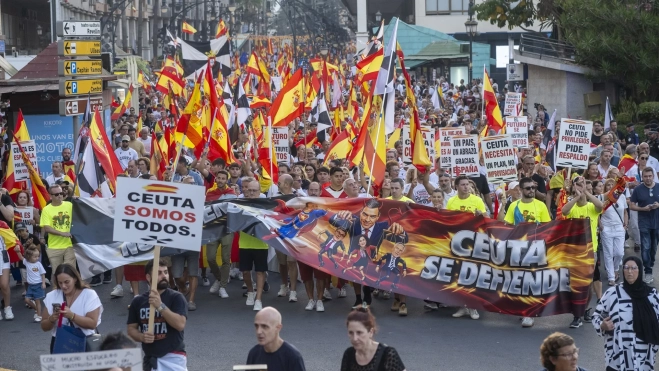
The bulk of the mobilization proceeded peacefully. There were some reproaches to press teams, but the march maintained the civic tone that the convening associations had requested. After the anthems of Ceuta and Spain, thousands of attendees moved towards the Plaza de los Reyes, in front of the Government Delegation, where the protest gradually faded into the night.
Madrid gathers three protests and ends with ultra violence in front of Congress
Madrid concentrated several mobilizations within a radius of less than one kilometer. The main one filled Cibeles and its surroundings. Another, called by Ceutians residing in the capital under the slogan ‘Ceuta unites us’, gathered hundreds of people in front of Congress. Ultra and neo-Nazi groups embedded themselves in this second event and ended up protagonizing the most serious incidents. In Callao, an anti-racist concentration was also held.
The Government Delegation estimated the attendance at Cibeles at 50,000. The City Council raised the estimate to 150,000. The concentration occupied the square, part of Gran Vía, and the Paseos del Prado and Recoletos. Spanish flags dominated the scene, accompanied by Ceuta banners and placards demanding the government's resignation.
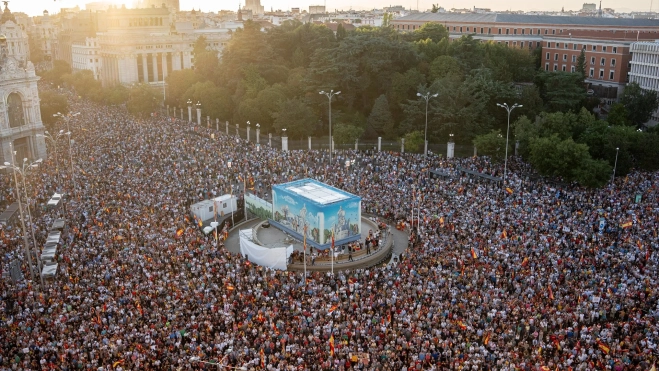
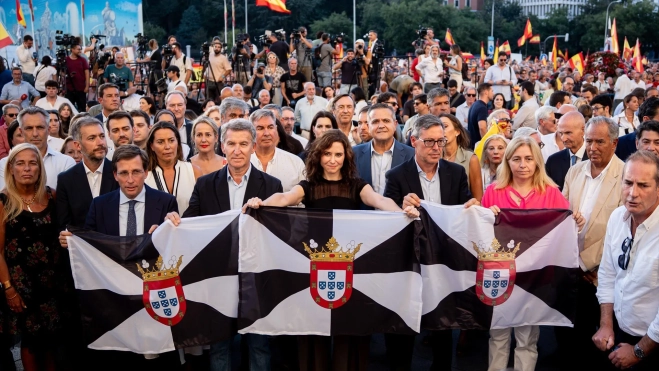
Alberto Núñez Feijóo, Isabel Díaz Ayuso, José Luis Martínez-Almeida, and Santiago Abascal attended the event, although the leaders of the PP and the far-right Vox avoided sharing a photograph. Almeida read the FEMP manifesto, demanded resources, and defended that “when a Spanish border is at risk, all of Spain must be behind it.”
Feijóo accused the Executive of hiding police reports on the massive entry and promised to go “all the way”. Ayuso demanded Sánchez's resignation for having left “all of Spain abandoned in the eyes of the world.” A few meters away, a large part of the crowd chanted “We want to vote,” “Government, resignation,” and harsh insults against the president.
The Cibeles concentration concluded without serious incidents. The focus of tension shifted towards Congress, where Ceutians residing in Madrid had asked to maintain the civic nature of the event. When insults to the Government began, those leading the call tried to recover the proclamations of support for their city.
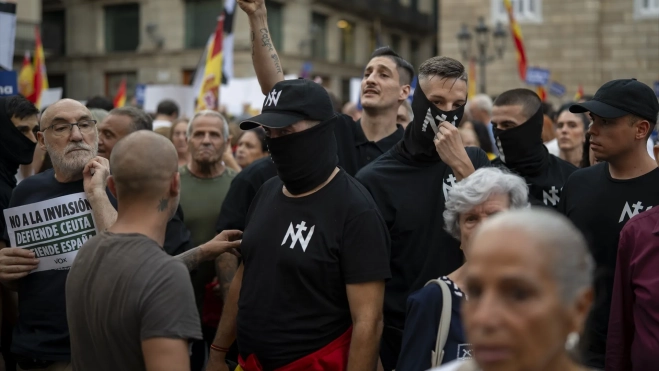
In the Plaza de las Cortes appeared members of Núcleo Nacional, individuals with Francoist flags, hooded, and the founder of Desokupa, Daniel Esteve. Some attendees surrounded RTVE and laSexta journalists, insulted them, pushed them, and hit their microphones. Several professionals had to leave the area escorted. Attacking those who were working turned a legitimate protest into a demonstration of intolerance incompatible with any democratic defense of Spain.
Around 9:20 PM, groups of protesters began to heckle the police with racist slogans. Then came the throwing of bottles, chairs, and other objects. Riot police responded with charges, tear gas, and rubber bullets. Four people were arrested, two of them minors, and four officers were injured.
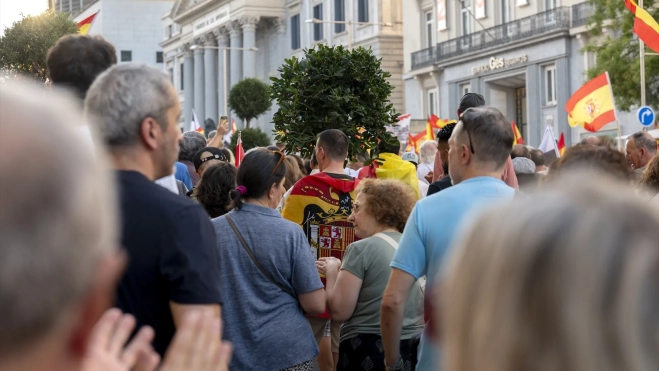
The Callao concentration, led by anti-fascist and anti-racist organizations, took place very close by under a large police deployment. Irene Montero, Ione Belarra, and Serigne Mbaye, leaders of Podemos, participated, demanding protection for migrants and denouncing Morocco's actions. The Police kept both groups separated to prevent clashes.
Andalusia and the two Castiles overflow their squares
The proximity to Ceuta meant that Andalusia registered one of the largest mobilizations of the day. The National Police estimated that more than 160,000 people participated in the eight capitals. Malaga gathered around 50,000 attendees; Seville, 40,000; Cordoba, 23,000; Granada, 14,000; Almeria and Jaen, 10,000 in each city; Cadiz, 8,000, and Huelva, 6,500.
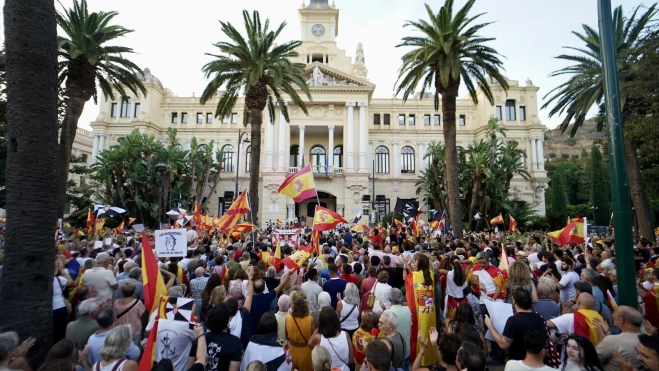
The events had a strong presence of PP and far-right Vox leaders, along with mayors and members of the Andalusian Government. "Seville is with you, Ceuta," proclaimed the Sevillian mayor. In Malaga, the Junta spokeswoman, Carolina España, reproached the Government for not having been "up to the task" and promised that the people of Ceuta would not be left alone.
Castilla-La Mancha also showed notable figures. Albacete gathered about 28,000 people, according to the Local Police; Guadalajara, 10,000; Ciudad Real, 7,000; Toledo, 6,000; Talavera de la Reina, about 5,000, and Cuenca, about 2,500. In Castilla y León, the Plaza Mayor of Valladolid was filled with about 20,000 attendees, while thousands of people remained in the adjacent streets. León exceeded 4,000 participants and had the presence of its socialist mayor.
Valencia and Zaragoza lead support in the east
The Plaza del Ayuntamiento in Valencia was completely full. The Government Delegation spoke of 25,000 people and the city council raised the estimate to over 50,000. There were also 15,000 attendees in Alicante, according to the National Police, and 7,500 in Elche. The demonstrators sang the anthems of the Valencian Community, Ceuta, and Spain.
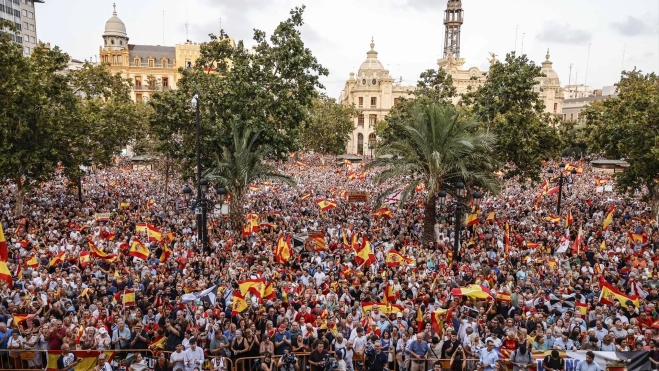
Most of the event proceeded peacefully, although a small group burned images of Sánchez and Mohamed VI and chanted slogans against Muslims. The Valencian president, Juanfran Pérez Llorca, distanced himself from the insults and asked the Government to heed the message expressed in the street.
Zaragoza turned the Plaza del Pilar into another of the day's major points. The City Council estimated 32,500 attendees using counting cameras, while other estimates placed participation between 23,000 and 25,000 people. The mayor, Natalia Chueca, read the manifesto and demanded a state and European response.
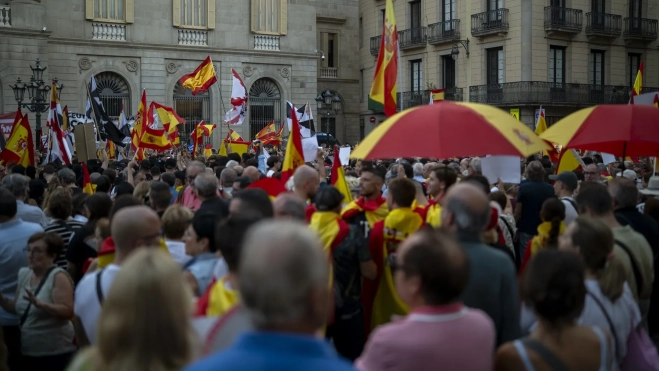
In Barcelona, 1,500 people participated in the concentration for Ceuta, according to the Guardia Urbana. PP and Vox occupied differentiated spaces, and members of Núcleo Nacional were also present. On the other side of the Plaza de Sant Jaume, about 700 people gathered against racism. A cordon of Mossos prevented contact between both groups.
From the Cantabrian Sea to the Canary Islands, Ceuta finds support throughout the country
Bilbao gathered about 3,000 people in front of the City Hall, while another 2,000 concentrated a short distance away against fascism and racism. The Ertzaintza closed the accesses between both protests and the day ended without incidents. In Vitoria there were around a thousand attendees in support of Ceuta and in San Sebastián several hundred gathered.
Pamplona gathered about 3,000 people in the Plaza Consistorial. The protest proceeded normally except for the harassment suffered by an RTVE team. Several journalists from other media intervened to protect their colleagues from pushes and attempts to prevent them from working.
In Asturias, the city hall squares of Oviedo and Gijón were filled. Galicia registered its largest concentrations in A Coruña, Vigo, Ferrol, and Pontevedra. Logroño packed the consistorial square; Murcia gathered more than 8,000 people and Palma brought together 8,000 attendees according to the Government Delegation and 19,000 according to the City Council.
Canarias added more than 10,000 participants. About 7,000 people gathered in Las Palmas de Gran Canaria and around 3,000 did so in Santa Cruz de Tenerife, first in front of the City Hall and then in the Plaza de España.
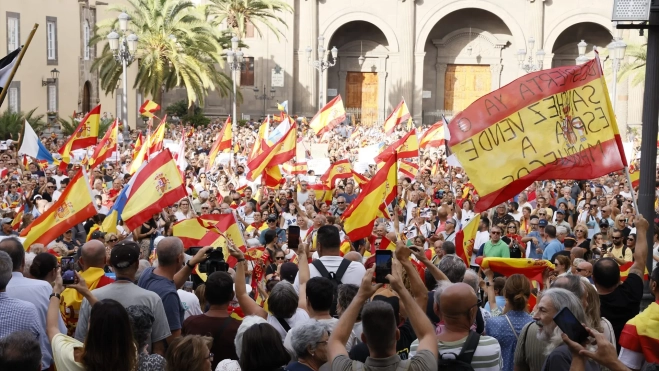
In Melilla, the sister city closed the night with Spanish and Ceuta flags in front of the Assembly Palace. Among the attendees, one of the slogans that had traveled the Peninsula throughout the afternoon was heard again. “Ceuta, hold on; Melilla rises.”
