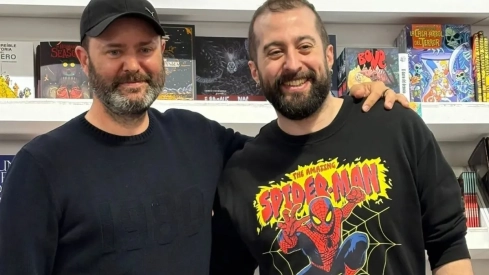
Comics can be fantasy, adventure, or memory. It can also become a tool to rescue uncomfortable stories and give a face to tragedies that run the risk of being diluted among figures and political debates. That is precisely what Raúl Madragón and Boris Ramírez have done with '7291', a graphic novel that reconstructs the drama experienced during the pandemic in Madrid from the point of view of care home workers.
They came from the world of fantasy and folklore, but a personal experience changed the course of this project. Through real testimonies from professionals and family members, the comic seeks to preserve the memory of those who died in care homes without receiving hospital care and also to vindicate the role of those who sustained those centers amidst the chaos.
In a conversation with ElConstitucional.es, Raúl Maldragón and Boris Ramírez reflect on public healthcare, memory, the role of comics as a social tool, and the emotional impact of confronting such a harsh story.
You come from fantasy and folklore. How does such a harsh story, so close to reality, like '7291' appear?
Raúl Madragón. Everything originated from a conversation with my father. In 2024, he was diagnosed with a tumor, and during treatment, he kept repeating an idea to me: “I am well because I have public healthcare that is taking care of me, but there are many people who did not have that opportunity”. He insisted that we had to talk about what happened in the care homes and put dragons and fantasy aside for a moment. When he passed away, that conversation stuck with me, and I decided to turn it into a promise.
Then I first contacted Boris, because I needed an artist capable of approaching terror. We saw this story almost as a real horror story. Afterwards, I started looking for testimonies and ended up reaching associations like Marea de Residencias and 7291 Verdad y Justicia, which were fundamental for our documentation.
Boris Ramírez. At first, I thought I knew a lot about the topic, because it seemed like something that had been talked about a lot. But when I started investigating, I realized how little I actually knew. There was a lot of political noise, many hoaxes, a lot of discussion, but little humanity. And there we saw that comics could contribute something different.
Precisely, the comic provides images for a tragedy for which there are almost no photographs or visual documents from inside the care homes. How was that graphic work?
BR. It was a very complicated process. The first thing was to document ourselves extensively. We needed to know what the residences were like inside, how the spaces were organized, how the caregivers worked, how the residents coexisted. We asked for images, references, and testimonies so that everything would be as faithful as possible.
From there, we did allow ourselves to experiment more artistically. We wanted to find a recognizable style for the comic. That's why the color palette changes depending on whether we are inside or outside the residence, and the stroke becomes dirtier and more claustrophobic as the story progresses. It was important to convey sensations and emotions, not just reproduce facts.
You have chosen to tell the story from the point of view of the workers. Why?
RM. Because they are also victims. We wanted to move away from a purely political approach and focus on the people who truly sustained that. The workers were the ones who were there every day watching people they had known for years die. Many times without resources, without protection, and completely overwhelmed.
We were very interested in hearing their point of view because they are a very invisible group. Furthermore, they allowed us to connect the inside of the residences with the families and with what was happening outside. It was a very human common thread.
The comic also conveys a very strong sense of memory; it gives the impression that even something that happened so recently is already at risk of being forgotten.
RM. Well, the truth is that I think it has been somewhat forgotten precisely because there is little imagery about it. So, we were interested in generating images from real testimonies, so that this is not forgotten and so that people see how the residences functioned and how they reacted to a situation that I consider practically a war.
They lived every day with people they had cared for for years, and suddenly they started dying one after another. The residence's morgue became too small, and bodies accumulated. It was an extremely harsh situation, and we wanted to focus on that humanity, on those workers who stepped forward when they were practically left alone.
BR. We did not want to make a political comic or look for specific culprits. From the beginning, we understood it more as an exercise in memory. Because in this country, we often have problems looking back and preserving certain stories.
And there is also an important problem: almost no images exist of what happened inside the residences. Everything turned into political noise, into figures or into television debates. The comic allowed us precisely to reconstruct those images from real testimonies and bring the reader closer to something much more human.
How were those testimonies?
RM. Extremely harsh. Very difficult to digest. There are tremendous stories that we even decided not to include because we did not want to fall into sensationalism nor lose the dignity of the people who appear portrayed. The important thing was to reflect the pain, but also the humanity and the effort of those who tried to care until the end.
I remember that after some interviews I was left completely affected. There Boris was also fundamental to emotionally sustain the project and move forward.
Public healthcare appears constantly in your reflection on the comic. What role does it really play in the work?
BR. Absolutely central. Public healthcare has saved all of us in one way or another. In my case, for example, it has been fundamental for very close people. And what we saw in the residences was precisely the opposite: people who were left aside when they most needed help.
We are talking about people who had contributed all their lives, who had sustained that system and who, at the critical moment, were abandoned. And furthermore for clearly discriminatory reasons. Many indeed could access hospitals if they had private insurance. That says a lot about what happened.
Public healthcare is a treasure and I believe that sometimes we are not aware of to what extent it must be defended.
RM. Totally. I myself had a tumor and surely if I had been born in another country I would not be here. Public healthcare saves lives and this comic also arises from there, from the need to remember what happens when it stops being protected.
Although the comic focuses on Madrid, do you believe it can be read as a universal story within Spain?
RM. Yes, completely. We focused on Madrid because that was where the situation reached a more brutal dimension, but this speaks of a structural problem that affects many residences throughout the country. In fact, professionals from other communities have written to us saying that they feel totally reflected.
The pandemic was the trigger, but the precariousness came from before: lack of staff, few resources and very harsh working conditions. All that already existed.
What would you say to someone who doesn't yet know '7291' to encourage them to read it?
RM. That they approach it thinking about the importance of public services and the people who sustain them. This comic is a tribute to those who stepped forward in a terrible moment. To the workers who stayed there when they could have left and literally risked their lives to care for others.
BR. And it is also a way of listening. To listen to an invisibilized collective and understand what really happened inside the residences. We have simply tried to convey their voices in the most honest way possible.
After an experience like this, do you consider continuing to explore social stories?
RM. I need to rest a bit because emotionally it has been very intense, but I do believe that this project has changed us. We came from fantasy, but we have discovered that there are also real stories that need to be told.
BR. Reality often surpasses any monster or any fiction. And after living with these testimonies, it is impossible not to come out transformed.
