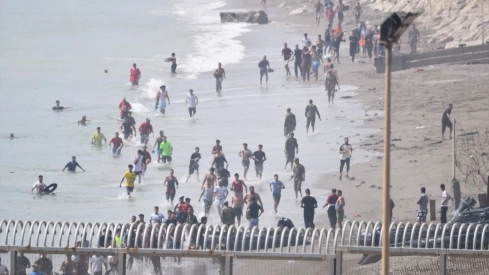
The National Intelligence Center (CNI) recognized this Wednesday that it failed to anticipate the magnitude or nature of the massive entry of migrants into Ceuta. The admission reinforces Moncloa's central argument, which distinguishes between warnings about calls disseminated on social media and an alert capable of foreseeing the arrival of more than 70,000 people.
Sources from the intelligence service explained that what happened on July 30 was "an unusual phenomenon that does not correspond to the migratory crises known to date." The CNI thus confirms that it handled information about calls to cross the border, although it lacked an estimate that would allow anticipating the final size of the movement.
Intelligence accompanied that explanation with a clarification about the versions published in recent hours. The agency assures that it has not made any institutional assessment regarding the declassification of the reports and denies other comments attributed to it, reminding that its members maintain the duty of secrecy from the very beginning.
Moncloa has hardened its own response after the 40 documents became known. Executive sources maintain that the message sent by a CNI agent on July 29 "was not formal" and was reduced to "an ambiguous WhatsApp to a minor official" of the Government Delegation in Ceuta.
"An agency that believes a massive entry is going to occur the next day does not limit itself to sending an ambiguous WhatsApp to a minor official; it escalates it," argue sources from the Presidency of the Government. According to this version, the warning never ascended through the CNI's chain of command nor reached any member of the Executive.
What the CNI messages did say
The declassified WhatsApp messages show that the CNI reported at 1:52 PM on July 29 of a "call for assault by fence and sea" planned for the next day. The message was sent to a member of the Cabinet of the Government Delegation in Ceuta.
The agent explained that the call was circulating in two groups with a total of 180,000 followers. "Just to give you an idea of the reach of the dissemination," he added. For Moncloa, that figure described the message's propagation capacity on social media, but had no value as a forecast of the number of people who would come to the border.
The communication continued with an eleven-minute call during the night. The CNI also contacted the Civil Guard's Central Special Unit number 3 (UCE-3), to which it transferred information about possible entries by swimming and a jump over the fence. After a first unanswered call, both interlocutors held another conversation lasting seven minutes and 38 seconds.
The intelligence service did send an early warning note to the Moroccan services that day. The warning requested their collaboration in the face of calls detected on networks. Moncloa's criticism is directed at the absence of an equivalent alert within the Spanish chain of command, which would have allowed the information to be formally transferred to Defense and the Government.
The National Police documents were more explicit. The National Immigration and Borders Center (CENIF) spoke on July 29 of possible "massive entries" and proposed three scenarios, including a simultaneous action by sea and over the fence with an "EXTREME" risk level.
The documentation thus confirms the existence of operational warnings during the previous hours. It also reflects that on the 28th, the Police themselves still did not detect indicators pointing to the organization of a massive jump for July 30. The 40 reports published by the Government show a threat that gained clarity during the eve, without a forecast close to the volume it finally reached.
The Government narrows its differences on the warnings
The President of the Government, Pedro Sánchez, has been placing the discussion on the scale for days. His position consists of acknowledging that there was data on an increase in migratory pressure and possible crossings, while emphasizing that no report anticipated the entry of more than 70,000 people. "We are talking about hundreds," he explained this Wednesday before the documentation was published.
The Minister of Defense, Margarita Robles, has defended that the CNI and military intelligence provided information during the previous days. The Government Delegation in Ceuta responded that it never received a report capable of warning of what would happen on July 30. The documents allow both statements to fit within different planes, because there were communications about calls and entries, although none calculated the final magnitude.
The lack of formal elevation leaves open another question about the internal functioning of the services. Moncloa considers that the CNI had the responsibility to transfer the information to its superiors if it understood that there was an imminent risk. Intelligence's own recognition confirms that its analysts never came to interpret the available data as the prelude to a crisis of that dimension.
The Minister of Interior, Fernando Grande-Marlaska, has insisted that no report identifies Morocco as the organizer of the massive entry. The head of Interior differentiates suspicions about the initial passivity of Moroccan forces from the existence of an order promoted from Rabat, which continues to not be accredited.
The Minister of Transport, Óscar Puente, has also criticized the "biased, broad-brush and quite unserious" readings of the documents. According to his analysis, the calls originated on social media, the most accurate warnings arrived a few hours before, and the causes of the late Moroccan police response admit different explanations.
The Executive's spokesperson, Elma Saiz, has defended the full publication of the reports as an exercise in transparency. "We have nothing to hide," she stated after the Council of Ministers that approved the declassification of the documentation prepared between July 1 and August 1.
The Minister of Territorial Policy and head of the single command in Ceuta, Ángel Víctor Torres, has described the massive entry as an "unprecedented" event and has defended that the relationship with Morocco must be modified after what happened. "It cannot happen again," he warned.
