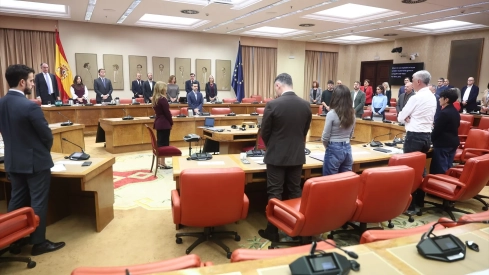
The Permanent Deputation of the Congress will debate and vote this Thursday, the penultimate day of the electoral campaign, on the last five decree-laws approved by the Government, among which are the salary increase for civil servants, the tax exemption of the Minimum Interprofessional Wage (SMI), new transparency measures in working conditions, the adaptation of the emissions trading market, and tax incentives for R&D&i.
These norms, reserved by legislation for matters of justified urgency, come into force after their approval in the Council of Ministers and their publication in the Official State Gazette (BOE), but must be ratified or repealed by Congress within thirty days. On this occasion, as the Chamber is dissolved due to the early elections, the decision falls to the Permanent Deputation, the parliamentary body that replaces the Plenary.
A parliamentary arithmetic different from that of the hemicycle
The Executive faces this vote with more favorable arithmetic in the Permanent Deputation, where it does not depend as much on Junts as in the Plenary. The body has 69 members, of whom 34 belong to PSOE, Sumar, ERC, Bildu, and Podemos, in addition to the representation of the Mixed Group, while the PP and Vox total 33. In this balance, the votes of Junts and the PNV, with one representative each, can be decisive in ratifying or repealing each of the norms.
Last week, the Popular Party supported the seven decrees that were on the table, a fact that has conditioned the debate prior to this new round of votes.
Since the early elections were announced on October 5, the Permanent Deputation has already debated nine decree-laws, of which it has ratified eight and only repealed one, the one promoted by Sumar to establish indefinite rents and oblige the owner to compensate the tenant in case of breach of the lease contract.
4.5% increase for public personnel and SMI adjustment
According to the agenda reported by Europa Press, the session will begin with the decree that approves a maximum global increase of 4.5% for personnel serving the public sector in 2027. The norm also raises residence allowances and social action items, which had been frozen for 14 years.
Next, the Permanent Deputation will address the decree that introduces the tax exemption of the SMI, which in 2027 will be revalued up to 1,286 gross euros per month in 14 payments. Although this increase has already been approved and does not need parliamentary endorsement, the Government must introduce adjustments so that recipients of the minimum wage do not have to pay IRPF.
In this way, the body will decide whether to ratify or repeal the deduction approved by the Government for those who earn the minimum wage, an amount of 1,033.58 euros per year that gradually decreases up to 23,172 euros annually, after which it ceases to apply.
Job offers must include salary
The third decree on the agenda transposes a European Directive on transparency in job offers and obliges companies to detail the salary they offer in their job advertisements. The norm will also allow public contracts to be terminated with companies that fail to comply with equal pay between men and women.
Next will be the turn of the decree on urgent measures to boost competitiveness and technological sovereignty in the scientific and research field, an initiative that seeks to provide incentives for innovation and improve the conditions of research personnel.
Finally, the Permanent Deputation will vote on the decree that regulates the regime of greenhouse gas emission allowance trading, a norm that will oblige fuel and gas marketers to buy allowances in the European market.
Contact