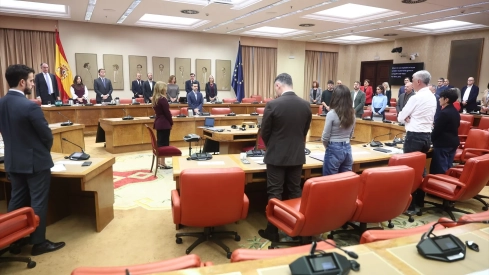
The Permanent Deputation of the Congress, the only parliamentary body that remains active after the dissolution of the Cortes, will meet this Wednesday to debate and vote on up to seven decree-laws approved by the Government in the last month. These texts, reserved by legislation for matters of justified urgency, come into force with their publication in the Official State Gazette (BOE), although they must be submitted to a vote in Congress within 30 days to decide whether they are validated or repealed.
As the Chamber was dissolved when the elections were called, that validation now falls to the Permanent Deputation, the body that replaces the Plenary and allows the Government and its partners to pass the decrees without needing to count on Junts. The body has 69 members and, in this distribution, PSOE, Sumar, ERC, Bildu and Podemos, the latter representing the Mixed Group, add up to 34 votes, compared to the 34 of PP, Vox and Junts, so the vote of the PNV is decisive to reach a majority of 35.
Ceuta, DANA Adam and the Urda railway tragedy
According to the agenda reported by Europa Press, the session will begin with the decree of urgent financial support measures for Ceuta after the massive entry of immigrants at the end of July, a regulation that provides for direct subsidies amounting to 45.32 million euros to finance actions derived from that crisis.
The decree responding to the damages caused by the floods and other events recorded between October 17 and 19, 2026 as a consequence of DANA Adam will also be put to a vote. This text incorporates measures in agricultural matters, repair of hydraulic damages and actions in the maritime-terrestrial zone, in addition to support for commerce, tourism and hospitality.
The Permanent Deputation will also debate the two decree-laws approved by the Council of Ministers after the Urda (Toledo) railway tragedy, one focused on aid to victims and the other aimed at strengthening operational safety in railway transport and the social protection of personnel in the sector.
The first sets aid for death and injuries ranging between 2,404 and 84,141 euros, and incorporates consumer protection measures, including the limitation of abusive prices that occur in emergency situations by some transport operators. The second modifies the regulation on train driving times, the reducing coefficients for the retirement age of certain railway categories, and the supervision of the State Railway Safety Agency, as explained last week by the former Minister of Transport Óscar Puente in the Permanent Deputation itself.
The social decrees of the pre-campaign
In addition to the measures linked to emergencies, the parliamentary body will debate three social decrees approved by the coalition Government in the weeks prior to the start of the election campaign for the elections on November 29.
One of them extends the protective action of the Social Security and incorporates menopausal disorder and injuries derived from gender violence as cases of temporary incapacity. It also modifies benefits for the care of minors with serious illnesses, the requirements for accessing widow's pensions for common-law couples with shared children, and orphan's pensions in cases of violence against women.
Another decree includes measures for the recognition and protection of single-parent families, with a special category for certain cases, such as families with two or more children, with one child and low incomes, or with one child with a disability. In addition, it extends the coverage of advances from the Food Payment Guarantee Fund.
The last decree-law is intended for the deployment of the reform of the System for Autonomy and Dependency Care, sets minimum monthly protection amounts of 90 euros for moderate dependency, 260 euros for severe dependency, and 660 euros for great dependency, and regulates credit supplements to finance the agreed level of protection in 2027.
Last week's precedent
Last Thursday, the two decrees related to housing policies were already voted on, and one of them went ahead thanks to the support of the PNV, while the other ended up repealed when the Basque nationalists added their votes to those of PP, Vox and Junts. That precedent once again places the Basque nationalist party as a key player in a session in which each vote can decide the immediate future of the measures promoted by the Executive.
Contact