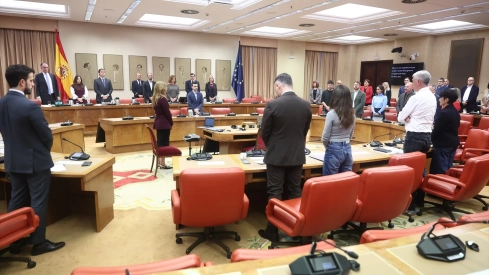
The Permanent Deputation will vote this Wednesday on the validation of the royal decree-law on urgent measures to reinforce railway safety and the protection of its professionals, a norm approved last Tuesday by the Council of Ministers after the high-speed accident recorded in Urda (Toledo), which left 69 dead, and in a context also marked by the strike days called in the sector, one of them this Tuesday.
The text incorporates the principles of the so-called "just culture" into the Railway Sector Law, through the creation of a specific chapter that regulates the communication of risks for railway operational safety and the protection of personnel, so that workers with safety-related functions can report incidents through internal channels or public notification systems that guarantee confidentiality.
Serious and imminent risk and increased inspection capacity
The regulation also recognizes the right of workers to adopt "necessary and proportionate" measures in situations of serious and imminent risk to safety, with the aim of avoiding or limiting them, measures that may include stopping a train or deciding not to start it, always with the obligation to communicate it to the corresponding agents.
The decree also reinforces the supervision and inspection of the State Railway Safety Agency (AESF), by allowing it to carry out its actions regardless of whether the facilities, trains or equipment necessary for the inspection belong to the supervised entity or another.
Driving times and adaptation until 2027
The royal decree-law, which is already provisionally in force except for its first article, specifies which activities and periods must be counted as driving time. These include maneuvers that involve the handling of the moving railway vehicle and interruptions during which the driver remains responsible for the vehicle, with attention to railway traffic or maneuvers.
However, this first article will come into force on May 11, 2027, so that railway companies and infrastructure managers can adapt the design of their driving schedules and other conditions of the organization of drivers' work to the new conditions established.
Retirement and reducing coefficients for other categories
The decree also extends the Social Security regime provided to personnel of railway companies operating on interoperable lines and/or on the General Interest Railway Network, with the aim of guaranteeing equal treatment in terms of reducing coefficients for the retirement age for professionals performing the same functions.
With this measure, the Government expands the social security regime to include other professional categories in terms of reducing coefficients for the retirement age.
Urgent aid for the victims of Urda
The Permanent Deputation will also vote this Wednesday on the approval of the royal decree-law to articulate an urgent package of economic and social aid for those affected by the accident in Urda (Toledo), which establishes direct indemnities exempt from taxation in the IRPF of 72,121.46 euros for death.
For the injured, the text sets indemnities of between 2,404.04 euros and 84,141.7 euros, depending on the severity of the injuries and the circumstances derived from the accident.
A close vote in the Permanent Deputation
Last week, the Government managed to validate one of the housing decrees by a single vote difference, and now faces a new vote in the Permanent Deputation, an body that replaces the plenary when the Cortes are dissolved. In this case, the bloc formed by PSOE, Sumar, ERC, EH Bildu, PNV and Podemos adds 35 votes in favor, compared to 34 against from PP, Vox and Junts.
Contact
We are listening. Get in touch.
