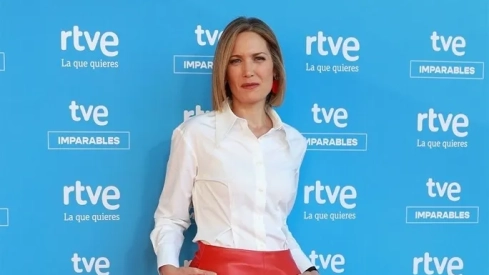
The opening of the disciplinary file against Silvia Intxaurrondo was imposed within a divided Central Electoral Board (JEC) and after rejecting the proposal of its legal services. The conservative majority gathered seven votes against five to proceed against the presenter of 'La hora de La 1' after the complaint from the far-right Vox. The lawyers proposed resolving the claim with a warning to the journalist and RTVE, without opening a disciplinary procedure.
The disagreement occurred at Monday's meeting, during which the members viewed the denounced fragment. The legal draft recognized possible neutrality problems in Intxaurrondo's questions, but considered it relevant that they were formulated in a talk show, that there were dissenting opinions, and that there was no record of any action to effectively restrict Vox's presence on RTVE. The final resolution retained much of that reasoning and changed the decision on the file, which could lead to a fine still pending resolution.
The origin is in the broadcast of November 10, the morning after the interview with Santiago Abascal on 'La Revuelta', David Broncano's program. Intxaurrondo raised whether the far-right should have a place on public television and opened a reflection on the defense of fundamental rights and the limits between pluralism and the normalization of discriminatory discourses. RTVE and the journalist defended that it was about sparking a debate on the function of public media.
The lawyers proposed warning without opening a file
The proposal of the legal services distinguished the context of those interventions. They occurred in the analysis and talk show space, outside the strictly informative block, and took the form of "questions and reflections". In addition, the presenter allowed collaborators to defend opposing positions, including the presence on public television of all legally constituted parties. These circumstances supported their recommendation to close the matter with a request to extreme neutrality during the electoral period.
The draft also contained a reproach to Intxaurrondo. Its authors considered that questioning the presence of certain political options and suggesting limitations due to their ideological orientation projected an appearance of a position contrary to a candidacy. They recalled that the participation of legal parties in public media cannot depend on the assessment that its professionals make of them. The discrepancy was in the response to these statements, which the technicians understood as insufficient to justify the opening of the file.
Professors Carlos Vidal and Javier Tajadura, proposed by the PP, argued during the deliberation that "the questions were not neutral and led to an answer". Against this interpretation, Francisco Javier García Roca, proposed by the PSOE, maintained that debating the media treatment of the far-right was protected by freedom of expression and was a discussion present in other European countries. The position in favor of the file had the support of the President of the Board, Eduardo Calvo. The Vice President, Pilar Teso, was absent from a session in which twelve of the thirteen members participated.
Intxaurrondo rejects reductions and announces she will appeal
The Board partially upheld Vox's complaint, opened the procedure personally against the journalist, and required RTVE to strictly comply with electoral principles. The file refers to a possible violation of article 66.1 of the Organic Law of the General Electoral Regime (LOREG), which demands pluralism, equality, proportionality, and informational neutrality from public media during elections. If it results in a sanction, the fine foreseen for individuals ranges between 100 and 1,000 euros. The presenter can submit allegations during the processing and appeal a possible sanctioning resolution.
Silvia Intxaurrondo tas ser expedientada por la Junta Electoral Central: "Los principios democráticos, la igualdad y los derechos fundamentales, ¿quedan suspendidos durante el periodo electoral? recibo este expediente de la JEC con orgullo y con honor" pic.twitter.com/B6YBiZyg2g
— La Hora de La 1 (@LaHoraTVE) November 24, 2026
Intxaurrondo responded this Tuesday from her program and explained that the amount could be reduced through voluntary payment and recognition of responsibility. "What's with this haggling? Does freedom of the press also have a discount for early payment?" she asked. The journalist announced that she will appeal until all judicial instances are exhausted and expressed her refusal to assume the infraction with a phrase that summarizes her position regarding the file. "I refuse to haggle with freedom of the press."
During her intervention, she also directed her questions to the electoral body. "Is the Electoral Board neutral between fascism and democracy?" she asked before asserting what she had written in her allegations. "I believe that xenophobic, sexist, and homophobic discourses have no place on public television as legitimate or normalized discourses. And I believe that they should not find protection or promotion in any democratic institution either."
Contact
We are listening. Get in touch.
