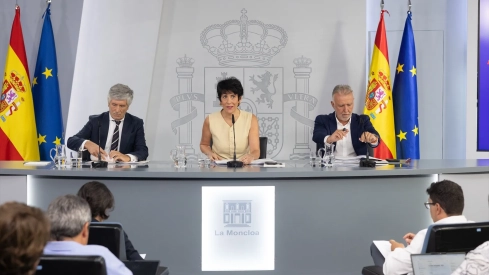
The Government has taken a new step this Tuesday, 26 days after the start of the crisis, to address the migratory situation in Ceuta after the massive entry of people from Morocco at the end of July. After the extraordinary meeting of the National Security Council, chaired by Pedro Sánchez, the Council of Ministers has declared the “situation of interest for national security” in the autonomous city and has approved the creation of a single command that will be led by the Minister of Territorial Policy and Democratic Memory, Ángel Víctor Torres.
The new functional authority aims to concentrate the coordination of the response among the different administrations and organizations involved. Torres will lead a specialized committee in which eleven ministries, the Government Delegation in Ceuta, the autonomous Executive chaired by Juan Jesús Vivas, the National Intelligence Center (CNI), and the Department of National Security will participate.
As explained by the spokesperson minister, Elma Saiz, this is a new stage to ensure that actions are carried out “in a coordinated and effective manner”. The minister, who has already requested to appear before the Congress's National Security Commission, plans to travel to Ceuta this Tuesday for working meetings.
Saiz has argued that the exceptional situation the city is going through requires an equally strong response. “Ceuta is today the heart of Spain,” she stated, before emphasizing that the Executive will remain in the city “as long as necessary with the resources that are needed.” The spokesperson explained that the governmental response has been articulated in different stages, from security and control actions to coordination between administrations and humanitarian aid.
The second phase in crisis management
Torres has now focused on the second phase of crisis management, after, according to his data, between 90% and 95% of the more than 70,000 people who entered Ceuta on July 30 and 31 returned to Morocco within 24 to 48 hours. The minister described this initial action as "successful and effective", but noted that the Executive must now address the situation of those who remained on Spanish territory. For this new stage, he has established as a priority the "return and repatriation of the largest number of people", both adults and minors, always within the legal framework and with respect for their rights.
Along with the single command, the Council of Ministers has approved two other important texts related to migration policy. These are the preliminary drafts of a new Asylum Law and a reform of the Organic Law on the rights and freedoms of foreigners in Spain and their social integration. As Saiz explained, both projects seek to update the Spanish legal system and adapt it to the European Pact on Migration and Asylum, which came into force last June. The Minister of Interior, Fernando Grande-Marlaska, noted that this adaptation constitutes the common objective of the two legislative initiatives.
