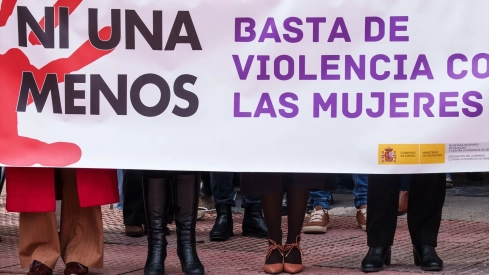
While thousands of people celebrated Spain's victory over Argentina in the streets, bars, and homes, calls to 016 began to skyrocket. Between eleven at night on Sunday and seven in the morning on Monday, they grew by 120.8% compared to the same period the previous week.
The data from the Ministry of Equality, released this Thursday, paints a bitter picture of the hours following the World Cup final. The surge has also coincided with an especially dark week, in which two new femicides have been confirmed in Antequera and Alameda de la Sagra.
The number of women murdered by their partners or ex-partners has thus risen to 31 so far in 2026. At this same point in 2025, 22 victims were counted. One has to go back to 2019, when 37 women had already been murdered, to find a worse balance.
The increase began at the end of the match
For much of Sunday, fewer calls were made to 016 than on other Sundays in July. The trend changed at the conclusion of the match and continued into the early morning, precisely when the celebrations ended and many people returned to their homes.
If the entire Monday is considered, telephone inquiries increased by 21.9% compared to the same day the previous week. Equality has not yet provided absolute figures, although the increase has been replicated across all available channels for requesting information, support, or advice.
The service's email registered a 1,000% growth, the online chat received 60% more contacts, and inquiries via WhatsApp increased by 8.75%. These are channels often used by women who cannot make a call safely or who fear being overheard by their aggressor.
The surge does not allow attributing each contact to an aggression that occurred during the celebration, but it does constitute a signal that institutions should study. All forms of access to the service increased just after one of the most followed sports and social events of recent years.
A pattern observed in other major tournaments
Spain still lacks extensive research that specifically measures the relationship between football matches and gender-based violence. Studies conducted in other countries have detected, however, repeated increases around major sporting events. A Lancaster University investigation analyzed police data from three World Cups and observed that incidents of domestic violence grew in Lancashire by 26% when England won or drew and by 38% when they lost. The day after each match, an 11% increase was still recorded.
Those figures inspired a well-known British campaign during the 2018 World Cup. Under the slogan "If England gets beaten, so will she", national flags appeared transformed into the faces of battered women. The message focused on what could happen inside the home when the match ended.
This same World Cup has once again activated preventive campaigns in the United Kingdom. Women's Aid has launched 'The Other Kick Off', focused on the time many victims fear their partners will return after England's matches. Police, prosecutors, and social organizations have also reinforced their response mechanisms during the tournament.
A scientific review published in 2022 confirmed that numerous studies had found an association between major sporting events and an increase in reported cases. Its authors warned of methodological differences and the scarcity of data outside the United Kingdom and North America, which is why Spain needs its own research to accurately measure the phenomenon.
The aggressor remains solely responsible
The responsibility for violence always lies with the perpetrator. The result of a match, alcohol consumption, rivalry, or collective exaltation can act as accelerators within relationships where control, threats, and aggressions already exist.
No victory or defeat turns a man into an abuser. Major events concentrate factors for a few hours that can aggravate previous violence, make it more explosive, and increase the risk for women who live with an aggressor.
The forensic doctor and former Government delegate against Gender Violence, Miguel Lorente, has described alcohol as a disinhibiting element that can intensify these behaviors. Along with it appear an aggressive idea of masculinity, frustration, the feeling of possession, and a culture that still tolerates controlling behaviors before blows arrive.
The 016 data also forces us to look beyond the murders. Every request for help can hide years of fear, surveillance, humiliations, economic violence, threats against children, or physical and sexual assaults. Most of these cases never appear in a headline and many take years to reach a police station or a court.
The worst balance since 2019
The murders in Antequera and Alameda de la Sagra have left several minors without their mothers and have led the Ministry of Equality to convene a new crisis committee. In 2026, 20 boys and girls have been orphaned by sexist violence, while the total number of women murdered since official registration began in 2003 has reached 1,372.
The crime in Antequera ended the life of a 29-year-old woman, mother of two small children. In Alameda de la Sagra, another woman was murdered in her home. Both cases have been confirmed as gender violence and add to a succession of crimes that has clearly worsened the year's balance.
Equality has convened for next Tuesday, July 28, the institutions involved in the response to sexist violence. The committee will have to review the circumstances of the latest murders, possible protection failures, and necessary measures in view of the upturn recorded during 2026.
The 016 provides free 24-hour assistance to victims of sexist violence and people in their environment. The email 016-online@igualdad.gob.es, the official chat, and WhatsApp 600 000 016 are also available. The call does not appear on the bill, although it must be deleted from the device. In case of an immediate emergency, contact 112.
Add ElConstitucional.es as a preferred Google source for free.
Stay informed about all the latest breaking news with the best information. Against disinformation, for democracy and social rights.
