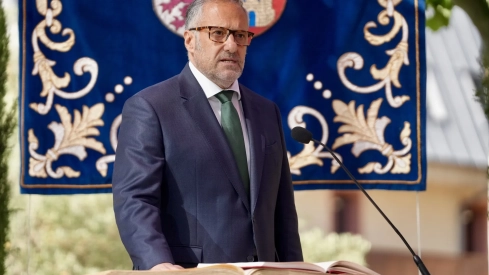
The Sectoral Commission for Children and Adolescents meets this Thursday as a preliminary step to the Sectoral Conference scheduled for the end of August, which will address the distribution among the autonomous communities of the 1,342 unaccompanied foreign minors currently in Ceuta. The vice-presidents of Extremadura, Aragon, and Castilla y León, who have powers in immigration matters, were summoned to the meeting: Óscar Fernández, Alejandro Nolasco, and Carlos Pollán. However, the three leaders have informed the Minister of Youth and Children, Sira Rego, that they will not attend the meeting and have thus formalized their rejection of the reception of these minors in their respective communities.
In the letters sent, the Vox representatives consider the summons to be "untimely" because, in their opinion, before addressing the territorial distribution, the "individualized files" corresponding to each minor must be finalized. "This autonomous community cannot accept the transfer of unaccompanied foreign minors from Ceuta," they state while demanding that "the prior processing and resolution of the legally required individualized procedures to determine their legal status by means of a firm resolution" be accredited.
Furthermore, they argue that these procedures should end with the "return to Morocco" of the minors. Along these lines, the vice-presidents also announce that they will appeal before the courts any file that does not end with the "return" of the minor to the neighboring country.
Vox's xenophobia in the face of the migration crisis
The far-right Vox reiterates once again its refusal to distribute minors after several weeks of statements by leaders of the party. Since the beginning of the Ceuta crisis, the party has hardened its discourse and has questioned the legal obligation of the autonomous communities to participate in the distribution system.
One of the most controversial messages was delivered by the secretary general of Vox, José María Figaredo, who went so far as to defend that they had to "hunt them one by one to return them to Morocco". He later insisted: "You have to go one by one. Pam, pam, pam". These statements were denounced by Compromís for an alleged hate crime. The party maintained that the ultra deputy's conduct is "repeated, conscious and deliberate, maintaining the term used even after requests for clarification" and pointed out that "the repeated use of the term hunt implies an explicit dehumanization of the migrant collective", reinforced by "expressions such as 'pam, pam, pam', which evoke the use of lethal violence".
Vox's criticisms have also been directed against the president of Ceuta, Juan Jesús Vivas, for requesting the collaboration of the autonomous communities to care for the minors who remain in the city. The national spokesman for Vox, José Antonio Fúster, described his position as "permanent whining" and even demanded his resignation. In an intervention on 'Radio Libertad', Fúster questioned Vivas's complaint that he has "many minors" in Ceuta and that "I need the communities to take them in". The Vox leader also defended that minors arriving from Morocco should be returned "with their family to their country", arguing that in this way "something as important as their identity, their culture, their religion and their language" would be preserved.
The leader of Vox, Santiago Abascal, also spoke about the crisis through the social network X. In one of his messages he wrote: "Not a single euro from Spaniards for MENAs, for illegals, for invaders, for human trafficking mafias, for Morocco. For NOTHING that is not the well-being of Spaniards".
What does the law establish?
The reform of article 35 of the Immigration Law obliges all autonomous communities to participate in the reception and relocation of unaccompanied foreign minors when the Government activates a migratory contingency situation. The objective is to avoid the collapse of the protection systems of territories especially affected by migratory pressure, such as Ceuta or the Canary Islands.
The norm establishes a mechanism of obligatory distribution, sets deadlines for transfers, attributes to the State the coordination of the process, and provides the necessary financing to guarantee the care of minors. In this way, the participation of the autonomous communities does not depend on a discretionary political decision, but constitutes a legal obligation aimed at guaranteeing the best interest of the minor and a solidarity and balanced distribution of reception throughout the national territory.
Add ElConstitucional.es as a preferred Google source for free.
Stay informed about all the latest breaking news with the best information. Against disinformation, for democracy and social rights.
