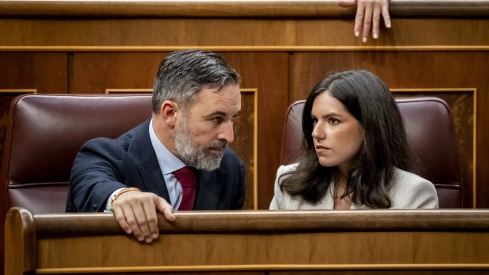
The far-right Vox wants to change the composition of the Permanent Deputation of Congress when its vote distribution opens up a possibility of approving the housing decrees that PP, Vox, and Junts rejected in the Plenary. Santiago Abascal's party has sent a letter to the Bureau of this body to demand a new distribution of its members, alleging that the current one violates the proportionality required by the Constitution.
The request affects the body that maintains certain functions of Congress after the dissolution of the Cortes and during the electoral period. Its composition was set at the beginning of the legislature through an agreement in which the PP, PSOE, Sumar, and most of the investiture partners participated. Vox was left out of that pact, whose distribution has remained in force throughout the legislature.
The timing of the claim has a specific political consequence. The three parties that rejected the housing decrees now gather 34 of the 69 votes of the Permanent Deputation. On the other hand, the Government could reach 35 supports if it manages to bring together the PSOE, Sumar, ERC, EH Bildu, PNV, and the representative of the Mixed Group. The difference allows a measure to go ahead even with Junts' rejection, although it forces the Executive to secure all necessary votes.
A vote that changes the majority
The Permanent Deputation is made up of 68 representatives of the groups and the President of Congress, Francina Armengol. The PP has 27 seats; the PSOE, 24; Vox and Sumar, six each; and ERC, Junts, EH Bildu, PNV, and the Mixed Group, one per formation. With Armengol, the socialists add 25 votes.
Vox focuses its claim on the PSOE and Sumar. It points out that the 25 socialist votes represent 36.23% of the body, while their 121 seats accounted for 34.57% of the Plenary. Therefore, it asks that Armengol's vote be computed within the quota assigned to the PSOE. Currently, the president is part of the Permanent Deputation by virtue of her position, in addition to the members designated by the groups.
The far-right formation also questions Sumar retaining six representatives after going from 31 to 26 deputies, following the departure of the four Podemos parliamentarians and Compromís deputy Águeda Micó to the Mixed Group. It demands to correct what it considers an "overrepresentation" and maintains that these changes must be reflected in the distribution.
The review requested by Vox could alter a very narrow majority. With a single vote, the validation or repeal of a decree is decided if all 69 members participate and those two blocs are maintained. The party also requests that its written statement and the decision of the Bureau be recorded in the minutes of the sessions in which Armengol's vote is decisive.
The housing decrees, at stake
The offensive comes after the Council of Ministers approved again, with modifications, the two housing decrees rejected by Congress. After the dissolution of the Cortes, it is up to the Permanent Deputation to decide on their validation. Changing its composition therefore affects the possibilities of maintaining measures against evictions and on rental contracts.
Support for both texts must be negotiated separately. The PNV supported the first decree, but rejected the second, related to the renewal of certain rentals. This upcoming vote will do the same. The 35 votes are a possible majority, which depends on the content of each norm and the position that the groups finally adopt. The Government has an opportunity to recover measures, but needs to secure support.
The Vox spokesperson, Pepa Millán, had already threatened to go to court against what she called a "cacicada" for bringing the decrees to this body. Now her party intends to modify the distribution that will determine the votes.
The Constitution expressly regulates this function. Its article 78 establishes the proportional representation of the groups and attributes to the Permanent Deputation the powers over decree-laws when the Chambers are dissolved. Validation during the electoral period is foreseen in the legal system; another issue is the discussion about the proportionality of the distribution or about the new texts approved by the Executive.
The next meeting is scheduled for Friday, October 16, but its agenda includes decrees on aid for the DANA and on the economic consequences of the Middle East crisis. The vote on the housing decrees is left for a later session.
